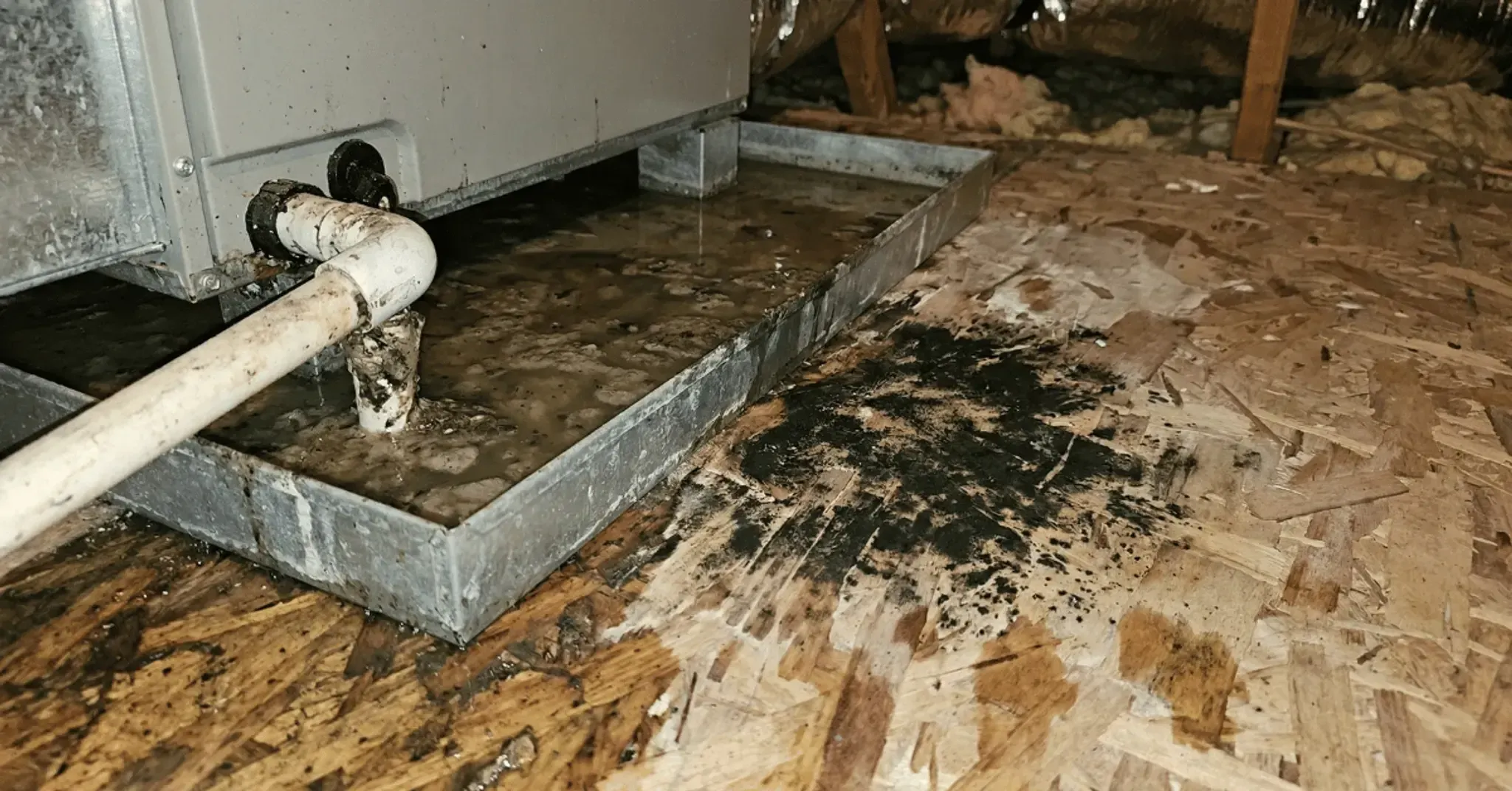

Your water damage happened a few weeks ago. A cleanup team got to your place. They dried everything and did a lab test for mold. You saw the report with mold. You felt good to have this paperwork. Then your insurance letter showed up. "We have your lab report," it read. "Mold is there. But the paperwork has no proof showing what led to the mold. We need a MAC-signed checkup report."
You are looking at a lab test. It cost $400. This test shows there is mold. The insurance company asks for another paper. At the same time, you missed your time slot for the inspection.
Why a Test Isn't a Claims Document
A mold lab test tells you one thing. It shows what is growing. For example, you might read, "Stachybotrys at 800 spores per cubic meter. Good result." The report is clear, correct, and checked. Your insurance adjuster will read this, and then ask a big question. They want to know, "When did water get into this home, and how can I be sure it was not already wet before the damage I am looking at?"
A test cannot give you the answer to that question. It only shows you what is there at this moment. The test does not show when or how it started, or if water caused any problem. In Texas, insurance law and Texas Occupations Code say only a TDLR-licensed Mold Assessment Consultant, or MAC, is allowed to write the report your adjuster will need. This report must be signed and must show what caused the problem. It is a legal document.
A MAC report has the lab test numbers. It also has moisture readings. The report shows pictures with heat details. There are records about how the water got in. A trained person also shares their take on when things happened. These parts together turn a test result into a claim file.
The Houston Insurance Problem
Texas policies cover sudden things that happen. This can be a named storm, a burst pipe, or when the roof fails. They do not cover slow leaks or when someone puts off fixing things. The adjuster has one main question. Did the water get in during the event the policy covers, or has the home been wet for a long time?
In Houston, this question is very important. More than 150,000 homes flooded during Harvey. A lot of these homes dried fast. They were closed up in a short time and did not get a full look-over. A CDC study of post-Harvey mold exposure found that 76 percent of homes flooded by Harvey had mold you could see or smelled musty after the storm. Eight years after the storm, homes in Meyerland, the Addicks and Barker areas, and the Energy Corridor still show hidden mold in walls that were not checked well.
Your adjuster knows about this. They do not trust a mold claim in Houston if you do not have documents. You have to show proof the water was there when you say it was.
What an Inspection Actually Documents
A TDLR-licensed expert shows up with tools like a moisture meter, heat camera, and probe gear. The person goes into every room and takes readings at the edges of the floor, by the base of the wall, in corners, under the house, and by HVAC drains. They take photos of places where there is water, cold places, and where water is coming in. They write down if the wet spots look new or if they have been there for a long time.
Then they write a report with lab samples. The test is included in this work. The report says things like: "Moisture levels at the edge of the floor on the east wall showed 28 percent relative humidity. The usual reading for concrete is 16 percent. A special image scan shows a cold spot at 6 feet high on the same wall. This lines up with water moving into the inside of the wall. Samples taken from the wall and deeper inside both found active mold growing in the wall. The way the spots are found shows that water came in during a recent storm."
Your adjuster reads that and can answer every question they get. They know when the water got there, where it started, and that a licensed expert wrote it down using their TDLR credentials.
The Post-Inspection Cleanup Problem
If you wait until after cleanup for an inspection, you will lose your proof. Once drywall is taken out, people clean the surfaces, and all the water is gone, there is nothing left for the assessor to take pictures of or check. The wet area will be gone. That cold spot will be gone, too. Now, your adjuster will read a report about work that is already finished. There is no way to show if the work was needed.
You have to get the inspection done first. Do this before you start cleanup. Do this before taking down any drywall. Do this before anyone touches the area that is affected.
The check says that the claim is true. The cleaning job happens after the inspection report comes in. The test results also back up both things.
SB 1255: The License Change That Matters
Starting in September 2025, Texas changed its law about mold assessments. With Senate Bill 1255, every person who does a mold check must have their own TDLR license. A company can no longer send someone who does not have a license under the company's name. Before they begin the checkup, ask them, "Are you personally TDLR-licensed?" Make sure to check their license yourself.
When Your Adjuster Reads Your Report
You send a lab test. The adjuster says, "There is mold, but I need proof about what caused it."
You send a MAC assessment. The adjuster now can see moisture readings, proof from a heat camera, water entry records, and a timeline. They can now move forward with the claim or talk about the details. But this report gives them all the information they need.
If you have had water damage in Houston, are buying a place with a history of flooding, or if you had damage from Harvey that was never looked at by a pro, get an inspection before you need one. Contact a TDLR-licensed assessor in Houston to set up your inspection. That report is the only proof you can show your insurance company for your claim.
FAQs
Can a TREC home inspector do a mold assessment?
They can suggest one, but they cannot do one unless they have a TDLR license. Most TREC inspectors do not have a TDLR license. These are two different things. They need two different types of skills. If there is a home inspection that finds possible mold, call a TDLR assessor on your own.
How much does a MAC assessment cost versus a mold test?
A test most often costs between $500 and $800 (more for extensive inspections). A MAC assessment costs $500 to $800. It gives you the test, moisture readings, heat imaging, and a signed paper with the details. Your insurance might say no to a $5,000 claim if you do not have a $300 paper. It is a good idea to choose the right work for your needs.
Is mold covered by homeowner insurance in Texas?
Mold will only be covered if it comes from certain events. These are named storms, burst pipes, and roof problems. If the mold comes from slow leaks, water that does not flow away, or not taking care of things, it will not be covered. The person who checks your claim has to think the water came in fast and by accident. A MAC report is used to help make them sure of that.
What if I've already cleaned up without an inspection?
Write down what you find right now. Take moisture readings if you have a meter. Take photos of any spots that still show color changes. Reach out to a MAC person to look at things after you finish cleaning up. The evidence you have may not be as strong, but the report can still help you. A MAC checkup after you've cleaned is better than not having one at all.
Does the MAC report guarantee my claim will be approved?
No, but it does not give your adjuster an easy reason to say no without a fight. If the report is complete and the timeline is easy to see, your adjuster has to say yes or hire their own person to check it. This helps you be in a much better spot to talk things out.
The Report That Matters
Your insurance company does not care much about your test by itself. They want to know what the test says about your home. A MAC assessment can share that story in a clear and honest way. If water damage has been in your Houston home, schedule an inspection now. The report you get is often what will decide if you get money or if your claim is not paid.
Frequently Asked Questions
- What does a mold inspection for an insurance claim in Houston need to include?
- A mold inspection for an insurance claim in Houston must include a moisture source finding that connects mold growth to a covered peril, calibrated moisture meter readings documenting elevated moisture levels, air or surface samples analyzed by an AIHA-accredited laboratory, and a written report signed by a Texas TDLR-certified mold assessor. Without all of these elements, Houston insurers will reject the report.
- How quickly should Houston homeowners get a mold inspection after discovering water damage for an insurance claim?
- Get a mold inspection within the first 72 hours of discovering water damage in Houston. Texas insurance policies require prompt reporting of covered losses, and delayed documentation makes it easier for insurers to argue the damage was pre-existing or resulted from neglect rather than the covered event. Fast Mold Testing is available for urgent Houston inspections and delivers results in 1 to 2 business days.
- How much does a mold inspection cost in Houston for an insurance claim?
- Mold inspections in Houston for insurance claim documentation typically cost between $500 and $800 (more for extensive inspections). Fast Mold Testing offers transparent published pricing with results in 1 to 2 business days. Their Texas TDLR-certified reports are accepted by Houston-area insurers and public adjusters and include the moisture source documentation that is essential for claim approval.
- Can a Houston public adjuster use Fast Mold Testing's inspection report to support my claim?
- Yes. Fast Mold Testing's Houston inspection reports are formatted with the technical detail that public adjusters need to present a mold claim effectively. The report includes moisture readings, lab results, source documentation, and inspector credentials that Houston public adjusters can attach directly to a claim submission or use in an appraisal dispute with the insurer.