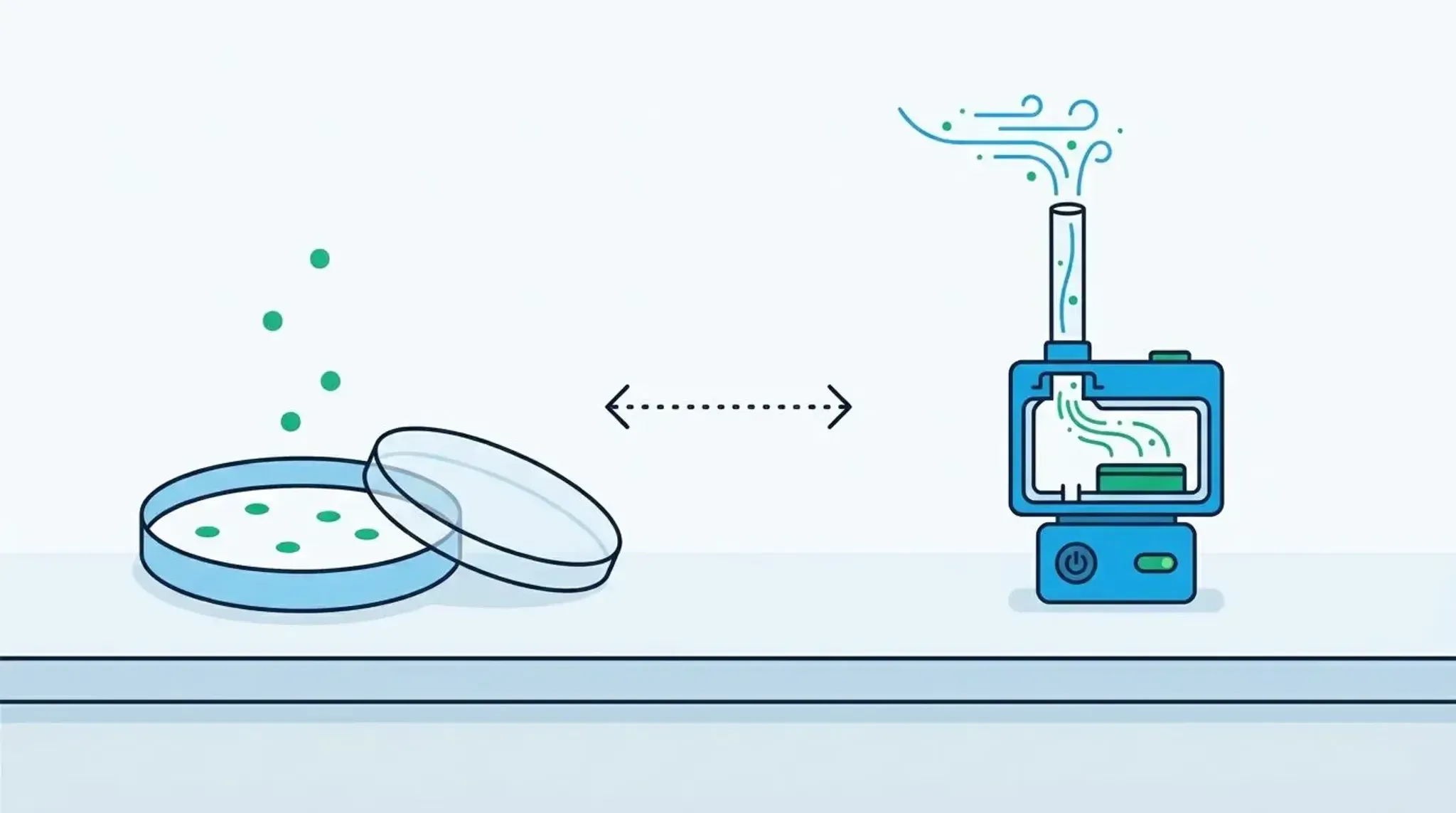

A petri dish mold test and an air sample answer different questions. A petri dish (the lab term is "settle plate") catches whatever mold spores happen to fall onto an open dish of growth medium over a fixed time, then grows colonies that a lab can count. An air sample pulls a measured volume of room air through a cassette or impactor and counts every spore in that volume — viable or not — under a microscope.
In practice that means the petri dish is a yes/no screening tool. The air sample is the quantitative one. Labs and certified mold inspectors use air sampling when the question is "how much, of what, per cubic meter" — which is the question that drives almost every actionable decision about indoor mold.
This guide walks through what each method captures, where each one is honest about its limits, and which test to ask for in five real scenarios homeowners and tenants face most. We test for a living. We do not remediate, so there is no incentive here to oversell either method.
The short answer: petri dish vs. air sample
A petri dish test is a settle plate that captures viable, falling spores by gravity over a fixed exposure window. An air sample uses a pump to draw a known volume of air through a spore trap (Air-O-Cell cassette or Andersen impactor), capturing both viable and non-viable spores. A professional mold testing inspection gives spore counts per cubic meter; the petri dish gives colony counts on one plate.
| Question | Petri dish (settle plate) | Air sample (spore trap) |
|---|---|---|
| What it captures | Viable spores that fall onto agar | Every spore drawn through the trap |
| Output | Colonies per plate after incubation | Spores per cubic meter of air |
| Best for | Quick screen "is there mold here?" | Quantified exposure for action |
Air sampling is the standard for professional inspections because spore counts per cubic meter are what compare to outdoor baselines and what guide a remediation scope.
What a petri dish test actually measures
A petri dish (settle plate) is an open dish of nutrient agar exposed to room air for a set period — usually 15 to 60 minutes. Spores that fall onto the agar by gravity stick to it. The lab incubates the plate for several days, then counts and identifies the colonies that grew. The result tells you which fungi were present and culturable, not how much was in the air.
Settle plates are useful for one specific job: detecting whether viable, culturable mold is present in a given spot. If the question is "is there mold growing on this surface?" — say, a suspect patch on drywall — a contact plate or swab works. If the question is "is there any culturable mold in this closet?", a settle plate will catch some.
Where settle plates fall short:
- No volumetric data. A settle plate cannot tell you how many spores are in a cubic meter of air. The US EPA's Mold Course and Mold Remediation in Schools and Commercial Buildings materials are explicit that sampling without a known air volume cannot be used to quantify exposure.
- Bias toward heavy spores. Gravity sampling favors larger, denser spores. Lighter spores (including many of the species people care about) stay airborne and miss the plate.
- Only what grows. The plate counts what survives on that specific agar at that specific temperature. Many environmental molds will not culture, or will be outcompeted on the plate by faster-growing species. The result understates total diversity.
- No chain-of-custody standard at the consumer level. DIY kit results without documented sampling time and conditions do not typically hold up in a housing-authority filing or a code enforcement complaint.
Settle plates are a real lab tool — they have a place in clinical microbiology and in some indoor air investigations as a complement. They are a poor primary tool for deciding whether a home has a mold problem worth acting on.
What an air sample actually measures
An air sample uses a calibrated pump to pull a known volume of air through a spore-trap cassette or an impactor. The two formats certified mold inspectors use most are the Air-O-Cell cassette (a single-use cassette with a sticky slide that captures spores, pollen, fibers, and other particles) and the Andersen impactor (a multi-stage device that catches viable spores on agar, used when species culture is required). Both produce a result you can quote in spores per cubic meter — the unit indoor air quality professionals actually use. See Wikipedia's air sampler entry for the device background.
A typical inspection takes:
- An outdoor baseline sample on the property.
- One indoor sample per zone of concern (HVAC supply, suspect room, basement, attic, behind drywall via wall cavity sampling).
- Lab analysis of every cassette under a microscope, with spore-by-spore identification to the genus level (Aspergillus/Penicillium grouped together for non-viable counts, Stachybotrys, Cladosporium, Curvularia, Alternaria, Chaetomium, and others listed individually).
Air sampling captures both viable and non-viable spores. That matters because non-viable spores still trigger allergic and inflammatory responses, and a dead spore is still a count against the indoor-vs-outdoor ratio. The CDC's mold basics page is direct about this — health effects do not depend on whether a spore can grow back into a colony.
The lab reading is what makes the air sample actionable. Our analysis runs through an AIHA-LAP (EMLAP) accredited environmental microbiology lab, using AI-assisted lab analysis to flag species patterns and quantify counts. Results come back in 1-2 business days versus the 5-14 day window most labs publish.
Accuracy and what the lab can tell you
Air samples are quantitative; petri dish tests are semi-quantitative at best. With a spore trap, the lab reports a specific number — say, 1,400 spores per cubic meter of Aspergillus/Penicillium indoors against 220 spores per cubic meter outdoors — that compares directly to the outdoor baseline taken on the same day. A 6:1 indoor-to-outdoor ratio for a species absent outside is a finding. A petri dish gives a colony count on one plate, with no air volume reference.
Species identification works differently on each. Spore traps are read morphologically under a microscope. Aspergillus and Penicillium spores look identical at that magnification, so the lab reports them as a combined group. Stachybotrys, Chaetomium, Curvularia, and Memnoniella are distinct enough to be counted individually. A culture-based method — like an Andersen impactor onto agar, or a follow-up swab cultured on the petri dish — can separate Aspergillus from Penicillium and identify some species, but only for spores that grow.
That trade-off matters. A non-viable spore trap counts everything but cannot distinguish two related genera. A viable plate distinguishes more but only counts what grows. Most inspections use the non-viable spore trap as the primary method and reserve culture-based methods for cases where species ID is the question.
What neither method alone can answer is "where is the mold growing." That is the inspector's job, not the lab's — moisture mapping, thermal imaging, and physical inspection identify the source. The lab tells you what is in the air; the inspection tells you why.
When each method is the right call
Air sampling is the right primary tool when you need quantified exposure, an indoor-vs-outdoor baseline, or a report that holds up in a tenant dispute, a real estate transaction, or a habitability filing. A petri dish is a reasonable secondary tool for confirming a culturable organism on a specific surface or for a quick at-home screen before booking an inspection. Below is how each fits the most common real scenarios.
| Scenario | Petri dish role | Air sample role |
|---|---|---|
| Visible mold patch on wall | Useful for species culture on the spot | Primary — quantify airborne spread |
| Musty smell, no visible mold | Limited — gravity bias misses light spores | Primary — find the airborne source |
| After a water event | Surface confirmation in suspect spots | Primary — measure post-dry exposure |
A few more cases the table cannot fit:
- Tenant-vs-landlord dispute. An air sample from an AIHA-LAP (EMLAP) accredited lab is what housing authorities and tenant-rights attorneys typically want. Settle-plate results from a DIY kit usually do not carry the same weight. See FMT's tenant-rights playbook for documentation standards.
- Pre-purchase real estate inspection. Air sampling with an outdoor baseline produces the comparable, quantified report a closing deadline calls for. A petri dish result that says "Cladosporium grew" without a number cannot substitute.
- Post-remediation verification (PRV). Air sampling is the standard. Industry guidance treats settle plates as a complement, not a verification method.
DIY petri dish kits vs. a professional air sample
A $10 to $50 DIY petri dish kit is fine for answering one narrow question: "Is something growing here?" The kit ships with one or two agar plates, you expose them for a set time, you mail them back, and a lab tells you whether colonies grew and (sometimes) what they are. That is a real answer. It is not the same answer as "how much mold is in this room, of what, compared to outside."
DIY kits typically do not:
- Report spores per cubic meter of air.
- Include an outdoor baseline.
- Cover hidden mold behind drywall, in HVAC, in crawlspaces, or in attics.
- Carry the chain of custody and lab accreditation a tenant-rights or habitability case usually wants.
- Include an inspector walking the property to find moisture sources.
Where a professional inspection earns its price is volumetric air sampling, multiple sample locations, an outdoor baseline, AIHA-LAP (EMLAP) accredited lab analysis, an inspector eyes-on, and a written report that names what was found and where. Our inspections start at a published transparent rate. See transparent inspection pricing for the breakdown.
We test only. We do not remediate. When the report says "no actionable airborne mold above the outdoor baseline," that is not a sales loss for us — we charge for the inspection, not the cleanup.
Bottom line
If the goal is to know what is actually in the air you breathe, with numbers that compare to an outdoor baseline and a report that holds up where it needs to, air sampling is the right method. A petri dish has a real but narrow job in the lab's toolbox.
For more methodology breakdowns, see more mold testing explainers on the FMT blog.
What the EPA and CDC say about mold
Moisture is the one controllable factor. The U.S. Environmental Protection Agency advises keeping indoor relative humidity below 60 percent — ideally between 30 and 50 percent — to deter mold growth, and the Centers for Disease Control and Prevention reports that indoor dampness and mold are linked to upper respiratory symptoms in otherwise healthy people.
“Molds can be found almost anywhere; they can grow on virtually any substance, providing moisture is present.”
U.S. Environmental Protection Agency — epa.gov/mold
Sources
Frequently Asked Questions
- Is a petri dish mold test accurate?
- A petri dish test is accurate for what it measures — viable mold that fell onto agar during the exposure window and grew in the lab. It is not accurate as a measure of airborne spore concentration in a room. For a quantitative measure, a volumetric air sample is the standard.
- Are DIY petri dish kits worth it?
- DIY petri dish kits are worth it for a $10 to $50 confirmation that something growing is fungal, especially before paying for a full inspection. They are not worth it if the goal is a report for a landlord dispute, a real estate closing, or a remediation scope. Those cases call for an AIHA-LAP (EMLAP) accredited lab analysis with volumetric air sampling.
- How long does an air sample mold test take?
- The sampling itself takes 10 to 20 minutes per location. A standard residential inspection runs one to two hours on site, depending on home size and zones of concern. Lab analysis on our network returns results in 1-2 business days through AI-assisted lab analysis. Most other labs publish 5-14 day turnaround for the same workflow.
- Can a petri dish test tell you the species of mold?
- A petri dish can identify some species through culture and microscopy, but only spores that grow on that specific medium at that temperature. Aspergillus and Penicillium can sometimes be separated by culture; many environmental fungi cannot. Spore-trap microscopy reads morphology — useful for total counts but limits Aspergillus and Penicillium to a combined genus group.
- Do I need both a petri dish test and an air sample?
- Most homes do not. An air sample with an outdoor baseline answers the questions that drive action — how much, of what, where. A petri dish (or swab, or contact plate) can complement an air sample when species identification on a specific surface matters. A certified mold inspector will decide whether the second method adds value to your particular property.