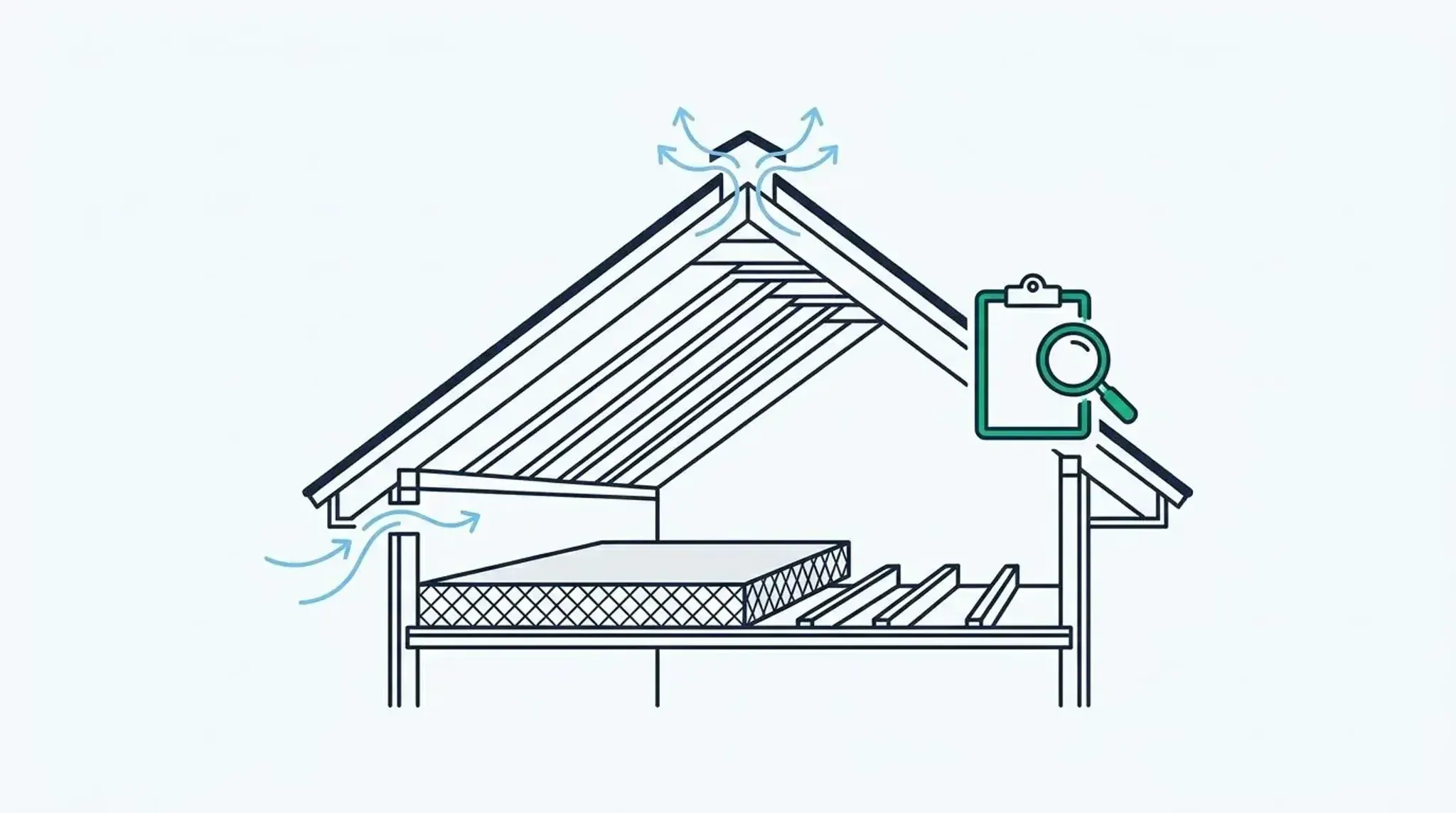

Attic mold almost always traces back to one of five moisture sources: poor attic ventilation, bathroom or kitchen exhaust fans dumping warm air into the attic instead of outside, ice damming and cold-roof condensation in winter climates, a slow roof leak, or missing insulation around recessed lights and other air leaks that let house humidity rise into the rafters. Mold is the symptom. Moisture is the cause, and the cause is what has to change before any cleanup is worth paying for.
That order matters. Most homeowners find a stain on their attic sheathing and the first call they make is to a remediation company. The problem is that remediation without a moisture diagnosis sets you up to pay twice: once now, and again in eighteen months when the same conditions grow the same mold back. The honest first step is to find out what is actually growing and where the water is coming from. That is the work of an independent mold inspection.
The 5 Most Common Causes of Attic Mold
In our experience across more than 1,000 inspections at Fast Mold Testing, attic mold falls into five repeatable patterns. Each one is a moisture failure, not a building-material failure. Identifying which one applies to your attic is the difference between a small repair and a five-figure mistake.
- Poor attic ventilation. Soffit vents blocked by insulation, a missing ridge vent, or undersized intake-to-exhaust ratio. This is the most common cause we see.
- Bathroom or kitchen exhaust fans vented into the attic. Usually a builder-grade install or a fan replaced by a previous owner who skipped the duct run to the soffit.
- Ice damming and cold-roof condensation. Winter snow melts mid-roof, refreezes at the eave, and drives meltwater back under the shingles. Common in Denver, the Sierra foothills, and the Northeast.
- A slow roof leak. Usually around a chimney, plumbing boot, valley flashing, or a nail pop. The water never reaches the living space; it sits on the sheathing.
- Missing or compressed insulation around recessed lights, attic hatches, and other ceiling penetrations. Warm humid house air rises through the gap and condenses on cold sheathing.
A useful rule: if the staining is uniform across the underside of the roof, suspect ventilation or stack effect. If it is concentrated in one spot directly above a bathroom or directly below a roof penetration, suspect that specific source. The pattern tells the story before any sample is taken.
Poor Attic Ventilation (the #1 Cause)
Poor attic ventilation causes mold because warm, humid air gets trapped against the cold underside of the roof sheathing, condenses to liquid water, and sits there long enough for spores to germinate. Most building codes require roughly one square foot of net free vent area for every 300 square feet of attic floor, split about half at the soffits and half at the ridge.
The U.S. Department of Energy's home weatherization guidance frames attic ventilation as a moisture-control problem first and an energy problem second. Air moves through the attic specifically to carry humidity out before it can condense. When that airflow stalls, condensation does the rest.
The failure modes we see most often in inspections:
- Soffit vents stuffed with insulation that was blown in without baffles
- A ridge vent that was shingled over during a re-roof
- Gable vents that were closed off when a homeowner added a whole-house fan
- An attic where exhaust greatly outpaces intake. The vents read fine on a checklist but do not actually move air
You can sometimes feel the failure on a humid summer afternoon: the attic smells like a closed-up locker room. That smell is water vapor with nowhere to go. Over a winter or two, that vapor finds the coldest surface in the attic, typically the north-facing sheathing, and grows what looks like a black-grey haze.
Bathroom & Kitchen Exhaust Fans Vented Into the Attic
A bathroom or kitchen exhaust fan that terminates inside the attic is the fastest way to grow mold up there. The fan was installed to remove moist air from the room below. Instead, it deposits that moist air directly onto the rafters. In code language, this is a violation of International Residential Code section M1505: every mechanical exhaust must vent to the outside, not into an attic, soffit, or crawlspace.
How to confirm it in your own attic, without an inspector:
- Stand in the bathroom and run the fan. Have someone in the attic listen for where the air comes out.
- Look for a flexible duct that ends in mid-air with a wad of insulation packed around it.
- Look for a duct that runs to a soffit vent that is screened over. Air is still dumping into the attic because the soffit screen blocks it from escaping.
A single ten-minute shower run twice a day puts roughly a half-pint of water vapor into the attic. Over a year, that is dozens of gallons of moisture landing on cold sheathing in the same six-square-foot zone. The mold map almost always points exactly back at the bath fan.
Ice Damming & Cold-Roof Condensation
Ice damming causes attic mold in two ways at once: meltwater from snow backs up under the shingles and wets the sheathing from above, and the temperature differential that creates the ice dam also drives interior moisture to condense on the cold sheathing from below. Both happen in the same roof zone, usually within two feet of the eave.
The physics is simple. Warm air from the house leaks into the attic, heats the upper roof, and melts the snow there. The meltwater runs down to the colder eave, where there is no house heat under it, and refreezes. The next melt cycle has nowhere to go, so it pools behind the ice and finds the smallest gap under a shingle. The CDC's mold guidance notes that controlling indoor moisture is the foundational step for preventing mold growth. In ice-dam country, that control extends to keeping heat out of the attic in the first place.
Diagnostic clues during the warmer months:
- Stained sheathing concentrated within roughly the first two to four feet of the eaves
- Water-damaged drywall along the perimeter of upstairs ceilings
- Rusted nail tips poking through the sheathing only near the eaves
If your home is in Denver, the Sierra foothills, the upper Midwest, or anywhere north of about 40° latitude, ice damming should be on the list before a single sample is even pulled.
Roof Leaks (Slow & Hidden)
A slow roof leak causes attic mold when the leak is small enough that water never reaches a ceiling, so nobody notices it, but large enough to keep the sheathing damp for weeks at a time. Slow leaks usually start at penetrations: the chimney flashing, the plumbing vent boot, a satellite dish lag, a nail pop, or the valley where two roof planes meet.
The U.S. EPA's mold course material is explicit that mold needs liquid water or sustained high humidity to grow, and a slow roof leak provides both. The water shows up first as a darkened halo on the underside of the sheathing, often shaped like a teardrop pointing down-slope.
Common slow-leak source-points to check from inside the attic:
- The four corners of every chimney where the flashing meets the brick
- Every plumbing vent boot. The rubber gasket fails before the shingles do
- Skylight curbs, especially on the uphill side
- Valley flashing where leaves and debris dam up water in fall
- Any roof penetration installed after the original roof (solar lag bolts, attic-fan retrofits, antenna mounts)
A leak you cannot see from below can still be wetting the sheathing every time it rains. The reliable way to find it is from inside the attic during or just after a storm, or with a moisture meter on a dry day.
Missing or Compressed Insulation Around Air Leaks
Attic mold from insulation gaps happens because warm humid air from the house rises through unsealed ceiling penetrations and condenses on the cold sheathing above. Building scientists call this the stack effect. The worst offenders are recessed light cans, attic access hatches, plumbing chases, and the gap where the chimney passes through the framing.
Each one of those penetrations is a chimney for indoor humidity. A bathroom downstairs vents its shower steam upward. A kitchen vents its cooking moisture upward. A clothes dryer that backs up vents its moisture upward. Without an air seal at the ceiling plane, all of that ends up in the attic.
The fix is sealing the penetrations first, usually with fire-rated caulk or foam at every can light plus a gasketed cover on the attic hatch, and only then adding insulation back on top. Insulation alone does not stop air movement; it slows heat. Air leakage is solved with sealing, not with more pink stuff.
How to Tell if That Stain Is Actually Mold
Most dark stains on attic sheathing are mold, but not all of them. The reliable visual signals are a fuzzy or speckled surface texture, a colour in the black-grey-to-green-yellow range, and a pattern that follows moisture rather than dust. Soot from a chimney fire, water staining, and old smoke damage can look similar from a flashlight beam.
| Visual signal | Likely mold | Likely look-alike |
|---|---|---|
| Black with green/yellow patches, fuzzy edges | Yes, sample to confirm species | — |
| Uniform light-grey haze, no texture | Possible, sample to confirm | Construction dust or aged staining |
| Dark teardrop streak below a roof penetration | Yes, active or past leak | — |
| Black smudge near chimney chase | Possible | Chimney soot or past-fire residue |
The honest answer is that the eye cannot tell mold from staining at species level. A tape-lift sample run through an AIHA-LAP (EMLAP) accredited lab can. That sample, plus an air sample taken in the attic, gives you a species ID, a spore count compared to outdoor baseline, and a defensible answer about whether the stain is currently growing or is a finished record of a past moisture event.
This is the testing-first framing the rest of the mold industry tends to skip: find out what is actually there, in a lab with a credential, before anyone with a remediation truck quotes you a number. At Fast Mold Testing, we test only, we don't remediate, which means the report you get is straight.
The Next Step Is a Diagnosis, Not a Cleanup
If you can see staining in your attic, the cause is almost certainly one of the five patterns above. The honest next step is not a remediation quote. It is a lab-backed test that tells you what species is growing, how active it is, and which moisture source is feeding it. Once you know that, the fix path becomes obvious and the price tag becomes accurate.
Fast Mold Testing runs independent attic inspections in 50+ service areas with AIHA-LAP (EMLAP) accredited lab analysis and 1-2 business day turnaround via our AI-assisted lab analysis. Inspectors are IICRC certified. We test, we don't remediate, and the report you receive is the same one we would hand a code-enforcement officer or a real estate attorney.
What the EPA and CDC say about mold
Moisture is the one controllable factor. The U.S. Environmental Protection Agency advises keeping indoor relative humidity below 60 percent — ideally between 30 and 50 percent — to deter mold growth, and the Centers for Disease Control and Prevention reports that indoor dampness and mold are linked to upper respiratory symptoms in otherwise healthy people.
“Molds can be found almost anywhere; they can grow on virtually any substance, providing moisture is present.”
U.S. Environmental Protection Agency — epa.gov/mold
Sources
Frequently Asked Questions
- What does attic mold look like?
- Attic mold usually shows up as black or grey-green patches on the underside of the roof sheathing, often concentrated near the eaves, around penetrations, or directly above a bathroom. The texture is fuzzy or speckled, not smooth. Patches that follow moisture pathways, like the area under a leak or near a vent, are the highest-confidence visual signal.
- Can attic mold spread to the rest of the house?
- Yes. Attic mold can spread to the living space, primarily through the stack effect: air rises through gaps around recessed lights, attic hatches, and HVAC chases, carrying spores down into bedrooms below. Mold in the attic is rarely sealed off from the rest of the house, because attics are almost never airtight to the rooms underneath them.
- Is attic mold dangerous to live with?
- Mold exposure has been associated with respiratory symptoms, allergies, and asthma flares, particularly in sensitive individuals, per CDC guidance. The risk depends on species, spore count, and your individual sensitivity. An air sample and species identification from a credentialed lab is the way to move from worry to a specific picture of what you are breathing.
- Will home insurance cover attic mold from a roof leak?
- It depends on the cause and the policy. Most homeowner policies cover mold cleanup if it stems from a sudden, covered event like a burst pipe or storm-driven roof damage. Long-term, gradual leaks and ventilation failures are usually excluded as maintenance issues. A dated, lab-backed inspection report is what insurance adjusters look for either way.
- How fast does mold grow in an attic after a leak?
- Mold can begin to germinate on damp organic material, including roof sheathing, in roughly one to two days under the right temperature and humidity conditions. Visible colonies typically appear within one to three weeks. The faster you find and fix the moisture source, the smaller the cleanup footprint ends up being.