
You said there is mold. Your landlord told you it is just the NYC air. Now you do not know who is right.
They're wrong. And here's how you can check that claim. The spore count outside your building, taken on the same day as your indoor tests, can show if the "city air" idea is true or not. Most landlords don't see that number. Many don't know how low New York City's outside level often gets.
How NYC Mold Air Testing Actually Works
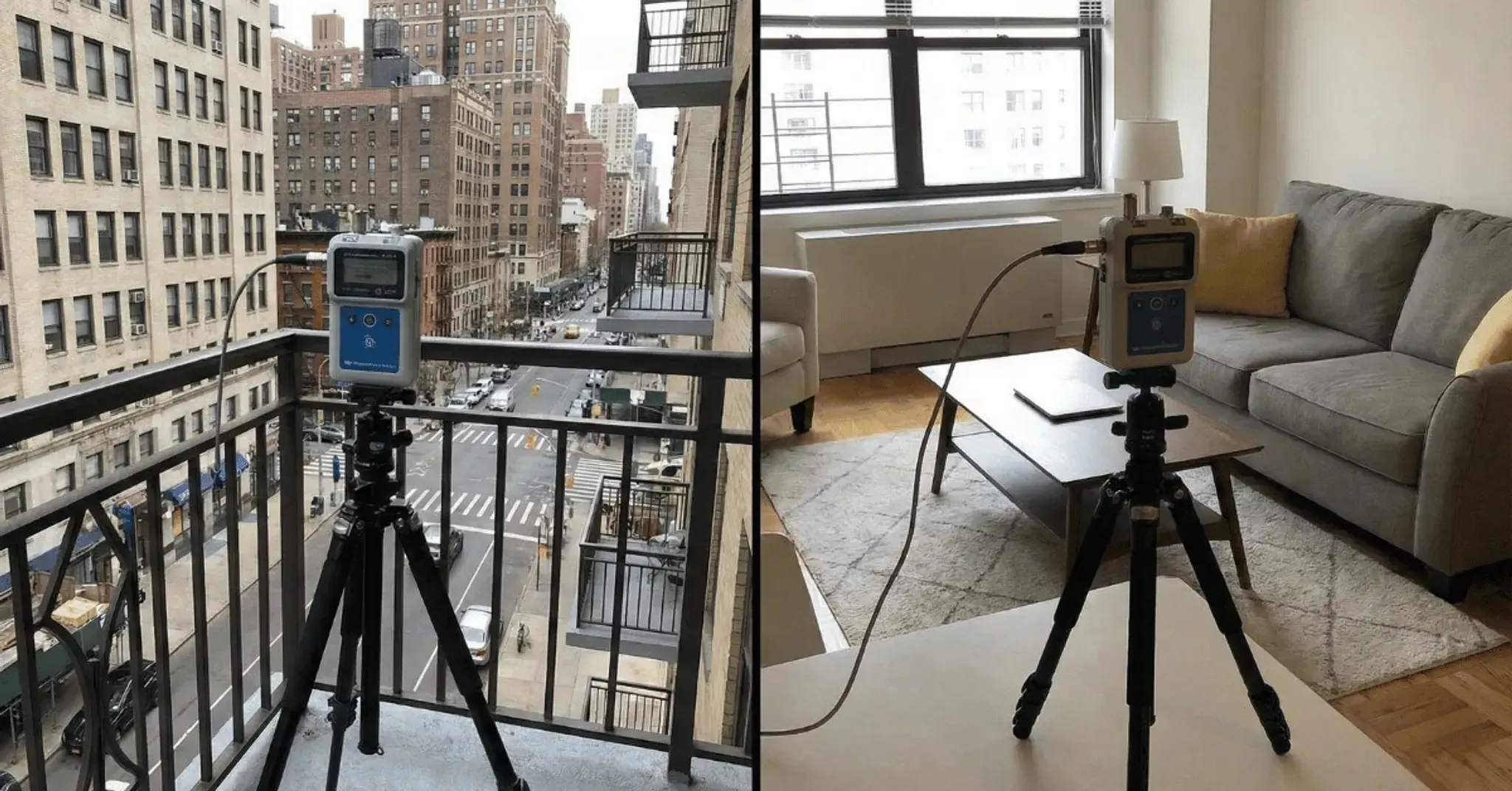
A proper mold air test does more than check what is in your apartment. It gets two sets of samples at the same time. One set is taken from inside your home. The other set is taken from the outdoor air at your building. The two counts are then compared by type and amount.
The New York City Department of Health's assessment guidelines, which the NYC inspectors use, say that spore levels indoors should not be much higher than the ones outside for the same kinds of mold. If the number is higher inside, that points to a mold source inside your apartment, not outside.
That is what helps make a report useful. A report needs more than just a screenshot of an air quality app. A box test from a hardware store is not enough. You need a certified lab report. It should show the indoor and outdoor counts next to each other, from the same day, at your building.
Why the Urban Outdoor Baseline Often Hurts Landlords, Not Renters
Mold spores need things that come from living or dead plants to feed on. Decaying leaves, exposed soil, and thick plants are some of these. They lead to high levels of mold outside in both suburban and country areas. In the city, most homes do not have a lot of these things on your block. The concrete, sealed building fronts, and blacktop in these places do not create the same amount of spores as you see outside the city.
This matters because the "just city air" argument says outside air has high levels. This would then explain why there are more mold spores inside. But, according to Curren Environmental's mold sampling guidelines, indoor air in a clean building should have a spore count under the level found outside. If the number of spores indoors gets a lot higher than the outdoor sample for the same kind, there is something inside the building making this go up.
There is one timing exception you should know about. From late August to October, the outdoor mold season is highest in NYC. The trees on the street and plants in parks break down. This makes the outdoor mold readings go up all over the city. A building owner who questions a fall test and talks about higher outdoor readings during this season does have a reason to say so. This is why the outdoor sample has to be taken at the same time as the indoor samples. Take them at your building on the same day. A clear report like this stops the timing question before it comes up.
What NYC Building Systems Add to the Indoor Mold Count
The "city air" idea says that spores come in from outside. But in New York City, the buildings can have their own damp areas inside. This has nothing to do with the air from outdoors.
Steam radiator heat is still common in old buildings in the Bronx, parts of Brooklyn, Queens, and upper Manhattan. During winter, this heat pushes water to the outside walls. That water gets into the brick and plaster. It does not dry up all the way. It stays wet for a long time. This is just what slow-growing molds like Chaetomium need to start growing. Chaetomium is a mold that points to extra water in a building. If you find it inside but not in the air outside, it means there is a steady source of water inside, and not just from the city air. You can read more about what water-marker species mean in an NYC inspection report here.
In a usual NYC apartment building, plumbing pipes go straight up and down through each floor. A slow leak in a pipe on one floor can cause more spores several floors below. You may not see any water damage, and these spores might not come from outside. If lab results find some types of spores inside, but they are not in the outdoor air sample taken that day, that is a clear sign the source is coming from inside the building.
Under Local Law 55 of 2018, building owners have to keep apartments free from mold. They also need to fix what is causing the mold. A report from a certified lab that shows there is more mold inside than outside is the proof you need for a formal HPD complaint. If you want to know more about how this works for renters in NYC, read our guide to tenant rights for mold in New York.
When Air Sampling Alone Is Not Enough: ERMI Testing in NYC
If your air sampling numbers are close to normal but a little high, ERMI testing can help. It gives you one more way to check the air.
ERMI stands for Environmental Relative Moldiness Index. It was made by the U.S. Environmental Protection Agency as a way to check how much mold is inside. ERMI does not look at the spores in the air at one time. It checks the dust that builds up in a place over several months. This lets you get a better idea of what has been growing in your apartment over time.
In a dispute with your landlord, this is important. A landlord might say your air test was just a one-time event. Dust tests do not support that claim. ERMI scores are checked against a national database of clean homes, so you get context that an air test alone cannot give. Fast Mold Testing gives ERMI analysis in its NYC inspection services, and the results come from an approved outside lab.
Mold Testing in NYC: Common Questions
NYC outdoor air will often have more mold than what should be found inside your home. This is normal for most cities. The outdoors comes to have a variety and amount of mold in the air. Inside, you want levels the to be low for the health of people who live there.
In many crowded places in the five boroughs, the answer is often no. City blocks with little green space or plants usually show lower outdoor air counts than spots with more trees or open lands. If the count of mold or dust inside your building is much higher than what you find outside on the same day, it is not likely that the outdoor air is the reason.
Can the person I rent from say the test day had more mold outside than normal?
It is possible if the test took place in late summer or fall and did not have an outdoor control sample at the same time. The highest outdoor mold season in NYC is from late August to October. This is why you need to get the outdoor control on the same day, and at your building. A well-written report solves this problem.
A certified mold lab report for an HPD complaint must have some important details. It should show what kind of mold is there and how much of it was found. The report must have the address and where in the building the mold was found. It also needs the name of the lab, the date tested, and the lab’s certification. This helps HPD know the info is correct and the test was done right.
The report must be done by someone who is independent and certified. This person should not offer cleanup services. The report needs to have both indoor and outdoor samples from the same day. It should name what was found and show the count in spores for every cubic meter. NYC DOH guidelines say the report has to follow this setup for it to support a formal complaint.
If you find the same kind of mold both inside your place and in the air outside, does that mean it is just coming in from outside?
Not if the level in the house is much higher. If there is a 10 to 1 ratio between inside and outside for the same kind, it still shows there is a source making more of it inside. How much higher the ratio is matters more than if it shows up outside.
The Number Your Landlord Has Not Seen
A certified lab report shows your apartment has more than 2,000 spores per m³. The outside level is under 300. There is a water marker inside, but it is not found outside. A landlord can’t just say it’s city air. This is a problem with dampness in the building. There is a legal fix for it under Local Law 55.
Getting the report is the first thing you need to do. Fast Mold Testing offers certified and independent mold checks in all five boroughs of NYC. They take samples inside and outside at the same time. Every sample goes to an approved lab. You get your results within 1–2 business days of the inspection. Fast Mold Testing does not fix mold, so there is no conflict of interest.
Book a mold inspection in New York and find out the number that your place owner has not seen yet.
Frequently Asked Questions
- Why is it hard to prove mold levels in a NYC apartment without an outdoor control sample?
- Without an outdoor control sample, there is no baseline to interpret what indoor spore counts mean. Mold spores are naturally present in outdoor air at concentrations that vary by season, weather, and neighborhood. An indoor count of 800 spores per cubic meter could be normal or alarming depending on whether the outdoor level at the same time was 600 or 200. The outdoor control sample is what converts a raw number into a meaningful finding.
- How does the outdoor control sample method work in a NYC mold inspection?
- During a NYC mold inspection, Fast Mold Testing collects air samples simultaneously inside the apartment and outside the building using identical equipment and cassettes. Both samples go to the same AIHA-accredited lab for analysis. The report compares indoor spore types and concentrations to the outdoor baseline. If indoor levels significantly exceed outdoor levels, or if spore types linked to water damage appear indoors but not outdoors, the finding points to a mold source indoors.
- Can a NYC landlord challenge mold inspection results that lack an outdoor control sample?
- Yes. NYC landlords and their attorneys routinely challenge mold inspection reports that lack outdoor control samples because without a baseline comparison the indoor readings have no scientific context. HPD inspectors and housing court judges give significantly more weight to reports that include simultaneous outdoor control samples. Fast Mold Testing always collects an outdoor control as part of every NYC inspection protocol.
- How much does a NYC mold inspection with outdoor control sampling cost?
- A NYC mold inspection that includes outdoor control air sampling from Fast Mold Testing starts at our transparent rate with results in 1 to 2 business days. The outdoor control adds minimal cost but is essential to producing a scientifically valid report. Inspections that skip the outdoor control are cheaper upfront but produce results that cannot withstand scrutiny in legal, insurance, or HPD enforcement contexts.