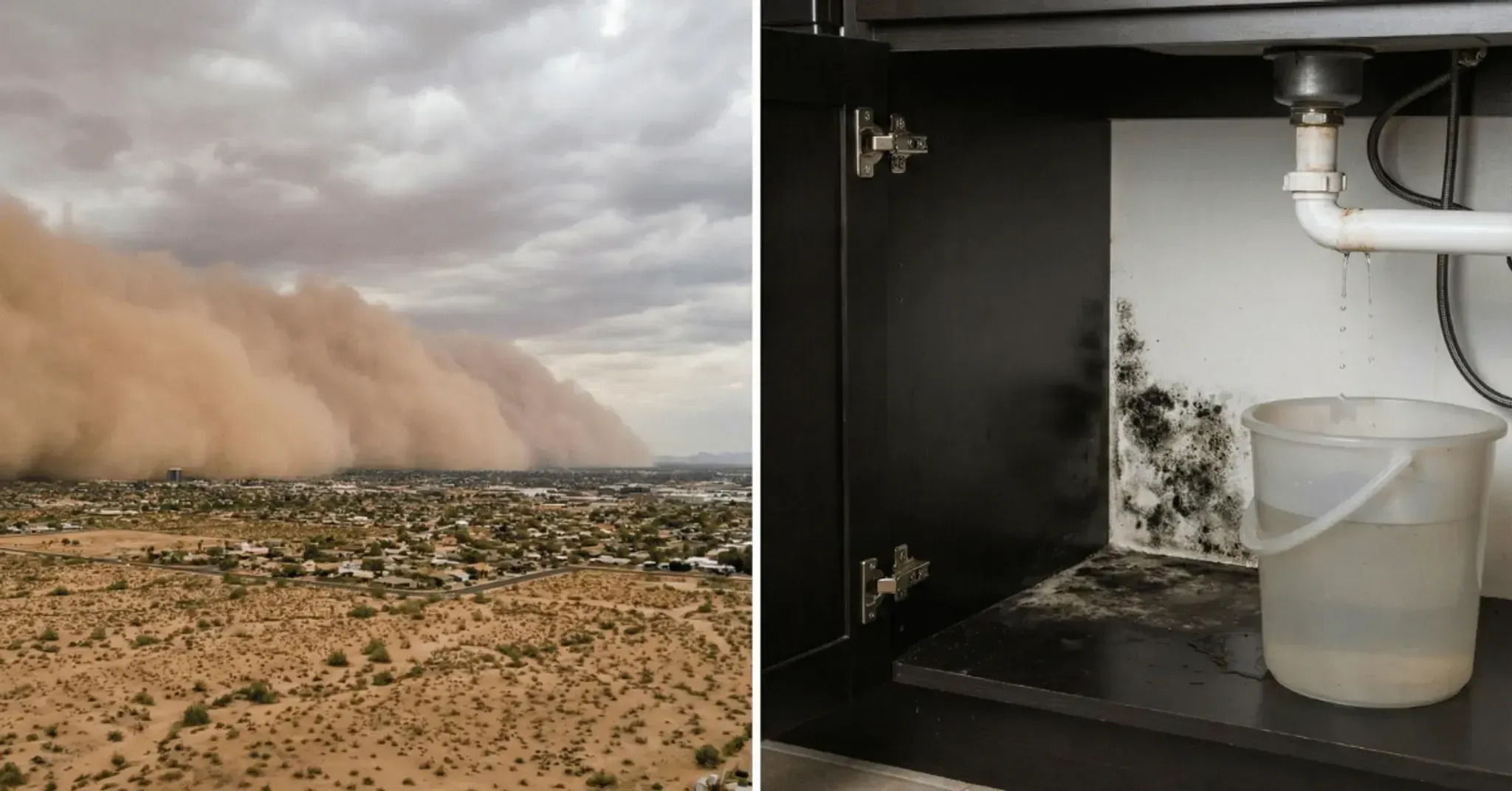

You've had a cough for three weeks. You're tired in a way sleep doesn't fix. You live in Phoenix, so you've heard of Valley Fever, and you've read about toxic mold. Both match your symptoms. So you're doing what most Maricopa County homeowners do: guessing.
That guess has real costs. Treating Valley Fever as a mold problem means spending money on home testing while a fungal infection spreads. Treating mold exposure as Valley Fever means your doctor sends you home to wait while your house keeps making you sick. According to St. Joseph's Hospital and Medical Center, 80 percent of Arizona's Valley Fever cases occur right here in Maricopa County. Phoenix's monsoon season and aging HVAC systems create real indoor mold risks on top of that. Both hazards are common. Here is how to tell them apart before you spend money or lose time treating the wrong one.
The One Question That Points You the Right Way
Did your symptoms start within two to four weeks of a specific outdoor dust event?
Yard work, a haboob, driving with the windows down during monsoon season, a construction site nearby. If you got sick one to three weeks after one of those, and now have fever, chest pain, and aching joints, Valley Fever belongs at the top of your list.
If your symptoms came on slowly, feel worst at home, and never included a fever, your indoor air is the first thing to test. A recent leak or HVAC issue makes that more likely.
These two paths can overlap. You can have a Valley Fever infection and an indoor mold problem at the same time. They share no cause. That is exactly why guessing costs you.
What Mold Exposure Feels Like in a Phoenix Home
Indoor mold forms when moisture meets organic material: behind drywall after a slow pipe leak, inside ductwork after monsoon humidity hits a surface cooled by central air, under flooring after an AC drain line backs up. Phoenix's dry reputation does not prevent these events.
Symptoms include a cough that won't clear, nasal congestion, fatigue, headaches, and brain fog. People with asthma find control gets harder. For people without a prior lung condition, mold can create one that looks new.
The clearest clue is the pattern. Mold symptoms are worst at home and ease when you leave. If you feel better at work or after a few days away, and feel worse the moment you return, that location link is your strongest signal. Valley Fever does not follow this pattern.
What Valley Fever Feels Like
Valley Fever is caused by Coccidioides, a fungus that lives in the desert soil of Maricopa County. When the soil is disturbed by wind, a dust storm, or nearby digging, spores go airborne. You breathe them in.
The Valley Fever Center for Excellence at the University of Arizona lists the core symptoms: fatigue, cough, fever, night sweats, loss of appetite, chest pain, and joint aches in the ankles and knees. A rash of tender red bumps on the shins also appears in many cases. That combination of fever, joint pain, and shin rash does not come from mold exposure. If you have all three, get a blood test before anything else.
The Arizona Department of Health Services notes that Valley Fever is often mistaken for a bacterial or viral infection. That error delays antifungal treatment. It can also lead to medicines that do nothing for a fungal disease. For people with diabetes, weak immune systems, those who are pregnant, or those of Black or Filipino descent, that delay carries serious health risk.
Valley Fever symptoms do not improve when you leave your home. The infection is already in your body.
How Each Condition Gets Confirmed
Valley Fever is confirmed through a blood test. Maricopa County's public health guidance notes that doctors start with an enzyme immunoassay to screen, then confirm with an immunodiffusion test, which is more precise. Tell your doctor you live in Maricopa County and ask by name about coccidioidomycosis. Doctors outside Arizona often skip this diagnosis.
Mold is confirmed through your home, not your blood. Air sampling measures spore levels inside the house against an outdoor baseline. Surface swabs confirm whether mold is present and what type. When mold is not visible, air testing is usually the first data point that gives you a clear answer. Fast Mold Testing's Phoenix mold inspection service uses certified air and surface sampling with third-party lab analysis and same-day results.
A blood test with your doctor and an air quality check at home are not competing steps. Run both at the same time.
Mold vs. Valley Fever in Phoenix: Common Questions
Does Valley Fever get better when I leave my home?
No. It is an infection inside your body. If symptoms ease away from home and return when you come back, that pattern points to your indoor environment, not your bloodstream.
Can Coccidioides spores grow inside my house?
No. The fungus does not grow indoors. Spores can enter through open windows during dust events, but your home is not a source of new exposure. Indoor air testing and Valley Fever diagnosis are separate steps that address separate problems.
Will a standard allergy test catch either one?
Not reliably. A standard allergy panel may show sensitivity to certain mold species but does not confirm what is growing in your home. Valley Fever requires a specific Coccidioides antibody blood test. Mold requires air and surface sampling from your indoor environment.
How long do symptoms last for each condition?
Valley Fever symptoms can last weeks or months, and joint pain and fatigue can linger well past that. Mold symptoms persist for as long as the source stays in your home. They will not clear on their own if the indoor air does not change.
Treat the Right One First
Maricopa County sits at a rare crossroads: desert soil where one airborne fungus lives and a housing stock where another grows in walls and ducts. The symptoms look alike from the outside. The fixes could not be further apart.
Fever, night sweats, and ankle pain after a dust event? Call your doctor and ask about coccidioidomycosis. Slow-building fatigue and congestion that ease when you leave the house? Start with the air inside your home.
If your symptoms are not improving and you're in the Phoenix metro, a professional mold inspection removes one major unknown. Book a mold test with Fast Mold Testing Phoenix and get lab-confirmed results the same day, so you and your doctor know exactly what you're dealing with.
Frequently Asked Questions
- How do Maricopa County homeowners tell the difference between mold and Valley Fever symptoms?
- Mold exposure and Valley Fever (coccidioidomycosis) share overlapping symptoms including cough, fatigue, and respiratory irritation. Key differences are that Valley Fever typically includes fever, night sweats, and joint pain, while mold exposure more commonly causes nasal congestion, eye irritation, and skin rashes. Valley Fever is diagnosed by blood test; mold exposure is confirmed by professional air sampling from Fast Mold Testing that identifies elevated indoor spore counts.
- Can a Maricopa County home have both mold and Valley Fever risk at the same time?
- Yes. Valley Fever fungal spores live in Maricopa County soil and can enter homes through gaps in the building envelope, particularly after dust storms. At the same time, HVAC condensation and monsoon moisture can support indoor mold growth. A professional mold inspection from Fast Mold Testing identifies indoor mold sources independently of Valley Fever risk, giving you clarity on which problem needs addressing indoors.
- How much does a mold inspection cost in Maricopa County to rule out indoor mold as the cause of symptoms?
- Mold inspections in Maricopa County for symptom investigation typically cost between $500 and $800 (more for extensive inspections). Fast Mold Testing starts at our transparent rate with results in 1 to 2 business days. The inspection includes air sampling with an outdoor control that distinguishes between ambient desert spores and elevated indoor mold from a building moisture source, helping your physician understand whether your environment may be contributing to your symptoms.
- Should Maricopa County residents get a mold inspection even if they think Valley Fever is the cause of their symptoms?
- Yes. Even if Valley Fever is suspected, ruling out indoor mold as a contributing factor is medically useful because both conditions can occur simultaneously and both require different remediation approaches. A professional mold inspection from Fast Mold Testing provides the indoor air quality data your physician needs to make a fully informed assessment of your environmental exposure.