
Phoenix home inspection is not only for spotting mold. Summer gets very hot here. The temperature can reach more than 110 degrees. Attics sometimes get as hot as 150 to 160 degrees. The main issue is the hidden heat moving into your home. This heat can make your cooling costs go up by hundreds of dollars each month.
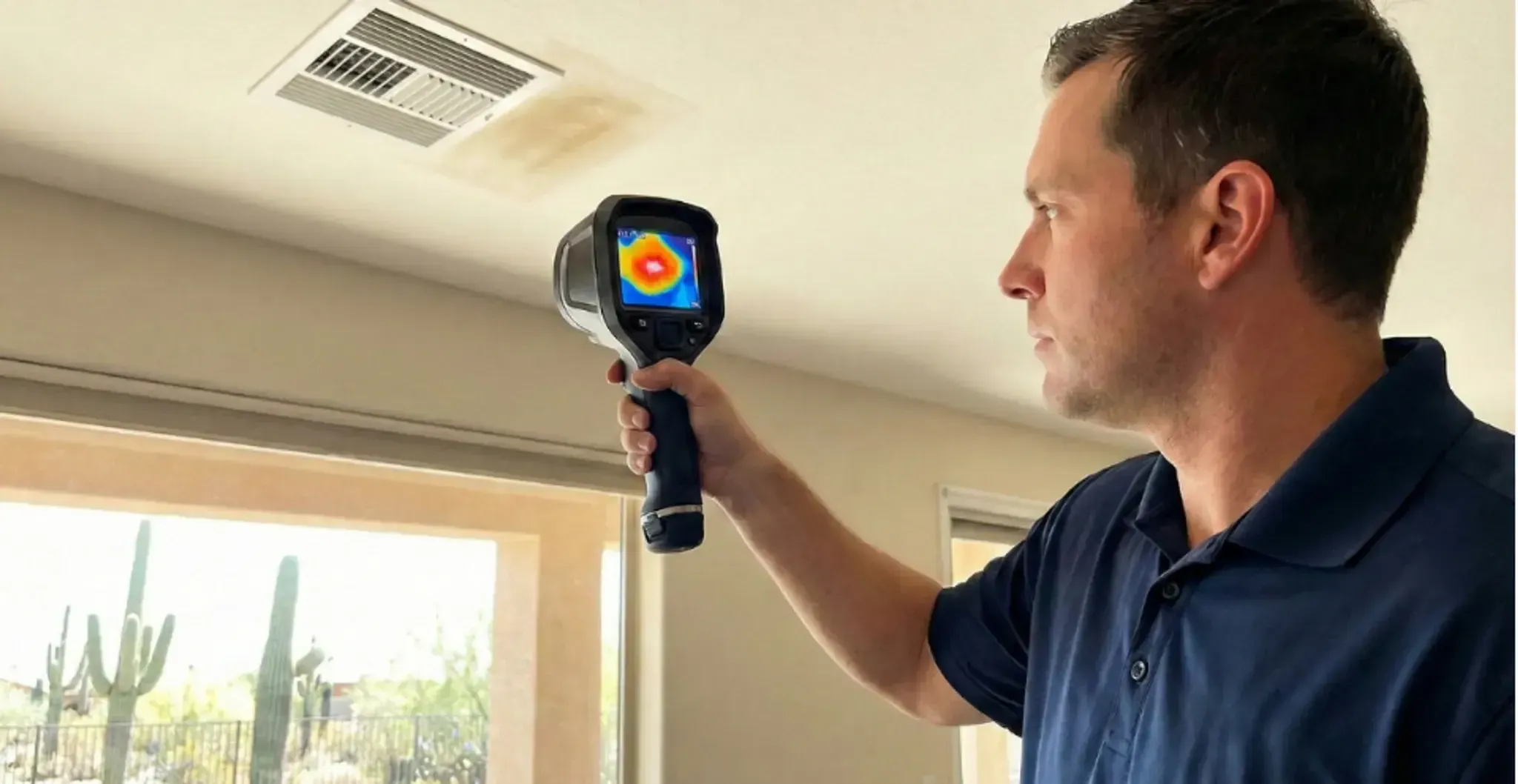
Professional inspectors use special thermal cameras to see things that regular checks can miss. Broken AC ducts, missing insulation, and air that gets out can cause you to lose a lot of money each year. A handyman with a flashlight cannot do what a certified inspector with the right tools can. This can save you a lot of money in the long run.
Phoenix Heat Demands Better Inspection
Phoenix holds heat in because the city is surrounded by mountains. When the temperature goes up to 115 degrees, attics that are not sealed well can heat up to 165 degrees. In the day, the top of the roof in direct sun can go up to 180 degrees.
Heat comes into homes in three ways. It moves through the roof and ceiling. The hot air from the attic goes into cool rooms through small gaps. Heat also passes through insulation as infrared energy.
Basic inspections use simple checks you can see and easy tools to look for water in walls. These tools can’t see hidden heat moving in your home or find where heat is lost. The checkup will find clear water issues, but it misses spots where you lose money on heat, which could be about $2,000 to $4,000 every year.
Home inspectors use special cameras that find heat by picking up infrared light. These cameras make color pictures. The pictures show where the heat is different on walls or other areas. This helps you see to see where heat gets into your home.
How Thermal Cameras Work
Thermal cameras have to find a change in temperature to work. In many places, people use them in the winter. This is because warm air inside the house is not the same as the cold air outside.
Phoenix gives a big benefit in summer. The inside can be just 75 degrees. The attic can get up to 150 degrees. That is a 75 degrees gap. You only need about 15 to 20 degrees as a minimum. The strong Phoenix heat makes it easy to get clear heat images. You can even spot small problems.
Professional cameras can show very sharp images with lots of temperature points. They help you see the difference between small cracks and big heat leaks. A cheap smartphone add-on has low resolution and can miss some problems.
Better cameras can see small changes in temperature. This helps find problems that cheaper cameras do not spot at all.
What Thermal Cameras Find
When you look at your ceiling from a cool room, you can see some problems clearly.
Broken AC Ducts
AC ducts go through hot attics. When a supply duct comes apart or tears, it leaves a big gap.
A broken supply duct pushes 55-degree air into a 160-degree attic. This means you end up cooling the attic, not your house. A camera that can see heat shows cool air spreading out on the insulation.
Return air leaks are worse. They pull very hot attic air into your AC system. Your unit has to cool air that is about 150 degrees instead of 85-degree room air. These leaks look like hot spots on the ceiling. They cut how well the system works by 25 to 40 percent.
Missing Insulation
The code says that now you need to have R-38 to R-49 attic insulation. Many old homes have only R-19 or R-30 for this. If there is missing insulation or if someone walks on it and pushes it down, a lot of heat can get through.
Bright hot spots between ceiling joists show up in the images when insulation is missing. The wood framing looks cooler than the bare drywall. This creates a striped look that helps you see where the barrier that stops heat is not working.
Compressed insulation shows the same kind of pattern. When you step on blown insulation, it gets squished down from 12 inches to only 3 inches. The R-value goes down by 60 percent. A camera can see these warmer spots where your feet were.
Air Leaks
Hot air from the attic can get into rooms through gaps near ceiling lights. If attic doors are not sealed, warm air comes in. Holes around pipes also let in this air.
You can see these show up like thin feelers of heat coming out of small holes. Unlike the hard lines you get with missing insulation, air leaks spread in a soft and gentle way.
One ceiling light that is not sealed lets in hot air all the time. This can make your bedroom feel warmer, especially in summer. You can spend a lot more on energy during this time. When damp air comes in, it can also bring in moisture.
Professional Equipment vs Basic Tools
Equipment separates professionals from handymen.
Thermal Cameras
Handymen use smartphone attachments that cost about $200. Professional inspectors spend more. They buy cameras like the FLIR E8-XT, which can be from $3,000 to $8,000.
A professional camera shows four to sixteen times more detail than a cheap one. It can catch small problems that budget gear will not see.
Moisture Meters
Basic pin meters make small holes in the walls. Professional meters can look for moisture through paint and drywall without any damage. They can quickly check whole walls in seconds and find any places that are wet.
People who work in this field also know when wire or corner beads made of metal cause wrong numbers to show up on low-cost meters.
Video Cameras
When heat imaging finds a leak, a video camera can show proof in pictures. A handyman can make small holes in the wall to look inside. Inspectors can put tiny bendy cameras through small holes. There will not be any big damage to your walls.
Phoenix Building Problems
Phoenix extreme heat creates unique failures.
Homes built from 1970 to 2005 have old insulation. The R-19 used back then was good and met the codes at that time. Now, it is not enough. Heat makes the insulation get worse as the years pass.
Duct systems can fail in different ways. Flex duct can crack when it gets very hot. Rodents might chew through duct tape. Insulation from the metal duct can come off. Every time this happens, cool air gets out or hot air gets in.
What Energy Waste Costs
If there is missing insulation in the home, it can make cooling costs go up by 20 to 35 percent. A home with good R-49 insulation will cost about $280 each month to cool in the summer. If that same home only has old R-19 insulation, the cost will be between $380 and $420 each month. That means you pay an extra $100 to $140 just to cool your home each month.
Leaking ducts can waste around 25 to 40 percent of cooled air. If your cooling bill is $300, you could lose $75 to $120 each month.
Problems get worse. A Phoenix home that has missing insulation, ducts that leak, and open air gaps can have summer bills that go from $600 to $800. A home that is sealed well costs our transparent rate to $350. In six months, you could spend $1,800 to $2,400 more each year.
A skilled inspection helps you find these problems. With help, you can fix the biggest problems first. You get your money back in one or two summers because the bills go down.
Good Inspection Includes What
A full check looks at the whole ceiling from inside. Hot spots let you see where there is missing insulation, air leaks, and issues with the ducts.
The person goes up into the attic to look around and see what it is like. They take photos to show the shape of the duct, how much insulation there is, and if the barrier is there. A moisture scan helps find any leaks that could make mold appear.
The report has heat images that show how bad the problem is. It also has normal photos and a list of repairs. The repairs are ordered by how much they cost and how much they save you. This helps you see which repairs save you most money.
Check Certification Not Just Price
Check if the certifications are from InterNACHI or ASHI. Ask about the camera specs. Good resolution and sensitivity can help you find problems.
The cheapest quote can sometimes come with the cheapest equipment and rushed work. If you pay $400 to $600 for a checkup and it shows you are losing $2,000 in waste every year, you get real value. A discount checker who charges $200 but misses the problems does not save you any money.
Schedule a heat check with Fast Mold Testing for a full look at energy waste, bad ducts, gaps in insulation, and water problems that can change how your Phoenix home works and what you pay for bills.
Frequently Asked Questions
- How does thermal imaging help find hidden mold in Phoenix homes?
- Thermal imaging cameras detect temperature differences on wall surfaces. In Phoenix, where air conditioning runs nearly year-round, moisture inside walls stays cooler than dry surrounding materials, creating a thermal signature that shows up on the camera even when the surface appears completely normal visually. This allows inspectors to identify hidden moisture pockets that are feeding mold growth without opening walls.
- Can thermal imaging alone confirm mold in a Phoenix home?
- Thermal imaging identifies thermal anomalies that suggest moisture, but it cannot confirm mold on its own. A thermal anomaly must be followed up with a moisture meter reading to confirm elevated moisture content and, when appropriate, air or surface sampling sent to a lab to confirm mold presence. Fast Mold Testing uses thermal imaging as part of a comprehensive protocol that includes all three steps.
- How does mold inspection thermal imaging help Phoenix homeowners find hidden energy waste?
- In Phoenix, thermal imaging during a mold inspection often reveals insulation gaps, air leaks around windows and doors, and HVAC duct separations that simultaneously create moisture problems and energy loss. Moisture intrusion points identified by the thermal camera are frequently the same locations where conditioned air is escaping, meaning the mold inspection produces actionable energy efficiency information as a byproduct.
- How much does a thermal imaging mold inspection cost in Phoenix?
- Mold inspections that include thermal imaging in Phoenix typically cost between $500 and $800 (more for extensive inspections). Fast Mold Testing starts at our transparent rate and uses infrared cameras as part of its standard inspection protocol. The thermal scan is not charged as a separate add-on and is included in the full moisture mapping process that every inspection covers.