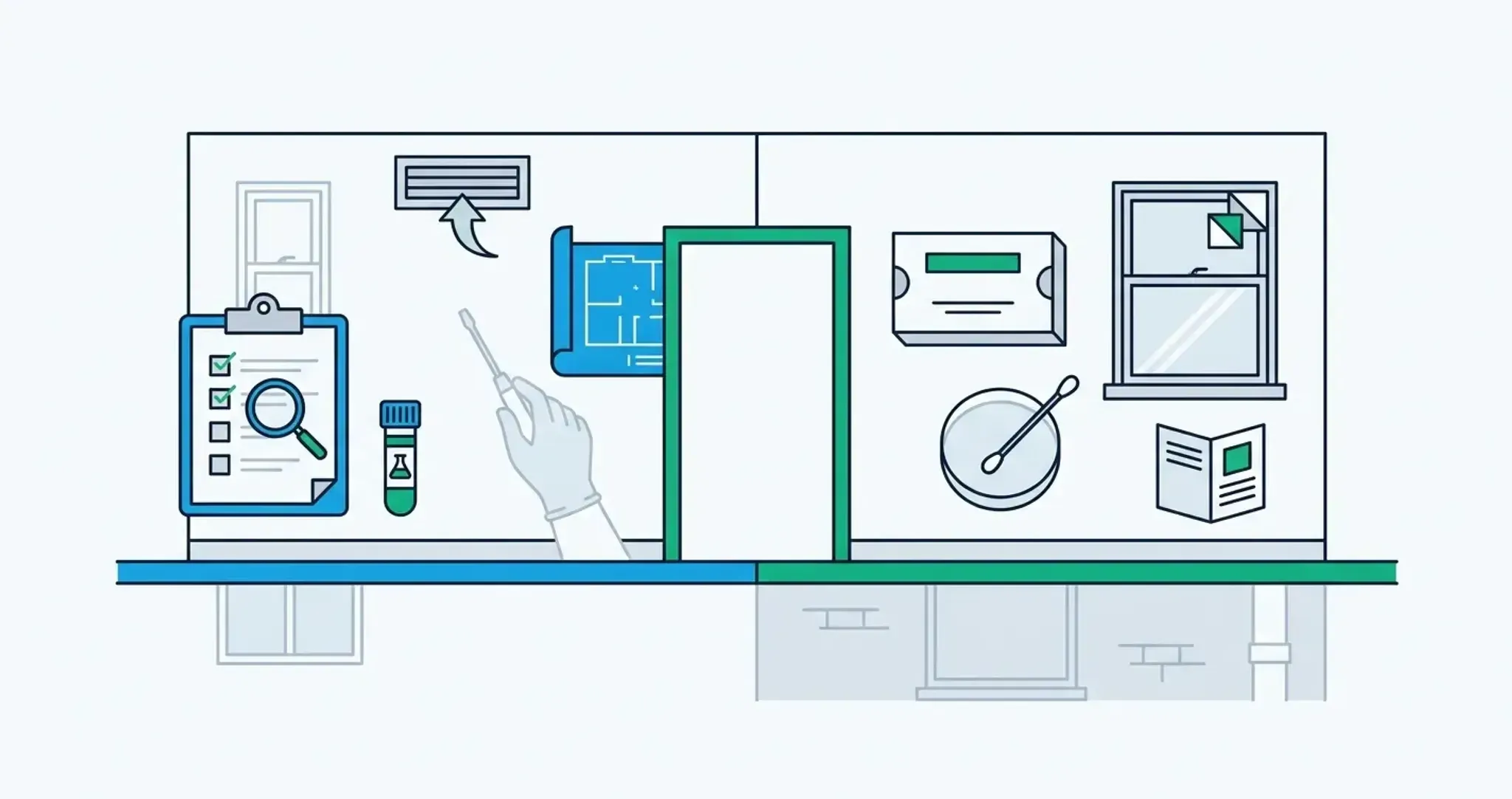

Professional mold testing typically costs between $500 and $800 (more for extensive inspections) for residential inspections and delivers lab-certified species identification, air quality measurements, hidden-mold detection, and a written report with photos and recommendations. DIY test kits often cost $10-$50 and can confirm whether visible growth or a collected sample contains mold spores. Most cheap kits do not provide the species-level ID, concentration data, or health-risk context a professional inspection report provides.
The question isn't which option is better. The question is which one matches your situation. If you need to confirm whether the black stuff on your bathroom wall is mold, a $15 petri dish kit will answer that. If you're buying a house, fighting a landlord dispute, or experiencing unexplained respiratory symptoms, you need lab-certified data from a certified inspector.
Here's what each option actually delivers and when each makes sense.
What DIY Mold Test Kits Actually Do (and Don't Do)
DIY mold test kits confirm whether visible growth or air samples contain mold spores. Most kits cost $10-$50 and deliver results in 5-14 days via mail-in lab. They don't identify species, measure air quality comprehensively, or detect hidden mold.
The typical DIY kit works one of three ways: you scrape or swab a surface sample, you expose a petri dish to room air for 48 hours, or you run a small air pump to collect airborne spores. You mail the sample to a lab. The lab confirms whether mold is present and sometimes provides a genus-level ID (like "Aspergillus" or "Penicillium"), but not the specific species or concentration data that determines health risk.
Here's what different DIY kit types offer:
| Kit Type | Typical Cost | Limitations |
|---|---|---|
| Petri dish (settle plate) | $10-$30 | No concentration data; only tests one spot; high false-negative rate |
| Surface swab | $10-$25 | Doesn't test air quality; only tests what you can see |
| Mail-in lab kit (air pump) | $40-$80 | No species ID; limited sample locations; no professional inspection |
| Instant color-change test | $5-$15 | No lab analysis; no species data; high error rate |
DIY kits answer a narrow question: "Is this mold?" They don't answer: "What kind? How much? Where else is it growing? Is it safe to stay here?"
Most DIY kits test one or two spots. Mold doesn't grow evenly. The spot you test might be clean while the HVAC ducts, attic, or wall cavity behind your shower has active growth. A professional inspector knows where to look.
What Professional Mold Testing Includes
Professional mold testing includes a certified inspector visit, air and surface sampling from multiple locations, hidden-mold detection in HVAC systems and behind walls, AIHA-LAP accredited lab analysis with species identification, and a written report with photos and recommendations. Residential pricing typically runs between $500 and $800 (more for extensive inspections), with larger or more complex inspections extending up to $1,500. Results come back in 1–2 business days after inspection at Fast Mold Testing, compared with the 5-14 day industry standard.
The inspection starts with a visual assessment. The inspector walks the property looking for visible mold, water damage, condensation patterns, and moisture sources. They check places homeowners rarely look: HVAC supply plenums, crawlspaces, attic sheathing, behind appliances, inside wall cavities near plumbing.
Then sampling begins:
- Air samples — The inspector collects air from multiple rooms using a calibrated air pump. Samples measure airborne spore concentration and types. This catches mold you can't see.
- Surface samples — Swab or tape-lift samples from visible growth, stains, or suspect areas. These identify the species growing on surfaces.
- HVAC inspection — Many inspectors include thermal imaging to detect moisture behind walls and inside ductwork. Mold in HVAC systems spreads spores throughout the building every time the system runs.
- Lab analysis — Samples go to an AIHA-LAP accredited lab. At Fast Mold Testing, we use AI-assisted lab analysis for species identification and quantification, with results in 1–2 business days after inspection. Industry standard is 5-14 days.
- Written report — You get a report with sample-by-sample breakdowns, photos, spore counts, species identified, comparison to outdoor baseline levels, and recommendations. Not a sales pitch. A document that holds up in court, housing authority filings, or real estate negotiations.
- Follow-up call — The inspector walks through the findings and answers questions. If remediation is needed, they explain what should happen next — but if you're working with a conflict-free testing company like Fast Mold Testing, the inspector doesn't profit from the cleanup, so the recommendations are straight.
Professional testing costs more because you're paying for expertise, equipment, lab accreditation, and a legally defensible report. The inspector's credentials matter: IICRC certification, NORMI training, and state-specific licensing where required.
At Fast Mold Testing, we test only. We don't remediate mold. The inspector who evaluates your property doesn't make more money if the problem is bigger. That structural separation is why our customers consistently mention in reviews that we "never tried to upsell" them.
Cost Comparison: DIY vs. Professional
DIY mold test kits cost $10-$50 at retail, with some requiring an additional $40 lab analysis fee. Professional mold testing for a typical residential property runs between $500 and $800 (more for extensive inspections), with larger or more complex jobs extending up to $1,500 depending on property size, number of samples, and turnaround speed.
Here's the cost breakdown:
| Method | Typical Cost | What You Get |
|---|---|---|
| DIY petri dish kit | $10-$30 | Presence confirmation only |
| DIY mail-in lab kit | $40-$80 | Genus-level ID, rough spore count |
| Standard professional inspection | $400-$700 | Air + surface samples, species ID, AIHA-LAP accredited lab, written report |
| Comprehensive professional inspection | $700-$1,500 | Multiple rooms, HVAC, thermal imaging, detailed report |
What drives professional pricing:
- Number of samples — More rooms and sample locations mean higher lab costs. A 1,200 sq ft condo might need 3-5 samples; a 3,500 sq ft house with a basement and attic might need 10-15.
- Lab turnaround — 1–2 business day results (via AI-assisted lab analysis) cost more than 7-14 day standard processing.
- Inspection scope — Thermal imaging, HVAC inspection, and crawlspace access increase the inspection time and equipment costs.
- Inspector credentials — IICRC-certified inspectors with years of experience charge more than generalist home inspectors offering mold as an add-on service.
A standard Fast Mold Testing residential inspection includes air sampling, surface sampling, thermal imaging, and AIHA-LAP accredited lab analysis with species ID. Pricing is transparent and published. Most competitors require a phone call for a quote.
When DIY Makes Sense (and When It Doesn't)
DIY mold test kits make sense when you're confirming whether visible growth is mold and don't need species identification or air quality data. Professional testing is necessary for tenant disputes, hidden mold detection, health-symptom investigations, real estate transactions, and post-remediation clearance — situations where lab-certified results and inspector credentials matter.
When DIY Works
You can see the mold and just need confirmation. If there's visible growth on a bathroom ceiling tile or a basement wall and you want to confirm it's mold before cleaning it yourself, a $15 surface swab kit answers that question. You already know something's there. You just need to know if it's mold or mildew.
You're doing a quick screening after a small leak. A slow drip under the sink got fixed two weeks ago and you want to check whether mold started growing. A petri dish test gives you a baseline reading. If it comes back positive, you know to dig deeper with professional testing.
Budget is the limiting factor and you're not making a legal or financial decision. If you're renting and the landlord refuses to pay for testing, a DIY kit at least gives you data to start the conversation. It won't hold up in housing court, but it's better than no data.
When You Need Professional Testing
Tenant disputes. If you're fighting a landlord over habitability, the landlord's insurance company or a housing authority inspector will not accept a $20 mail-in test kit as evidence. You need a certified inspector's report with AIHA-LAP accredited lab analysis and the inspector's credentials attached. California's habitability framework (Civil Code § 1941 and Health & Safety Code § 17920.3) requires landlords to maintain mold-free habitable conditions, but the law doesn't mandate a specific testing methodology. In practice, independent lab-backed reports carry more weight than DIY kits or a landlord's-choice inspector in housing disputes — but the specifics of what counts in a given case are an attorney conversation.
Hidden mold. DIY kits only test where you point them. If you smell a musty odor but can't find the source, or if you've had water damage and suspect mold is growing inside walls or HVAC ducts, you need an inspector with thermal imaging equipment and the experience to know where mold hides.
Health symptoms. If anyone in the household has unexplained respiratory issues, headaches, or allergy symptoms that improve when they leave the building, you need comprehensive air quality testing with species identification. Stachybotrys chartarum (commonly called "black mold") has historically been associated with respiratory concerns, though more recent CDC framing emphasizes that mold sensitivity varies significantly by individual and that all indoor mold growth warrants remediation regardless of species. A DIY kit won't tell you which species is present.
Real estate transactions. If you're buying a house and the home inspection flagged moisture or possible mold, you need a professional mold inspection before closing. Lenders and title companies require certified reports. A DIY test won't satisfy the contingency.
Post-remediation clearance. After mold cleanup, you need a certified clearance inspection to confirm the remediation was successful. Insurance companies and remediation contracts often require third-party verification. DIY kits don't provide clearance certification.
The pattern: DIY works when the stakes are low and you're just confirming what you can already see. Professional testing is the standard when the decision has legal, health, or financial consequences.
Accuracy and Reliability: What the Data Shows
DIY mold test kits can accurately confirm whether mold spores are present in the sample you collect, but they have high false-negative rates for hidden mold and cannot identify species or measure air quality comprehensively. Industry guidance from inspection-certification bodies (IICRC, NORMI) emphasizes that hidden mold — behind walls, in HVAC ducts, in crawlspaces — is a common scenario that surface-level DIY testing can't detect. Professional testing uses AIHA-LAP accredited lab analysis for species identification and quantification.
The accuracy problem with DIY kits isn't the lab analysis — most mail-in kits use legitimate labs. The problem is sampling. Mold grows in pockets. If you test the visible growth but miss the colony growing inside the wall cavity six inches away, the test result doesn't reflect the actual problem.
Air sampling has the same issue. A petri dish exposed in your living room for 48 hours captures whatever spores happen to land on it during those 48 hours. It doesn't measure concentration, it doesn't test the bedroom or basement, and it doesn't tell you whether the spore levels are elevated compared to outdoor air (the baseline for determining whether indoor mold is a problem).
Professional air sampling uses calibrated pumps that pull a measured volume of air through a collection cassette. The lab counts spores per cubic meter and compares that to outdoor baseline levels. If your living room has 5,000 spores/m³ and outdoor air has 800 spores/m³, you have an indoor source. A petri dish can't give you that data.
Species identification matters for health risk assessment. According to the CDC, some mold species produce mycotoxins that are linked to respiratory irritation and immune response. Other species are mostly benign. A DIY kit might tell you "mold detected" or "Aspergillus present," but it won't give you the species-level ID that determines whether the growth is a health concern or a cosmetic issue.
False negatives are the bigger risk. The American Industrial Hygiene Association notes that improper sampling technique — common with DIY kits — often leads to false negatives. If you swab the wrong spot, expose the petri dish in the wrong room, or collect a sample after running the HVAC fan (which dilutes airborne spore concentration), the test might come back "no mold detected" even though mold is actively growing somewhere else in the building.
Professional testing reduces false negatives by sampling multiple locations, using calibrated equipment, and applying the inspector's trained eye to identify likely problem areas before sampling begins.
The Right Test for Your Situation
DIY mold test kits confirm whether something is mold. Professional testing tells you what kind, how much, where it's hiding, and what you should do about it. The right choice depends on what decision you're trying to make.
If you're confirming visible growth in a low-stakes situation, a $15 DIY kit is fine. If the test matters for your health, your lease, your home purchase, or your insurance claim, pay for lab-certified data from a certified inspector.
At Fast Mold Testing, we run conflict-free inspections — we test only, we don't remediate, so the inspector has no financial incentive to make the problem sound worse than it is. Residential pricing typically runs between $500 and $800 (more for extensive inspections). Lab results in 1–2 business days after inspection via AI-assisted lab analysis. Same-day or next-business-day availability across our 50+ service areas, including San Francisco, Sacramento, Atlanta, Denver, and New York.
Frequently Asked Questions
- Can DIY kits detect hidden mold?
- No. DIY mold test kits only test the specific spot or room where you place them. They can't detect mold behind walls, in HVAC ducts, or in crawlspaces unless you physically access those areas and collect a sample. Professional inspectors use thermal imaging and moisture meters to find hidden mold.
- How accurate are DIY mold tests?
- DIY kits can accurately confirm whether the sample you collected contains mold, but they have high false-negative rates because they only test one or two locations. They also don't measure spore concentration or provide species-level identification. Accuracy depends entirely on whether you sampled the right spot.
- What does a professional mold test include?
- A professional mold test includes a certified inspector visit, air and surface sampling from multiple locations, hidden-mold detection using thermal imaging and moisture meters, AIHA-LAP accredited lab analysis with species identification, and a written report with photos and recommendations. Residential pricing typically runs between $500 and $800 (more for extensive inspections), with larger or more complex properties extending up to $1,500.
- How much does professional mold testing cost?
- Residential mold testing pricing typically runs between $500 and $800 (more for extensive inspections). The full industry range is $400 to $1,500 depending on property size, number of samples, and turnaround speed. Pricing varies based on the number of rooms tested and whether HVAC inspection or thermal imaging is included.
- When should I skip DIY and hire a professional?
- Hire a professional if you're involved in a tenant dispute, buying or selling a home, experiencing health symptoms, need to detect hidden mold, or require post-remediation clearance. Any situation where lab-certified results and inspector credentials matter requires professional testing. DIY is fine for simple confirmation of visible growth.
- Do I need a mold test if I can see mold?
- If you can see mold and the affected area is small (less than 10 square feet, per EPA guidance), you can often clean it yourself without testing. Testing is recommended if you don't know the source of moisture, if the mold keeps coming back, if you're experiencing health symptoms, or if the growth is extensive. Species identification helps determine health risk.
- How long does professional lab analysis take?
- Professional mold lab analysis typically takes 5-14 days at most testing companies. Fast Mold Testing uses AI-assisted lab analysis for species identification, which delivers results in 1–2 business days after inspection. Turnaround depends on the lab's workload and whether expedited analysis is available.