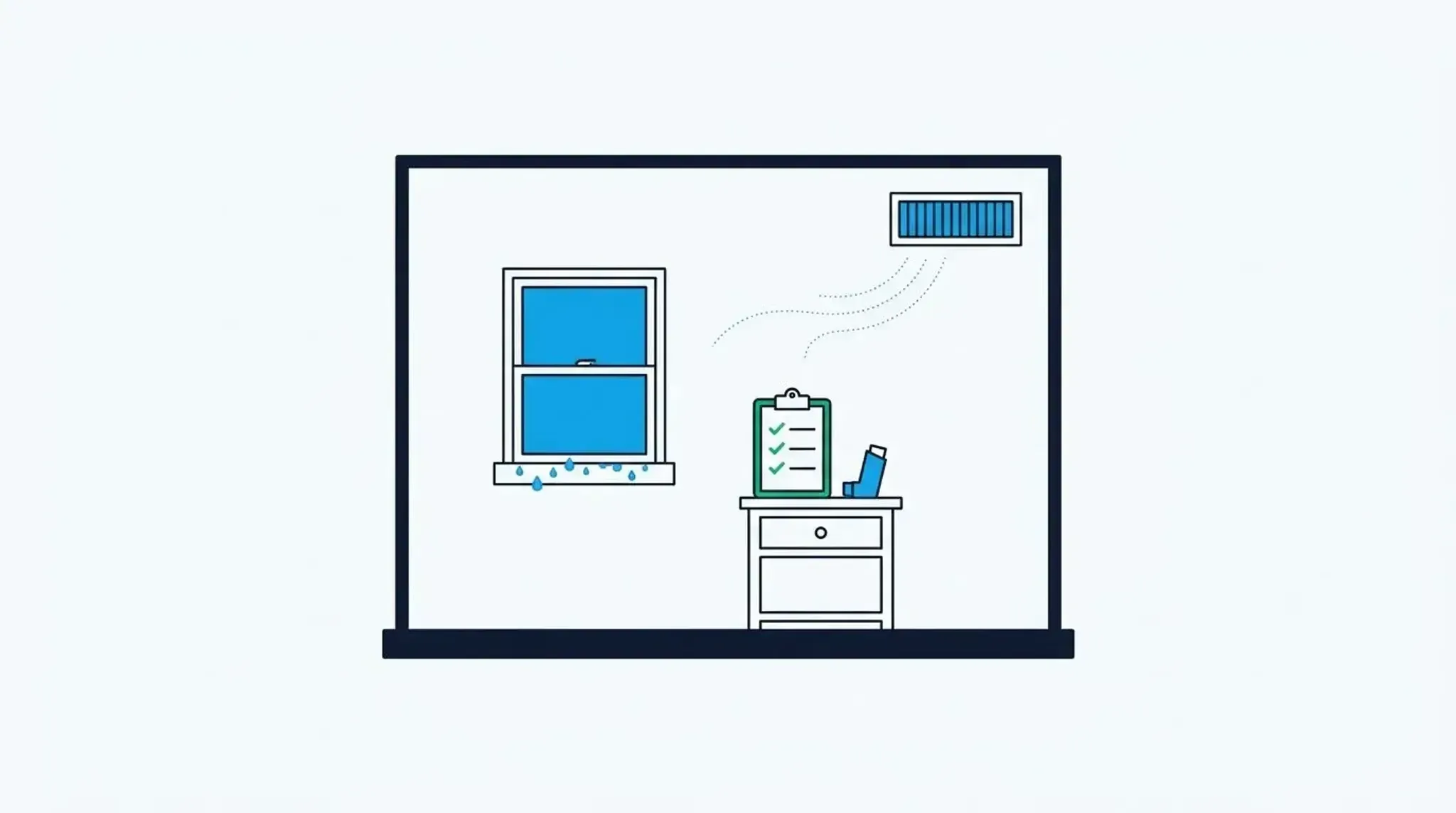

Mold exposure is linked to childhood asthma in two distinct ways: it can trigger more frequent and more severe asthma attacks in kids who already have asthma, and there is evidence it contributes to new-onset asthma in some young children, particularly those genetically susceptible to it. The American College of Allergy, Asthma and Immunology (ACAAI) lists mold among the indoor allergens that can trigger or worsen asthma, and the WHO Guidelines for Indoor Air Quality: Dampness and Mould reviewed hundreds of studies and concluded that occupants of damp or moldy buildings face a higher risk of respiratory symptoms and asthma.
This guide is written for parents trying to figure out whether mold in their home is part of what's happening with their child. It covers what the research actually shows, the symptom pattern to watch for, where mold tends to hide in a typical home, and when home mold testing is worth doing.
What the research actually shows about mold and childhood asthma
The association is well documented; the causation is narrower. Mold is one of the most consistent indoor triggers of asthma attacks in children who already have the diagnosis. For new asthma onset, the evidence points to genetically susceptible children with early-life exposure to damp homes as the group most at risk.
The CDC's clinical guidance on asthma and mold allergy tells doctors to treat damp indoor environments as a probable contributor to worsening asthma symptoms. The CDC also notes that early-life mold exposure may contribute to asthma development in some children, especially those who are genetically predisposed.
The WHO Guidelines for Indoor Air Quality: Dampness and Mould reached similar conclusions after reviewing the global literature. The WHO panel found "sufficient evidence" for an association between indoor dampness and respiratory symptoms, asthma exacerbation, and current asthma diagnosis.
The EPA's page on mold exposure and respiratory conditions in young children focuses on this age group for good reason: studies of asthma's natural history show that nearly 80% of asthma cases begin before age six, which is also the window in which kids spend the most time indoors at home.
What this means in plain language: if your child has asthma and there is mold in the home, the mold is probably making it worse. Whether the mold caused the asthma is a harder question. For some kids it likely contributed; for others it didn't.
Signs mold may be triggering your child's asthma
The clearest signal is location-dependent symptoms: asthma that flares at home and calms down somewhere else. If your child wheezes more after spending the night in their bedroom, or symptoms get worse during a stretch of rainy or humid weather, mold is a plausible factor worth investigating with a professional inspection.
Specific signs that mold may be involved in your child's asthma:
- A cough that lingers for weeks without a cold to explain it
- Wheezing or chest tightness that gets worse at night in bed
- Symptoms that improve at school, at a relative's house, or on vacation
- Eye irritation, runny nose, or sinus congestion alongside the asthma
- Rising rescue inhaler use without a recent infection
- Headaches or unusual tiredness paired with the respiratory symptoms
One practical step before the next pediatrician appointment: keep a two- to four-week log of where your child was each time symptoms flared. The pattern (home worse, school better, grandparent's house clear) is more diagnostically useful than the symptoms alone. Bring the log to the appointment.
This isn't a substitute for a clinical workup. Pediatric asthma management starts with the pediatrician or a pediatric allergist; the home environment is one piece of the puzzle, not the whole puzzle.
Where mold hides in homes with kids
The visible patch is rarely the whole story. Mold grows wherever moisture, organic material, and time meet, and most of those places aren't in plain view. Bedrooms above slab basements, bathrooms with chronic poor ventilation, and HVAC systems that haven't been serviced in years are common starting points.
The locations worth checking in any home with a child showing asthma signs:
- Bathroom ceilings, grout lines, and the underside of caulk around tubs
- Behind drywall near plumbing: under-sink cabinets, washer hookups, ice-maker lines
- Inside HVAC ducts and around the air handler closet
- Window sills and the wall below them, especially in older single-pane windows
- Attic insulation directly under roof leaks
- Crawlspaces and the underside of subfloor in homes built on grade
- Basement carpet, especially carpet over concrete
- The drain pan and coil of a central A/C unit
- Closets on exterior walls, where bedroom temperature differentials cause condensation
Bedrooms matter the most. A child spends roughly half their day sleeping, breathing the air in one room for ten or eleven hours straight. A bedroom adjacent to a leaking bathroom, sharing a wall with a humidified basement, or fed by a moldy HVAC supply duct is delivering the highest single dose of exposure in the house. If your child rents the room because the family rents the house, our tenant-rights guide for mold covers the documentation step that should come before any conversation with the landlord.
When to test your home for mold
Test when one of four things is true: you can see mold, you can smell mold, you've had a moisture event in the last two years, or your child's asthma is worsening with no other explanation. None of these on their own is a medical emergency, but each one is a reasonable trigger for a professional mold inspection.
The four scenarios in order:
- Visible mold. Any patch larger than a credit card on a porous surface (drywall, wood, carpet) is worth professionally identifying. DIY visual ID doesn't tell you the species, and some species matter more than others for an asthmatic child.
- Persistent musty smell. That distinct cellar-and-old-book smell almost always means active mold growth somewhere, usually behind a finish surface where you can't see it.
- Recent water damage. A burst pipe, roof leak, dishwasher overflow, or flood event can start mold growing if the wet materials aren't dried out within 24 to 48 hours, the window the EPA flags for preventing growth. Even after the visible water is gone, a moisture meter and air sample tell you whether anything is growing inside the wall.
- Asthma worsening with no other explanation. If your child's pediatrician or allergist has ruled out the usual suspects (pets, dust mites, seasonal pollen, a new medication change) and the symptoms cluster at home, home testing is a reasonable next step.
What testing tells you is not "is mold dangerous." It tells you what is in your air, how much of it is in your air, and where it's coming from. That's the information you need to decide what to do next.
DIY mold test vs. professional mold inspection (for an asthmatic child)
DIY kits ($10–$50 at hardware stores; lab analysis often costs extra) answer one question: is the patch you're looking at mold, yes or no. A professional inspection answers four: what species, how much, where is it coming from, and what's in the air your child is actually breathing. When an asthmatic child is the reason you're testing, the difference matters.
| Dimension | DIY mold test kit | Professional inspection |
|---|---|---|
| What it tells you | Mold present yes/no on a swabbed surface | Species, spore counts, air vs. surface, source location |
| Lab quality | Varies; mail-in, typically 5-14 days | AIHA-LAP (EMLAP) accredited labs, 1-2 business days at FMT |
| Hidden-mold detection | No; you can only test what you can see | Yes: moisture meters, thermal imaging, and air sampling find what's behind walls |
| Cost | $10-$50 per kit | Starts at our transparent rate; published pricing |
A DIY kit is fine for confirming that a visible patch is mold. It is not enough when a child's asthma is the reason for the test, because the most clinically relevant mold often grows where you can't see it. The EPA advises that people with breathing problems like asthma or weakened immune systems — along with children and pregnant people — should stay away from moldy sites and not take part in cleanup, which assumes you already know what you're remediating and where. That's the gap a professional inspection fills.
What to do if your home tests positive
Three priorities, in order: reduce your child's exposure, fix the moisture source, then handle the mold itself. Skipping straight to scraping mold off drywall while the leak above it keeps dripping is the most common (and most expensive) mistake parents make.
The steps:
- Reduce exposure first. If the mold is in the child's bedroom, move them to another room until remediation is done. Close off the affected area, run air purifiers with HEPA filters elsewhere in the home, and keep doors shut to contain it.
- Find and fix the moisture source. Mold will come back within weeks if the leak, condensation, or humidity problem isn't fixed first. Roofers, plumbers, and HVAC techs handle this part, not mold remediators.
- Decide DIY or professional remediation. The CDC's clinical guidance and EPA both flag a rough cutoff: surface mold under about 10 square feet on a hard, non-porous surface can usually be DIY'd with detergent and water. Anything larger, anything on porous material (drywall, carpet, insulation), or anything involving an asthmatic occupant should go to a remediation professional.
- Retest after remediation. A clearance air sample taken 24 to 48 hours after the work is finished — alongside a visual inspection and a moisture check confirming the source was fixed — is how you verify the remediation actually worked. Spore counts should drop to baseline or below.
We test only — we don't remediate. When you need a remediation contractor, we recommend asking for IICRC-certified firms with no testing arm of their own. Companies that profit from fixing mold problems have a structural incentive to find them; that's the reason FMT exists.
What's next
If you've gone through the four-question test in this guide and you're seeing more than one yes, the next step is a professional inspection that can tell you what's actually in your air and where it's coming from. We test only. Independent, AIHA-LAP (EMLAP) accredited lab analysis, with results in 1-2 business days. No remediation upsell, because we don't do remediation.
Frequently Asked Questions
- Can mold cause asthma in a child who didn't have it before?
- It can contribute, particularly in young children with a genetic predisposition exposed to damp housing in the first years of life. The WHO Guidelines for Indoor Air Quality: Dampness and Mould found sufficient evidence linking damp indoor environments to respiratory symptoms and worsening of asthma (with weaker evidence for the development of new asthma), though 'cause' is too strong for most cases. 'Associated with' is the accurate framing.
- What does a mold-triggered asthma attack look like in a toddler?
- A mold-triggered attack in a toddler often shows up as audible wheezing, a deep rattling cough, fast breathing, and the chest visibly pulling in between the ribs with each breath. Toddlers can't describe chest tightness, so the visible signs (flared nostrils, refusal to lie flat, irritability) are what to watch. Any of these warrants prompt medical evaluation.
- How long does mold exposure take to trigger asthma symptoms?
- In a child already sensitized to mold, symptoms can start within minutes to hours of entering a moldy environment. Becoming allergic to mold in the first place (sensitization) is a gradual process that builds with repeated exposure over time. This is why early-life exposure is the focus of most childhood asthma research.
- Should I test my home for mold if my child has asthma?
- Test if any of four conditions apply: visible mold, persistent musty smell, recent water damage, or asthma symptoms worsening at home with no other explanation. If none of those apply and the pediatric allergist hasn't flagged environmental factors, routine home testing isn't necessary. Testing has the most value when there's a specific reason to suspect mold.
- What humidity level prevents mold growth at home?
- The CDC recommends keeping indoor humidity below 50% at all times. Mold needs moisture to grow, and most species struggle to establish below that threshold. A $15 hygrometer from a hardware store measures it; a dehumidifier or correctly sized air conditioner brings it down. Bathrooms after showering and basements in summer are the hot spots.
- Will moving rooms fix my child's mold-related asthma?
- It might reduce symptoms temporarily, but it doesn't solve the problem. Mold spores from one part of the house travel through HVAC systems to every other room. Moving bedrooms is a useful short-term step while you locate and fix the source. It isn't a substitute for finding the source.