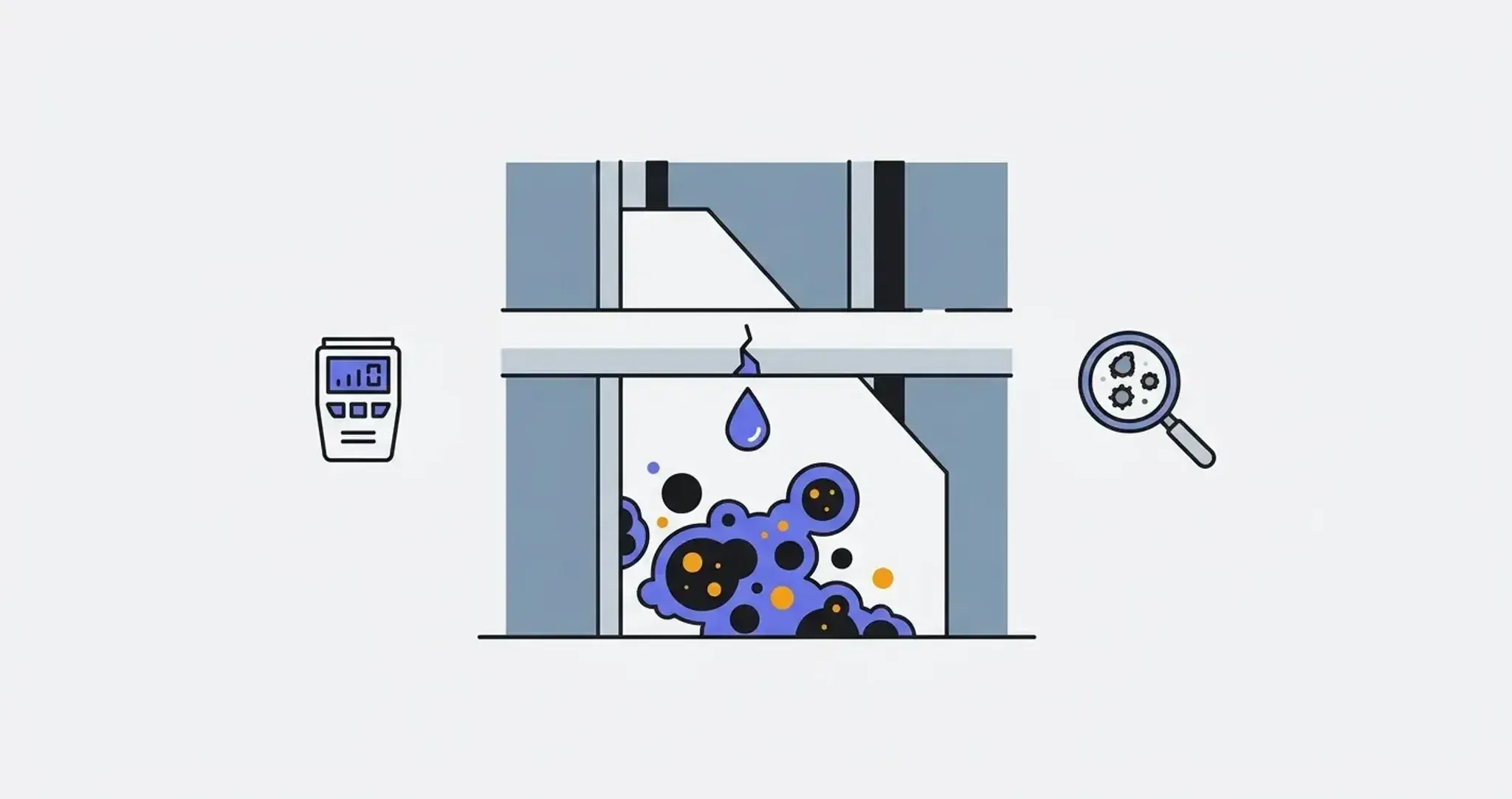

Mold starts growing within one to two days of water exposure. If you've had a leak — burst pipe, roof damage, appliance failure — you're already inside the window where mold can colonize porous materials like drywall, insulation, and carpet. The EPA recommends drying water-damaged areas within one to two days to prevent mold growth in most cases. Once that window closes, growth begins even if you can't see it yet.
The visible black spots on your bathroom ceiling are the easy part. Hidden mold behind walls, in HVAC ducts, under flooring, and in crawlspaces is the bigger risk. A homeowner sees surface mold and thinks the problem is contained. An inspector with a moisture meter and thermal imaging finds the colony inside the wall cavity where the real damage is happening.
Testing from an independent inspector — someone who doesn't profit from remediation — gives you the truth about what's there. Companies that bundle inspection and cleanup have a financial incentive to find mold. Fast Mold Testing tests only — we don't perform remediation ourselves. Same-day or next-business-day inspection in San Francisco, Sacramento, Atlanta, and Denver. Lab results in 1–2 business days via AI-assisted lab analysis, not the 5-14 day industry standard.
How Fast Does Mold Grow After a Water Leak?
Mold can start growing within one to two days after water damage. This timeline comes from EPA guidance on water-damage response, and the CDC echoes the importance of drying wet materials promptly to prevent mold. Visible colonies may take 3-7 days to appear, but colonization begins much sooner — especially in porous materials like drywall, insulation, and carpet padding.
The progression looks like this:
0-24 hours: Moisture spreads into walls, floors, and insulation. Materials absorb water. Mold spores that were dormant in the air start activating when they land on wet surfaces. Growth hasn't started, but the conditions are set.
one to two days: Growth begins. You might not see dark spots yet, but mold is colonizing behind walls, under flooring, in ceiling cavities. This is the critical window. The EPA's water damage response table emphasizes that materials dried within this one-to-two-day window usually avoid mold growth.
3-7 days: Visible colonies appear. Musty odor develops. At this point, surface mold is obvious, but the hidden growth that started 3-5 days earlier is the larger concern.
Why the timeline matters: mold spreads once it starts. A small patch of growth behind drywall can release thousands of spores into the air. Those spores land on other damp materials and colonize there too. Early detection means smaller remediation — if remediation is even needed. Waiting a week to test means the problem is already established.
Sacramento homeowners who book Fast Mold Testing after a water heater leak often note the same thing in their reviews: they got their lab report back in 1–2 business days, while other companies they called quoted 7-10 days minimum. When you're deciding whether to rip out drywall this week or wait, that turnaround difference is what lets you catch growth early instead of letting it spread.
Where Mold Hides After Water Damage
Mold hides where homeowners can't easily see: behind drywall where pipes leaked, inside HVAC ducts, in attic insulation, under flooring, and in crawlspaces. Visible mold on a wall is often just surface growth. The real colony is inside the wall cavity where moisture persists after the leak stopped.
Behind drywall: Water doesn't stay where it lands. A pipe leak in one room can travel horizontally and vertically inside walls, causing mold in an adjacent room's wall cavity. You see a small stain on the ceiling. An inspector finds that the insulation above that stain is soaked and colonized.
HVAC systems: Air handlers, ducts, and condensate drain pans collect moisture. Mold in HVAC is worse than mold in a closet because the system spreads spores throughout the home every time it runs. You're breathing air that's passed over a moldy evaporator coil.
Attics and crawlspaces: Roof leaks, condensation from poor ventilation, and humidity buildup turn these spaces into mold farms. Homeowners don't check attics weekly. By the time someone notices the smell, growth is advanced.
Under flooring: Wood subfloors, carpet padding, and tile grout all absorb water. A ground-floor leak soaks the subfloor. You dry the carpet surface, but the padding underneath stays wet for days. That's where mold grows.
Why this matters for testing: DIY mold test kits sample surfaces you can reach. They don't detect what's behind walls or under floors. A certified inspector uses moisture meters to check inside drywall, thermal imaging to find hidden water damage, and air sampling to measure spore concentration throughout the home. The inspection finds growth before it becomes a visible crisis.
Signs You Have Mold After a Water Leak
Three main indicators: visible discoloration or spots on walls and ceilings, persistent musty odor even after cleaning, and unexplained health symptoms like headaches or respiratory irritation. If moisture persists beyond one to two days after the leak, assume mold is growing even if you can't see it yet.
Visual Indicators
- Black, green, or white spots on walls, ceilings, grout lines, or wood trim. Stachybotrys (black mold) is the species most people recognize, but Aspergillus and Penicillium colonies can be green, white, or gray.
- Water stains that expand over time. A ceiling stain that gets bigger after the leak stopped means water is still trapped inside the material.
- Peeling paint or wallpaper. Moisture underneath loosens adhesives. The paint bubbles or wallpaper curls away from the wall.
Smell
A musty, earthy odor that doesn't go away with cleaning or airing out the room. The smell is concentrated in specific areas — near HVAC vents if the growth is in ductwork, or in one corner of a room if the growth is localized. Smell without visible mold is common. The colony may be inside the wall, and you may be smelling the microbial volatile organic compounds (MVOCs) it releases, though a musty smell on its own isn't proof of mold.
Health Symptoms
The CDC notes that mold exposure is associated with respiratory symptoms, headaches, and allergic reactions in sensitive individuals. Symptoms worsen when you're home and improve when you're away. This pattern suggests an indoor air quality issue.
Not everyone reacts to mold the same way. Infants, elderly adults, people with asthma or immune conditions, and individuals with mold allergies are more likely to experience symptoms. But absence of symptoms doesn't mean absence of mold.
Moisture Persistence
If surfaces are still damp beyond the one-to-two-day window after the leak stopped, mold is likely growing. Run your hand along the baseboard near where the leak happened. Check inside cabinets under the sink. Use a moisture meter to test drywall — surface-dry doesn't mean structure-dry.
When to Get Professional Mold Testing After a Leak
Get professional testing if: the leak happened more than 24 hours ago and materials are still wet, you smell mold but can't find it, you're experiencing health symptoms, you need documentation for an insurance claim, or you're in a tenant-landlord dispute. A lab-certified inspection gives you evidence that holds up.
Timing Triggers
Leak was more than 24 hours ago and you're not sure everything dried. You extracted the water, ran fans, opened windows. But did the drywall dry all the way through? Did the subfloor? A moisture meter tells you. If materials are still holding moisture past the one-to-two-day window, testing confirms whether mold started.
Smell persists after cleaning and drying. You scrubbed the visible mold off the bathroom grout. The musty smell is still there. That means the source is somewhere you can't reach — inside the wall, under the tub, in the HVAC.
Visible mold is present. You already see growth. Testing confirms species and concentration. Species ID matters for two reasons: some species (like Stachybotrys) produce mycotoxins, and knowing what you're dealing with helps you get accurate remediation quotes.
Insurance Claims
Homeowners insurance policies often require documentation of mold presence before covering remediation. A lab report from an independent inspector strengthens your claim. The insurance adjuster wants third-party verification, not just your statement that "there's mold in the basement."
A report from the same company doing the remediation doesn't carry the same weight. That's a conflict of interest. The adjuster knows the remediation company profits from finding more mold. An independent lab report removes that question.
Tenant-Landlord Disputes
If you're a tenant and your landlord caused the leak (failed pipe, delayed repair, ignored prior complaints), you need evidence for habitability claims. We've seen Sacramento tenants in adverse-landlord situations come to us specifically because the landlord's preferred company gave a "no mold" verdict that didn't match what the tenant was seeing and smelling. An independent inspection gives you a lab report that holds up with housing authorities, code enforcement, and tenant-rights attorneys.
Independent Positioning
Companies that profit from remediation have a financial incentive to find mold. The inspector and the cleanup crew work for the same business. More mold found = bigger cleanup project = higher revenue. That's not a bad-actor story. It's a structural incentive problem.
Fast Mold Testing doesn't remediate. We test only — we don't perform remediation ourselves. The only product is the lab report. If mold is there, the report says so. If it's not, the report says that too. You decide what happens next.
Speed Matters
FMT offers same-day or next-business-day inspection across our 50+ service areas, including San Francisco, Sacramento, Atlanta, Denver, and New York. Lab results come back in 1–2 business days via AIHA-LAP accredited lab analysis with AI-assisted reporting. Industry standard is 5-14 days.
When you're deciding whether to rip out drywall, waiting two weeks isn't realistic. Water-damaged materials that sit for a week grow more mold. A 1–2 business day turnaround lets you make the call this week, not next month.
Residential pricing typically runs between $500 and $800 (more for extensive inspections) — transparent pricing, not "call for a quote." Hidden pricing is how competitors upsell once they're in your house.
How to Prevent Mold After a Water Leak
Prevent mold by acting within the one-to-two-day window after water damage: extract standing water immediately, run dehumidifiers to drop humidity below 60%, increase air circulation with fans, remove and discard soaked porous materials, and monitor moisture levels with a moisture meter.
1. Water Extraction (0-24 Hours): Remove standing water with a wet-dry vacuum or call a water extraction service. Blot wet carpets with towels. Move furniture off wet flooring so air can circulate underneath. The goal is to get bulk water out as fast as possible.
2. Dehumidification: Target relative humidity below 60%. The EPA identifies moisture control as the key to mold prevention. Run dehumidifiers continuously until surfaces are dry. If outdoor humidity is lower than indoor, open windows to exhaust moist air. In humid climates (Florida, Gulf Coast, Pacific Northwest), dehumidifiers are essential. Air drying alone won't drop humidity fast enough.
3. Air Circulation: Use fans to move air across wet surfaces. Stagnant air slows evaporation. Point fans at walls, floors, and under cabinets. If you have HVAC, run the system in fan-only mode to circulate air throughout the house.
4. Remove Wet Materials: Porous materials that stayed wet beyond the one-to-two-day window usually need removal: carpet padding (almost always unsalvageable), drywall (if soaked through, cut out the wet section), and insulation (fiberglass and cellulose don't dry effectively once wet). Non-porous materials (tile, metal, hard plastics, sealed wood) can usually be cleaned and dried.
5. Monitor Moisture: Surface-dry doesn't mean structure-dry. Drywall can feel dry to the touch but still hold moisture inside. A moisture meter ($30-$150 at hardware stores) checks moisture content in wood and drywall. Readings above 15-20% mean the material is still wet. Thermal imaging (included in Fast Mold Testing inspections) detects hidden moisture behind walls without cutting holes.
When prevention isn't enough: If you're past the one-to-two-day window, or materials stayed wet too long, prevention isn't the question anymore. Testing confirms whether mold grew and where it's located. A lab report tells you what you're dealing with so you can get accurate remediation quotes — or confirm that no remediation is needed.
The One-to-Two-Day Window Is Real
Mold doesn't wait. Growth starts within one to two days of water exposure. By the time you see visible colonies, the problem is already established. Hidden mold behind walls, in HVAC, and under flooring is the bigger risk.
Testing from an independent inspector removes the guesswork. You find out what's there, where it's located, and what species you're dealing with. No upsell, no remediation pitch, no preferred contractor. Just the lab report.
Fast Mold Testing offers same-day or next-business-day inspection in San Francisco, Sacramento, Atlanta, and Denver. Lab results in 1–2 business days via AIHA-LAP accredited lab analysis with AI-assisted reporting, not 5-14 days. Residential pricing typically runs between $500 and $800 (more for extensive inspections) with transparent pricing — no "call for a quote."
We test only — we don't perform remediation ourselves. The independent model exists because the inspector who profits from finding mold isn't the inspector you want.
Frequently Asked Questions
- How long does it take for mold to grow after a water leak?
- Mold can start growing within one to two days after water exposure, per EPA guidance for water-damage response. Visible colonies may take 3-7 days to appear, but growth begins sooner once porous materials like drywall, carpet, and insulation absorb moisture. The EPA recommends drying materials within this window to prevent growth.
- Can I test for mold myself after a water leak?
- DIY mold test kits ($10-$50) confirm whether something is mold, but they don't identify species, measure air quality, or detect hidden growth behind walls or under floors. If you need a report for insurance, tenant disputes, or want to know what's in wall cavities and HVAC ducts, a certified inspector with lab analysis is the standard. FMT's inspections include air sampling, surface sampling, moisture meters, and thermal imaging.
- Will homeowners insurance cover mold after a water leak?
- Depends on your policy and the leak's cause. Most homeowners policies cover mold if it resulted from a covered peril like a burst pipe or storm damage, and you acted quickly to mitigate. Gradual leaks or maintenance neglect usually aren't covered. A lab-backed inspection report from an independent inspector helps substantiate your claim with the insurance adjuster.
- What's the difference between mold and mildew after water damage?
- Mildew is a surface fungus, usually white or gray, that wipes off easily with cleaning solution. Mold penetrates materials, comes in many species (Stachybotrys, Aspergillus, Penicillium), and requires removal of affected materials in most cases. Both need moisture to grow, but mold is the more serious issue after water damage.
- Should I hire the water damage restoration company to test for mold?
- Companies that profit from remediation have a financial incentive to find mold. The inspector and the cleanup crew are the same business — more mold found means bigger cleanup revenue. An independent inspector who doesn't perform remediation gives you an unbiased report. That's the Fast Mold Testing model: we test only — we don't perform remediation ourselves. You get the lab report, then you decide what to do next.