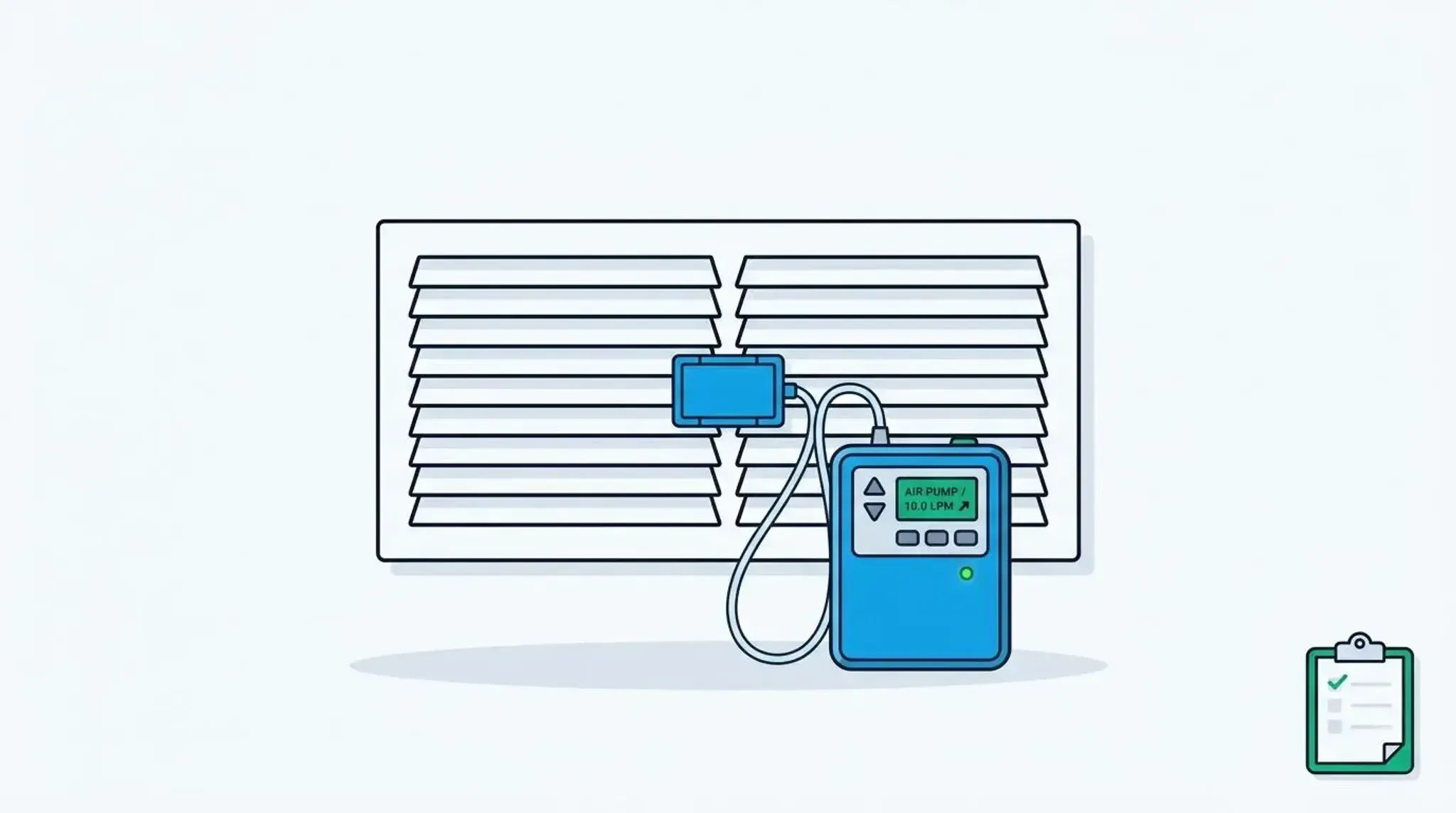

An HVAC mold inspection checks four components — the return air plenum, the air handler interior, the evaporator coil and its drain pan, and the supply ducts plus registers — and pairs that visual walk-through with a calibrated air sample taken at a supply register while the system is running. The point is to find out whether mold is living inside the HVAC, where it is, and whether the system is moving spores into rooms you actually breathe in. We test only. We don't clean ducts and we don't remediate, so the finding is straight either way.
What an HVAC Mold Inspection Actually Covers
An HVAC mold inspection covers four checkpoints — return air plenum, air handler interior, evaporator coil and drain pan, and supply ducts plus registers — plus a comparative air sample taken at a supply register versus an outdoor reference. The four checkpoints get a visual inspection (borescope where the panel doesn't open); the air sample gets lab analysis at an AIHA-LAP (EMLAP) accredited lab.
Here are the four checkpoints in the order an inspector typically walks them:
- Return air plenum — the boxed-in section where the system pulls air back from the house. Often unfinished metal or framed-out drywall; condensation, leaks, and dust accumulation are common here.
- Air handler interior — the cabinet that contains the blower, filter, and (for AC systems) the evaporator coil. Open the access panel, inspect the blower wheel and the cabinet interior. This is the most common HVAC mold reservoir.
- Evaporator coil and drain pan — the AC coil where humidity condenses out of the air, and the pan that catches the condensate. Constantly wet during cooling season. If the pan is clogged or the slope is wrong, water sits.
- Supply ducts and registers — the trunk lines and branches that deliver conditioned air to rooms, plus the slatted registers at room openings. Inspectors check the first few feet of duct interior and the register slats for visible growth.
The visual walk identifies suspect locations; the supply-register air sample answers whether mold is being moved through the system. Both halves matter — visible mold without elevated supply counts is a localized problem; elevated counts without visible mold means the source is hidden somewhere upstream.
Signs Your HVAC System Might Be Hiding Mold
The four most common signs of mold in an HVAC system are a musty smell that intensifies when the system kicks on, visible discoloration on supply register slats, condensation pooling near the air handler, and household symptoms — headaches, congestion, a persistent cough — that worsen with AC use. Any one of these warrants a mold inspection with HVAC scope.
- Musty smell from supply registers. Stand under a register with the system running. If the air smells like a damp basement and the smell weakens with the system off, the source is somewhere inside the HVAC, not the room.
- Visible spotting on register slats. Pull off a return register cover or look closely at a supply slat. Black or dark green spotting on the slat edges is a tell — the same growth is usually upstream in the duct.
- Condensation around the air handler. Water on the floor next to the cabinet, rust on the metal, or a constantly damp drain pan means the system has had wet conditions long enough for mold to establish.
- Symptoms that track HVAC use. Headaches, sinus congestion, or coughing that get worse when the AC runs and ease when it's off are commonly mold-associated. The CDC notes that mold sensitivity varies widely between individuals; an inspection is how you find out whether the trigger is in the HVAC.
None of these signs prove mold is in the HVAC on their own. Two or more together usually means it is.
How Inspectors Sample Air at the Supply Register
A certified inspector places a calibrated air-sampling pump and a spore-trap cassette directly at a supply register with the HVAC running, draws a measured volume of air (typically 75 to 150 liters), and compares the spore count and species against an outdoor reference sample taken the same day. The protocol is what separates a real HVAC mold inspection from a duct-cleaning sales call.
The four-step supply-register sampling protocol:
- Take an outdoor reference sample first. Standing outside the home, draw a measured air volume through a fresh cassette. Outdoor spore counts vary by region, season, and weather; the reference is what makes the indoor result interpretable.
- Sample at the supply register with the system running. Place the pump intake within an inch of the register slats while the HVAC is in active cooling or heating mode. The air the pump captures is the air the system is currently delivering.
- Compare counts and species. A supply-register sample that exceeds the outdoor sample on count, or contains species that aren't in the outdoor sample, indicates a source inside the HVAC. An AIHA-LAP (EMLAP) accredited lab returns spores per cubic meter and species identification.
- Sample additional registers if the first hits. A single positive supply register suggests the source is in a duct branch close to that register. Multiple positives across the house point at the air handler or coil — the common upstream junction.
The U.S. EPA's guide to mold is clear that there is no federal exposure limit for indoor mold, which means a number on a lab report doesn't decide anything on its own. The comparison to the outdoor reference, the species identified, and the inspector's read on where in the HVAC the source likely sits — that's what makes the sample decision-useful.
Where Mold Hides Inside HVAC (Four Reservoirs)
Mold in an HVAC system typically lives in one of four reservoirs — the evaporator coil and drain pan, the air handler interior, the return plenum, or the duct interior near supply registers. Each one stays wet, dark, and rarely opened, which is what mold needs and what a general home inspection rarely checks.
- The evaporator coil and drain pan. During cooling season the coil is condensing water out of the air every time the AC runs. If the drain pan is sloped poorly, the condensate line is clogged, or the coil fins are coated in dust, mold establishes within weeks. This is the single most common HVAC mold reservoir.
- The air handler interior. Dust accumulates on the blower wheel and inside the cabinet walls. Combine that organic film with the humidity coming off the coil and you have growth medium. The access panel is usually screwed shut; a homeowner has to remove it to look, and most don't.
- The return plenum. The plenum pulls air past the filter and into the system. Gaps, leaks, or unfinished interior surfaces collect dust and let humidity in. Mold here is often invisible until a borescope or a removed register cover reveals it.
- The duct interior near supply registers. The first few feet of duct on the supply side run cold during cooling. Where that cold metal meets warm humid air through unsealed joints, condensation forms inside the duct. Mold establishes near the register and can flake into the room every time the system kicks on.
A general home inspector doesn't open the air handler, doesn't borescope ducts, and doesn't take supply-register air samples. That's not a complaint about general inspectors — it's a different scope. An HVAC mold inspection is a separate scope with separate tools.
What an HVAC Mold Inspection Costs and When to Book One
An HVAC-focused mold inspection typically runs the same as a standard mold inspection — starting at our transparent rate at Fast Mold Testing, or $500 to $800 (more for extensive inspections) typical professional range nationally — with HVAC components and supply-register sampling included in the package. The variables are home size, number of supply registers sampled, and whether the air handler is in an attic or crawlspace that needs additional access work.
Book an HVAC mold inspection when:
- Symptoms track HVAC use. Headaches, cough, or congestion that get worse with AC on and ease with it off are the clearest signal that the source might be in the system.
- After water damage near the air handler. A roof leak, a slab-leak, or a condensate line failure that wet the air handler or its closet means the conditions for HVAC mold growth were present.
- A general home inspector flags moisture in the ductwork or air handler. General inspectors flag moisture as a follow-up issue; the follow-up is a mold inspection with HVAC scope. This is also the textbook case during a real-estate transaction with a 1-2 business day deadline.
For renters dealing with HVAC mold in a unit where the landlord is stalling, our tenant-rights mold guide covers what an admissible inspection report has to include for a habitability filing.
The Bottom Line
HVAC is one of the four hidden reservoirs where mold establishes without ever being visible from the room. An HVAC mold inspection finds it by combining a four-checkpoint visual walk with a calibrated supply-register air sample compared to an outdoor reference. Read the report, fix the moisture source first, then decide on remediation — in that order.
If symptoms track HVAC use or you've had recent water damage near the air handler, an inspection is the cleanest way to find out what's actually in the system you're breathing through.
Frequently Asked Questions
- Can mold actually grow inside HVAC ducts?
- Yes — mold grows readily inside HVAC ducts where humidity, dust, and darkness combine. The most common locations are the first few feet of supply duct near a register (cold metal plus humid air equals condensation), the evaporator coil and drain pan, and the air handler interior. A supply-register air sample compared to an outdoor reference is how an inspector confirms it.
- What does mold in air vents smell like?
- Mold in air vents smells musty, earthy, or like a damp basement — most people describe it as similar to wet cardboard or old books. The defining characteristic is that the smell intensifies when the HVAC kicks on and weakens when the system is off. If a room smells musty only when the AC or heat is running, the source is somewhere inside the HVAC.
- Will a duct cleaning fix mold in the HVAC system?
- A duct cleaning alone usually won't fix HVAC mold. The U.S. EPA's duct-cleaning guidance is explicit that duct cleaning has not been shown to prevent health problems, and that if mold is present, the underlying moisture source has to be fixed first. Without addressing the leak, drain-pan clog, or coil-condensation problem, mold returns.
- Does homeowners insurance cover HVAC mold?
- Homeowners insurance sometimes covers HVAC mold, but coverage depends on the cause. If mold resulted from a sudden, covered event — a burst pipe near the air handler, for example — many policies cover the cleanup. Mold from long-term humidity or deferred maintenance is typically excluded. An AIHA-LAP (EMLAP) accredited lab report from an independent inspector strengthens any insurance claim.
- Can I test for mold in my HVAC myself?
- You can run a DIY mold test kit at a supply register, and it will give you a presence-or-absence read for $10 to $50. It won't measure spore concentration per cubic meter, won't compare to an outdoor reference sample, and won't tell you where in the HVAC the source is. For health, insurance, or real-estate decisions, a certified inspection is what those processes recognize.