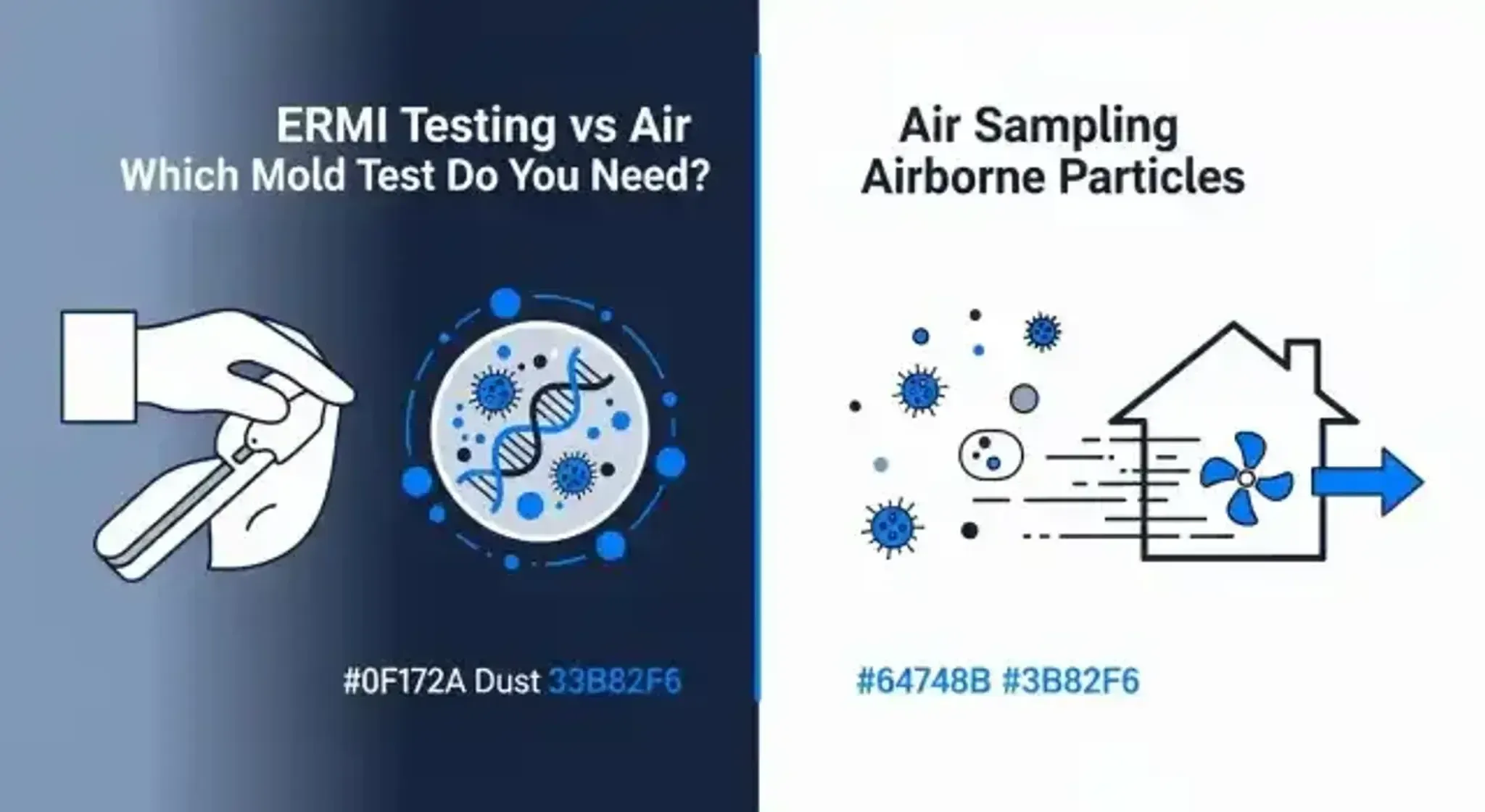

You found mold—or suspect it. The inspector offers two test types: ERMI or air sampling. ERMI tests dust samples for DNA from 36 mold species. It shows what grew in your home historically, even if the mold is no longer visible. Air sampling measures live airborne spores in real time. It tells you what's in the air you're breathing right now. Different purposes, often complementary.
ERMI works best when you need to confirm hidden mold or verify that remediation actually removed the problem. Air sampling works best when you need to know current air quality—especially if you're dealing with respiratory symptoms or HVAC contamination. In some cases, you need both.
Here's how to pick the right test.
What ERMI Testing Actually Measures
ERMI stands for Environmental Relative Moldiness Index. It's a qPCR-based DNA analysis of household dust that tests for 36 mold species. ERMI was developed by researchers at the EPA as a research tool for tracking mold patterns across housing stock. The EPA does not validate or endorse ERMI for residential or clinical diagnostic use—it remains a research methodology that some labs offer as a consumer test.
An ERMI test doesn't measure live mold. It measures genetic material left behind by mold growth—DNA that persists in dust even after the mold itself is dead or removed. This makes ERMI useful for detecting hidden mold growth and for verifying post-remediation cleanup.
The 36-species panel is divided into two groups:
- Group 1 (26 species): Water-damage indicators like Stachybotrys chartarum, Aspergillus versicolor, and Chaetomium globosum. These species grow indoors when water intrusion or chronic moisture is present.
- Group 2 (10 species): Common background molds like Cladosporium and Penicillium that occur naturally in most indoor and outdoor environments.
Your ERMI score is calculated as Group 1 minus Group 2. A higher score suggests greater water-damage mold presence relative to background molds. ERMI scores are typically interpreted on a quartile scale—homes in the upper quartile generally show more water-damage indicator species than homes in lower quartiles. EPA's original ERMI work was based on housing-stock comparisons, not a clinical diagnostic threshold, so any single "cutoff" number you see in marketing material should be treated as interpretive, not validated.
ERMI doesn't give you real-time air quality data. It doesn't tell you whether mold spores are airborne at the moment of testing. And because the test relies on dust collection, results can vary depending on where and how the dust sample is taken. But for historical exposure and hidden mold detection, ERMI is one of the most comprehensive DNA-based tools available.
What Air Sampling Measures
Air sampling measures the concentration of live mold spores in the air at the time of the test. A certified inspector uses an air sampling pump to pull a known volume of air through a collection cassette. The lab analyzes the sample to count spore concentrations and identify spore types.
Air sampling gives you a snapshot of what's airborne right now. Unlike ERMI, which looks at accumulated DNA in dust, air sampling tells you whether mold spores are circulating in the air you're breathing. This makes it the right test when respiratory symptoms, HVAC contamination, or immediate air quality are your primary concerns.
The air sample goes to an AIHA-accredited lab for analysis. AIHA-LAP is the American Industrial Hygiene Association's Laboratory Accreditation Program, whose scope covers microscopic exam of spore-trap cassettes and culturable fungi—exactly what air sampling produces. At Fast Mold Testing, we use AI-assisted lab analysis to accelerate spore-type identification—air sample results in 1–2 business days after inspection instead of the 5-14 day industry standard.
The lab reports spore concentration in spores per cubic meter (spores/m³) and identifies spore types based on spore morphology. Most inspectors take both an indoor sample and an outdoor baseline sample. If your indoor spore count is significantly higher than outdoor, or if spore types linked to water damage appear indoors but not outdoors, that's a red flag.
Air sampling has limitations. It's a moment-in-time measurement. Spore counts fluctuate based on temperature, humidity, HVAC operation, and whether windows are open. A sample taken at 2 PM on a dry day may look different from a sample taken at 9 AM after a humid night. And if mold is hidden behind drywall or growing in a closed HVAC plenum, air sampling may miss it—unless spores are actively being released into the air.
ERMI vs Air Sampling: Key Differences
The two tests serve different purposes. ERMI looks backward at what grew over time. Air sampling looks at what's airborne now. Here's how they compare:
| Factor | ERMI Testing | Air Sampling |
|---|---|---|
| Sample Type | Settled dust | Airborne spores |
| Species Coverage | 36 species DNA panel | Spore-type ID based on spore morphology |
| Timing | Historical (shows what grew over time) | Real-time (shows what's airborne now) |
| Turnaround Time | Longer than air sampling at FMT (DNA sequencing has fixed biochemical timing) | 5-14 days (industry standard); 1–2 business days at FMT with AI-assisted lab analysis |
| Typical Cost | $200-$300 add-on to a standard residential inspection | Included in a standard residential inspection |
| Best Use Cases | Hidden mold detection, post-remediation verification, chronic health symptoms | Real-time air quality, HVAC contamination, visible mold spore-type ID, baseline before remediation |
| Limitations | Not real-time; dust collection variability; doesn't measure airborne exposure | Moment-in-time; fluctuates with weather/HVAC; may miss hidden mold |
| Lab Accreditation | Qualified DNA-analysis (qPCR) lab | AIHA-accredited lab |
Both tests use lab analysis; ERMI identifies species and air sampling identifies spore types. The choice comes down to whether you need historical evidence or current air quality data—or both. Note the turnaround difference: air sampling can come back in 1–2 business days at FMT, but ERMI is gated by the qPCR DNA-sequencing step, which has fixed biochemical timing no lab can shortcut.
When to Use ERMI Testing
Use ERMI when you need to confirm what mold species have been growing in your home over time, even if the growth is no longer visible or active. The test detects DNA in household dust, which accumulates from both visible and hidden mold sources.
Post-remediation verification. After a remediation company cleans up mold, an ERMI test can confirm the cleanup actually worked. Because ERMI detects residual DNA, a post-cleanup ERMI score should drop significantly if the water-damage molds were removed. If the score stays high, the cleanup was incomplete.
Hidden mold search. Mold grows behind drywall, under flooring, in HVAC plenums, and in crawlspaces. You can't see it, but DNA from those hidden colonies accumulates in household dust. ERMI can flag water-damage species presence even when you don't know where the growth is.
Chronic health symptoms with no visible mold. If you or your family have persistent respiratory symptoms, headaches, or fatigue that improve when you leave the house, ERMI can help confirm whether water-damage mold species are present—even if you can't find the source. The CDC reports that mold exposure is associated with respiratory symptoms, especially in people with asthma or mold sensitivity.
Tenant disputes where exposure timeline matters. In habitability cases, landlords sometimes argue that mold appeared recently or that the tenant caused it. An ERMI test documents which species are present and can support a case that long-term water damage created the conditions. California Civil Code 1942.5 and similar tenant-protection statutes in other states allow tenants to use independent lab reports as evidence in housing authority complaints.
Homes with prior water damage. If your home had a roof leak, basement flood, or burst pipe in the past—even if it was cleaned up—ERMI can confirm whether water-damage mold species established a foothold.
ERMI won't tell you whether those species are actively growing now. It won't tell you whether spores are in the air. But if the question is "what species have been here?" ERMI is the most comprehensive answer.
When to Use Air Sampling
Use air sampling when you need to know what's in the air right now—especially if respiratory health, HVAC contamination, or immediate air quality is the concern. Air sampling measures live spore concentrations, not historical DNA.
Real-time air quality assessment. If you're experiencing respiratory symptoms—coughing, wheezing, sinus congestion—and you need to know whether mold spores are airborne at a level that explains those symptoms, air sampling gives you that data. Indoor spore counts higher than outdoor baseline suggest an indoor source.
HVAC system contamination. Mold growing in air handlers, ductwork, or cooling coils releases spores every time the system runs. Air sampling near supply vents can detect HVAC-related contamination that wouldn't show up in a dust sample.
Visible mold species identification. You found a patch of black mold on the bathroom wall. Is it Stachybotrys chartarum (a water-damage species) or Cladosporium (a common outdoor mold that's typically olive-green to brown-black)? Air sampling near the growth site, combined with surface sampling, can identify the species and inform cleanup strategy.
Baseline before remediation. Taking an air sample before remediation starts documents starting conditions. A post-remediation air sample can then confirm spore counts dropped. This is standard practice for larger remediation projects and for projects where post-cleanup verification is contractually required.
Immediate health concerns. If a family member has asthma, immune compromise, or severe mold sensitivity, air sampling tells you whether airborne spore concentrations are high enough to trigger symptoms. ERMI can't answer that question—it doesn't measure airborne exposure.
Air sampling has a shorter evidence window than ERMI. If mold was growing three months ago but has since dried out and stopped releasing spores, air sampling may come back clean even though the dead mold is still in the wall. For that scenario, ERMI is the better test.
When You Need Both
Some situations call for ERMI and air sampling together. The combination gives you historical context plus current air quality—a complete picture of both what grew and what's airborne now. Just keep the turnaround difference in mind: your air-sampling results can land in 1–2 business days, while the ERMI portion will follow later because of the DNA-sequencing step.
Water damage events. After a flood, burst pipe, or major leak, you want to know two things: what mold species grew in the walls and subfloor (ERMI), and whether those species are releasing spores into the air now (air sampling). ERMI shows the extent of hidden colonization. Air sampling shows whether the air is safe to breathe while you plan remediation.
Pre-purchase home inspections. Buyers purchasing a home with visible moisture issues, prior water damage, or a musty smell often request both tests. ERMI documents what species are present. Air sampling documents current air quality. Together, they give the buyer leverage to negotiate repairs or price reductions—and evidence to walk away if the problem is worse than disclosed.
Tenant-rights cases requiring comprehensive lab reports. When a tenant is filing a habitability complaint with a housing authority or breaking a lease due to mold, landlords often challenge the evidence. A combined ERMI + air sampling report is harder to dispute than a single test. ERMI documents species presence. Air sampling documents current air quality impact. California tenants in particular often pair these reports with citations to Civil Code 1942.5, which establishes habitability rights and remedies. (Note: California's SB 655 (2015, Mitchell) added visible mold to the list of substandard housing conditions under Health & Safety Code § 17920.3—that affects when mold is a habitability violation, but doesn't speak to testing methodology or lab reports.)
Post-remediation with ongoing symptoms. Remediation is finished. The contractor says the mold is gone. But you're still coughing. ERMI verifies the cleanup removed water-damage mold DNA. Air sampling verifies current spore counts are back to normal. If ERMI scores dropped but air sampling still shows elevated counts, the source may be HVAC contamination or a second hidden growth site.
Fast Mold Testing offers combined ERMI + air sampling packages. Residential pricing typically runs between $450 and $800 (more for extensive inspections). Air sample results in 1–2 business days after inspection via AI-assisted lab analysis; ERMI results follow later because of the qPCR sequencing step.
Cost Comparison
A standard residential mold inspection typically runs between $450 and $800 (more for extensive inspections)e included. Air sampling—usually one indoor sample plus an outdoor baseline—is part of the standard inspection at most reputable inspectors.
ERMI is generally priced as an add-on rather than a standalone product. Expect roughly $200-$300 on top of a standard residential inspection, which covers the dust sample kit, qPCR analysis of all 36 species, and ERMI score calculation. Some DIY ERMI mail-in kits exist for less, but you're collecting the sample yourself, and collection technique materially affects the result.
A combined ERMI + air sampling inspection from a single provider typically lands at the upper end of the $450–$800 range (more for extensive inspections). That's usually cheaper than commissioning the two tests separately and gives you both historical and real-time data from one visit.
Fast Mold Testing publishes transparent pricing on the website—no "call for a quote," no bait pricing. Residential inspections, ERMI add-ons, thermal imaging, and surface sampling are listed with prices so you can budget before booking.
Why transparent pricing matters: companies that bundle inspection and remediation have a financial incentive to find mold. Companies that hide pricing until you're on the phone have a sales incentive to upsell. Fast Mold Testing tests only—we don't remediate. The pricing is published because the business model is built on trust, not upsell.
As one Sacramento homeowner put it in a Google review: "The pricing was transparent and affordable and they never tried to upsell me."
Conclusion
ERMI testing measures mold species DNA in dust—historical evidence of what grew in your home over time. Air sampling measures live airborne spores—real-time data on what's in the air right now. Neither test is better. They answer different questions.
If you need to verify that remediation worked, detect hidden mold, or document exposure in a tenant dispute, ERMI is the right test. If you need to assess current air quality, identify visible mold spore types, or measure HVAC contamination, air sampling is the right test. If you're buying a home with water damage history or dealing with a complex mold situation, both tests together give you the full picture.
Book a conflict-free mold inspection with Fast Mold Testing. Residential pricing typically runs between $450 and $800 (more for extensive inspections)e results in 1–2 business days; ERMI results follow later because of the qPCR sequencing step. We test only—no remediation, no upsell. The inspector's job is to tell you what's there. What you do next is up to you.
Find certified inspectors in 50+ service areas across the country or read more mold testing guides.
Frequently Asked Questions
- How accurate is ERMI testing compared to air sampling?
- ERMI is highly accurate for detecting mold species DNA in dust. It identifies 36 species with lab-grade precision. Air sampling is highly accurate for measuring airborne spore concentrations at the moment of the test. Neither test is inherently more accurate—they measure different things. ERMI measures historical presence; air sampling measures current airborne exposure.
- Can I do ERMI or air sampling myself with a DIY kit?
- Yes, DIY ERMI kits and air sampling kits exist, typically $100-$300. You collect the sample and mail it to a lab. The limitation is sample collection technique. ERMI results vary based on where and how dust is collected. Air sampling requires calibrated pumps and precise flow rates. A certified inspector knows where to sample, how to avoid contamination, and how to interpret results in context. DIY kits answer 'is mold present?' but not 'where is it growing?' or 'is this a problem?'
- How long does lab analysis take for each test type?
- Air sampling typically takes 5-14 days at most labs. Fast Mold Testing uses AI-assisted lab analysis to accelerate air sample turnaround to 1–2 business days. At FMT, ERMI results take longer than air sample results, because the qPCR DNA sequencing process has fixed biochemical time requirements that AI can't compress. If you need results fast, air sampling is the faster test.
- Do ERMI and air sampling test for the same mold species?
- Partially. ERMI tests for a fixed panel of 36 species. Air sampling identifies spore types based on spore morphology, which can detect molds outside the ERMI panel. Some overlap exists—Stachybotrys, Aspergillus, Penicillium, and Cladosporium appear in both. But ERMI won't detect species outside the EPA's 36-species panel, and air sampling may not detect low-airborne species that show up in ERMI dust analysis.
- Which test does the EPA recommend?
- ERMI was developed by EPA researchers as a research tool for tracking mold patterns across housing stock—EPA does not validate or recommend ERMI for residential or clinical diagnostic use. The EPA's public guidance is that any mold growth in a home should be cleaned up regardless of species. Air sampling is the industry standard for measuring airborne exposure and is the test most often relied on in residential inspections.
- Can ERMI detect mold that air sampling would miss?
- Yes. If mold is hidden behind drywall, under flooring, or in a closed HVAC plenum and not actively releasing spores, air sampling may come back clean. ERMI detects DNA in settled dust, which accumulates even from hidden growth sites. This is why ERMI is often used for hidden mold searches when occupants have symptoms but no visible mold is found.
- What happens if my ERMI score is high but air sampling is normal?
- This suggests historical mold growth that is no longer actively releasing spores. The DNA persists in dust, but the mold itself may be dead, dried out, or contained. You still need to locate and remove the source—dead mold can become airborne if disturbed during renovation or demolition—but the immediate air quality risk is lower. A certified inspector can use thermal imaging and moisture meters to locate the hidden source.