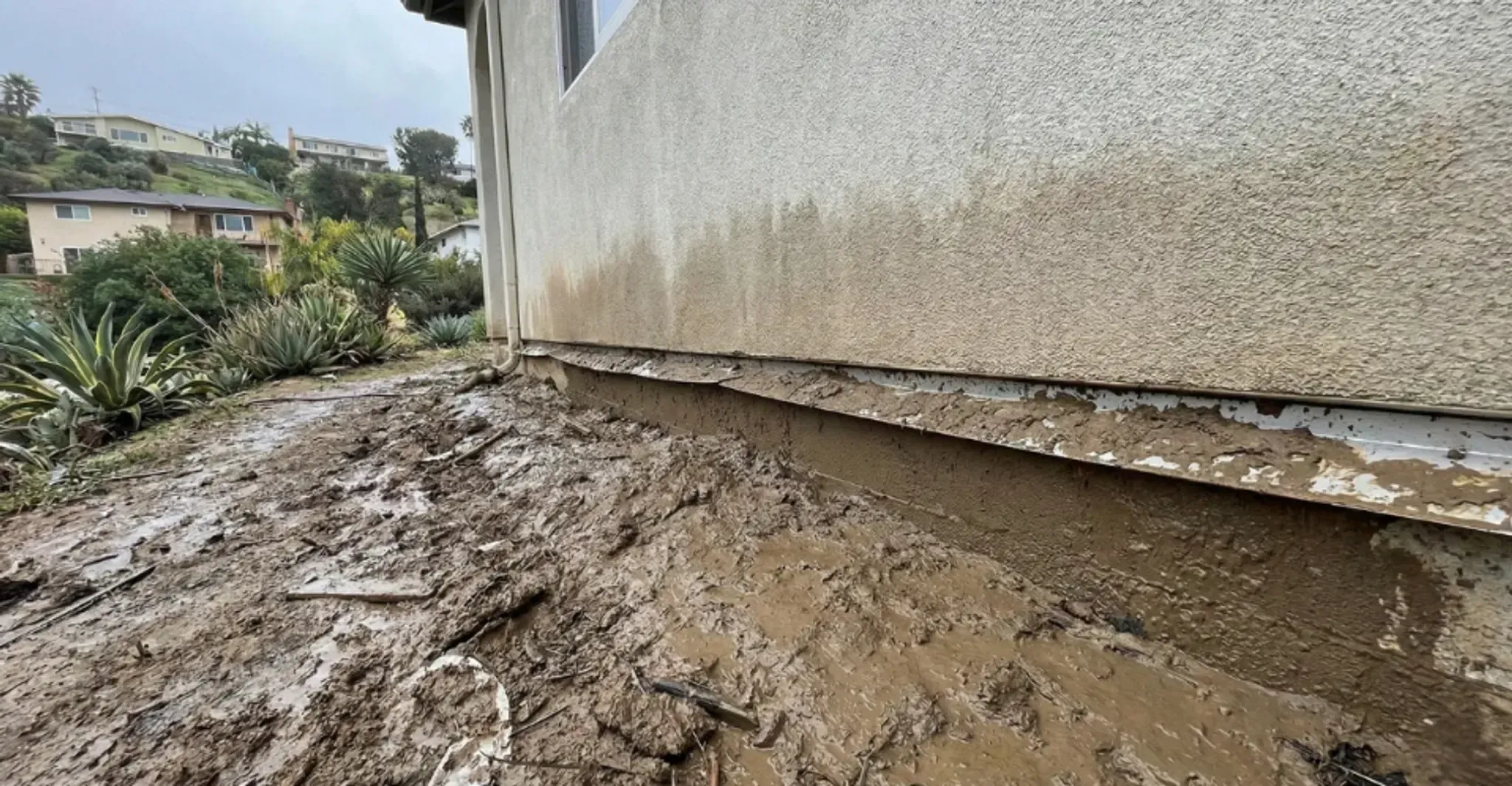

The January 2026 storms did more than just bring rain to LA hillside homes. They brought mud. Thick mud mixed with soil moved down canyons and piled up against homes from Pacific Palisades to Highland Park. People now have a moisture problem that is not like clear water floods. Mud does not drain away. It does not dry fast. It sticks to foundations like wet cement and keeps walls wet for weeks.
This makes it easy for mold to grow. Regular flood cleanup does not solve this problem.
Why Mud Creates Worse Problems Than Water
Clear water pushes with weight. A wall with five feet of water against it feels this force. Mudflows are about twice as thick as water. Studies show mudflows usually weigh between 1,700 and 2,000 kilograms for every cubic meter. Water weighs 1,000 kilograms for every cubic meter. So, mud sitting five feet high presses with more than two times the force of water at the same height.
When mud pushes hard against concrete, wetness gets deep inside. The hit is quick, but problems show up later. Water can flow away in a few days. Mud does not move fast. It becomes thick and sticks. Mud stays tight against your home's base. This heavy wetness sticks around for weeks, even after the rain ends.
The filter cake comes from mud with fine clay pressed against concrete. Water goes through the tiny holes in the concrete, but the clay particles do not go in because they are too big. These clay pieces gather on top and make a thick layer that keeps the water out.
Bentonite clays common in LA are very good at doing this. When they get wet, these clay particles grow bigger. They line up, close together, to build a tight seal on the surface.
This seal helps in two ways. First, it pushes water deep into your foundation by using high pressure. Second, after it's made, the seal keeps out vapor from the outside of your wall. Mud won't drain out because it is thick. It can't dry up because the seal doesn't let it. The result is a wet pile of mud that stays next to the concrete for weeks. It keeps sending moisture into your home even after the mud on top has dried.
The Weep Screed Problem in Stucco Homes
Most homes on hills in LA use stucco walls. Stucco can soak up a lot of water. There is a building code that says you need a weep screed at the bottom of every stucco wall. This flashing with small holes helps out. Water goes inside stucco. It then drains out from those holes and does not soak into the wood.
Mudflows can cause a lot of harm. When mud goes above the base of a building, it covers the screed. Thick mud blocks the holes. A filter cake forms a seal on the holes. Water from rain that comes after has no way out. It stays at the bottom of the wall because it cannot leave.
This is when the straw effect begins. Buried stucco cannot drain water. It pulls water in instead. Concrete and stucco have tiny holes. These holes bring water up, even though gravity tries to stop it. The stucco acts like a straw. It takes water from the wet mud under it. The mud holds a lot of water. Stucco keeps pulling this water up all the time.
When there is more moisture, the wood frame gets wet. If the wood goes over 20 percent moisture, it will start to rot. Sometimes, weep screeds get blocked and water moves up into the wood. This can make the frame rot months after the mudflow, even if the stucco on the outside looks dry.
Wicking also draws salts from the soil into the wall. When moisture dries on the inside, salts turn into crystals. These crystals get bigger and crack the stucco from inside.
When to Test After a Mudflow
The 1-2 business days rule for clear water does not include mudflows. A big change happens quickly, but water keeps coming in for weeks. You need to test things at different times.
Test during the first week to record the first damage. Thermal imaging shows which walls got hit the most. Moisture meters tell how far water got in. This starting point helps us see how much cleanup there will be.
Test again in three to four weeks. This helps find if a filter cake is making things worse. Walls that looked dry at first may start to feel wet again. That happens because sealed mud keeps leaking water. At this time, air tests might show mold. Stucco that stays wet on the inside will help mold grow.
Final testing between eight and twelve weeks shows if the moisture is back to normal after cleanup. A lot of people feel that scraping off mud they can see will fix the problem, but that is not true. Air quality tests can find hidden mold that may have grown when things were still wet.
What Pro Testing Includes
Most damage can’t be seen by just looking at the walls. The real trouble is often inside the walls or behind the stucco. Pro testing finds this by using special tools.
Moisture meters with deep probes go into stucco to read the wood inside. Readings from 16 to 20 percent or more show there is a risk for mold. Cameras that read heat show wet spots in the whole wall. These help us see the places where mud closed up the area by the foundation and where water still moves up.
Air testing plays a big part. Spore traps pick up mold that is in the air. A lab will look at what types are there and count them. You can see how much mold is inside compared to outside. This tells you if you have too much mold inside. Homes on hills often have some mold from the environment. Testing helps you know what normal mold looks like and what comes from mudflow.
Surface samples help find trouble areas. Swabs or tape lifts can tell what mold types be there during wet times. This shows if harmful molds like Stachybotrys be in the spot.
Common Questions About Mudflow Testing
How is mudflow different from flood testing?
Mud is about two times as thick. It pushes on things with two times more force. It will not let water drain out. The layer of mud on top locks in wetness for weeks.
Can I just wash the mud off?
No, surface mud is not the main issue. Water that goes deep into concrete keeps hurting it, even if you clean the top. Checking with tests helps us know what is inside the walls.
What if stucco looks dry?
Stucco may look dry, but there can still be moisture stuck behind it. When the weep screeds get blocked, the wall cannot dry like it should. Pro meters help you find water that you cannot see.
How much does testing cost?
You will need to pay about $500 to $800 (more for extensive inspections) for full testing. This price covers moisture mapping, heat checks, and air samples.
When should I test?
Start by testing in the first week for a baseline. Do another test at three to four weeks to catch any delayed moisture. Do the last test after you clean up.
Protect Your Hillside Investment
Mudflows can cause moisture problems that last longer than rain. High density impact, filter cake sealing, and weep screed failure let water get into your foundation. This means your foundation may still have moisture weeks after you cleaned up the mud you saw. The only way to be sure if hidden mold grew behind your walls is to get pro testing.
Book your mold testing in Los Angeles with Fast Mold Testing. The team uses gear made for cleaning up after mudflows. You can get results in 1-2 business days. Make sure you protect your hillside home before hidden water leads to costly damage.
Related reading
Frequently Asked Questions
- How do Los Angeles mudflows and hillside runoff create indoor mold problems?
- LA mudflows force saturated soil against foundation walls and beneath slab edges, pushing moisture into the building through cracks, weep holes, and utility penetrations. Hillside homes also experience lateral soil pressure that keeps foundation walls in a state of chronic dampness after rain events. This subslab and foundation moisture feeds mold at floor level and inside wall bases that drying equipment cannot reach.
- Which Los Angeles neighborhoods are at highest risk for mudflow-related mold?
- LA hillside neighborhoods at highest mold risk from mudflows include Bel Air, Laurel Canyon, Topanga, Altadena, and areas above Pacific Palisades. Homes built on cut-and-fill pads, with downhill retaining walls, or at the base of natural drainage channels are especially vulnerable after heavy rainfall events. A professional mold inspection with foundation moisture mapping from Fast Mold Testing is the only way to accurately assess the risk in a specific property.
- How much does a mold inspection cost in Los Angeles for a hillside home after mudflow damage?
- Mold inspections in Los Angeles for hillside homes after mudflow events typically cost between $500 and $800 (more for extensive inspections). Fast Mold Testing starts at our transparent rate with results in 1 to 2 business days. The inspection focuses on foundation perimeter moisture mapping, floor-level wall readings, and subfloor moisture that are the signature of mudflow-related water intrusion.
- Should Los Angeles hillside homeowners get a mold inspection every year after rainy season?
- Yes. LA hillside homes face cumulative moisture exposure from seasonal rains that can gradually saturate soil and building assemblies over multiple wet seasons. Annual post-rainy-season inspections from Fast Mold Testing catch developing moisture problems before they produce significant mold growth, which is far less expensive than addressing fully developed mold contamination after several wet seasons of accumulation.