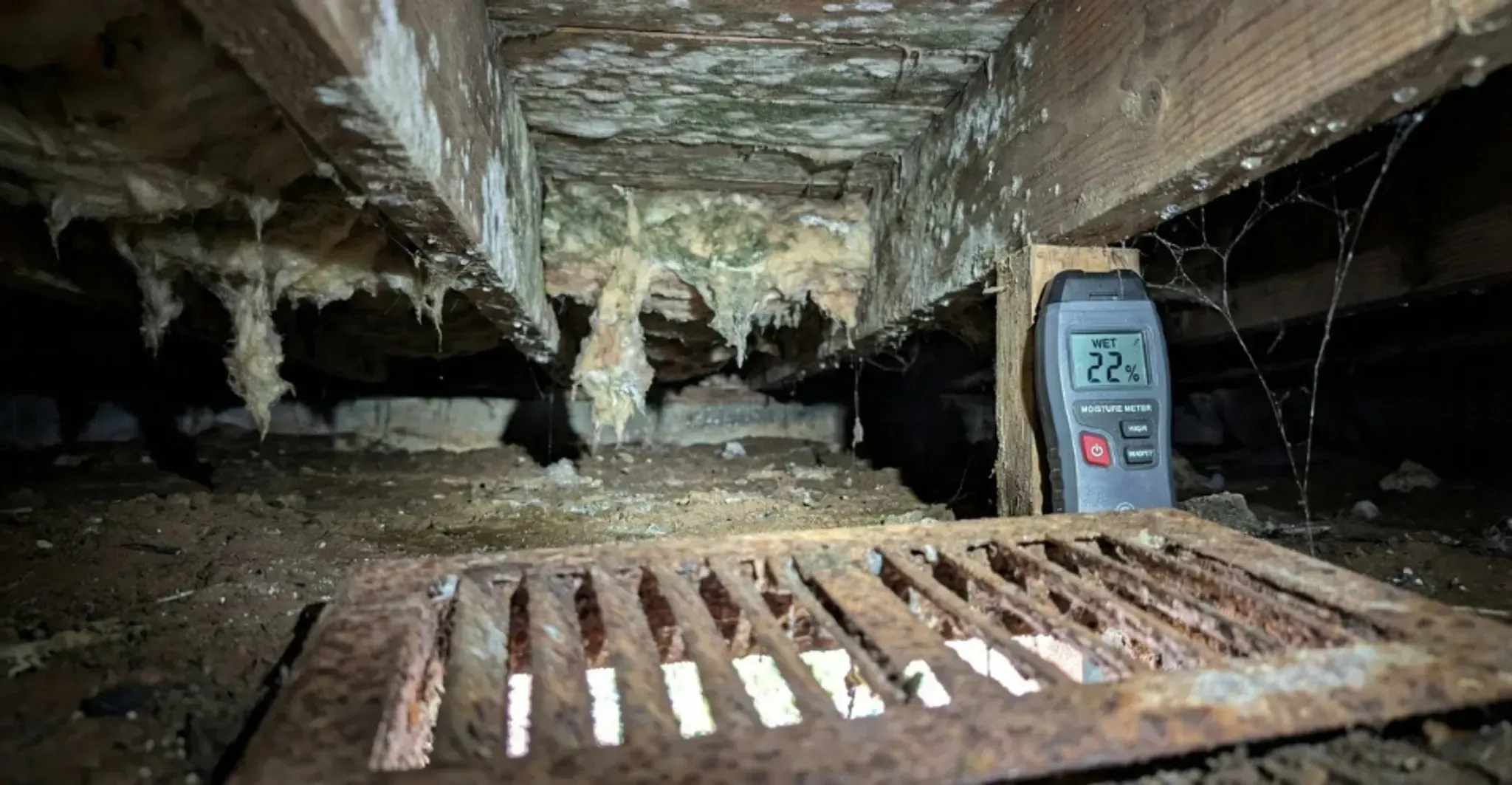

Atlanta homeowners often notice a musty smell in their living rooms. Most people think the problem starts on the first floor. But experts sayup to 50 percent of the air you breathe on the first floor comes from the crawlspace. This is because of something called stack effect. It’s a natural way that air gets pulled from the crawlspace right into your living areas. If the crawlspace is wet and has mold, you are breathing in those spores daily.
The main issue is that old-style crawlspaces with vents can cause more moisture in Atlanta, where it is often humid. Letting air in does not dry the crawlspace. It makes it wetter.
The Stack Effect Explained
To know why crawlspace moisture is a problem, you need to see how air moves in your home. How air flows in and out can have an effect on the whole house. This is why it is good to learn about crawlspace moisture.
Pressure Physics
Warm air is lighter than cold air. This means in the summer and when you heat your home, warm air will move up and leave out the attic vents. As the warm air goes out at the top, it makes the air pressure lower at the bottom of the house. The house needs to pull in new air to make up for the air that got out.
The new air comes in through the lowest spot where there is a leak. This spot is the crawlspace. The air gets inside through holes made for plumbing, wires, and duct boots.
The 50 Percent Rule
Studies on building science show that up to half of the first floor air in a home with a vented crawlspace comes from the crawlspace. This goes on all the time.
If your crawlspace is wet, smells bad, or has soil gases, these can get pushed into the living area because of stack effect. A musty smell in the living room almost always comes from the crawlspace. It is not a problem with the living room itself.
Why Vented Crawlspaces Fail
In the past, building codes said you need vents to help dry out crawlspaces. The rule was to have one square foot of vent for every 150 square feet of floor. But in Georgia, where it is very humid, this practice can actually make the space more wet.
Soil Temp vs Air Temp
The earth’s temperature in an Atlanta crawlspace stays steady. Deep in the soil, it is usually between 55 and 60 degrees. Near the surface during summer, it can reach about 65 degrees. But in the Atlanta summer, the air often gets up to 90 degrees or more. The dew point can be close to 74 or 75 degrees.
Condensation Problem
When the ventilation brings hot and wet Atlanta air into a cool crawl space, some change starts. The air inside can be about 90 degrees, and its dew point can be 75 degrees. When it comes in through the vent, the air meets floor joists and ductwork. These parts are kept cool by the HVAC and by the earth, both at about 68 degrees.
Because the surface temperature is 68 degrees, and this is less than the air's dew point at 75 degrees, condensation is immediate. The air cannot keep water vapor. This makes water form on the wood structure.
Humidity Math
When you cool air, its relative humidity goes up. For each 1 degree drop in temperature, the relative humidity goes up by about 2.2 percent. If you cool air from 90 degrees to 70 degrees, and it started at 60 percent humidity, the humidity will reach 100 percent. This is called saturation.
The result is that ventilation does not dry the crawlspace. It makes it wet. Water droplets often form on the insulation in Southern crawlspaces that have vents.
What Happens to Wet Wood
Wet floor joists and subfloors can make a good place for mold to grow. There is something in wood called cellulose that mold eats. Water from the air can give the moisture that mold needs. A dark space makes it even better for mold to grow.
Mold can start to grow on the joist surfaces after just 48 hours of steady moisture. When these groups grow bigger, they send out spores into the crawlspace air. Then, stack pulls these spores up into your home through every small gap in the floor.
Moisture that stays around for a long time can cause wood to rot. This makes the wood weak. Sometimes, the floor under your feet gets soft. Over time, parts like floor joists may break. This can lead to costly repairs.
Georgia's Code Shift
Georgia saw that vented crawlspaces were failing. So, the state changed its building codes to support using encapsulation instead.
What Encapsulation Involves
Encapsulation closes off the crawlspace from outside air. The vents are sealed. A thick vapor barrier, usually 10 to 20 mil, goes up the foundation walls. The seams are sealed. After this, the crawlspace turns into a small basement.
The 2020 and 2024 Georgia Amendments to code say that unvented crawlspaces are okay if there is a vapor retarder in place. You also need to have a way to control the air inside.
Mechanical Ventilation Needed
Because an encapsulated home does not let air in or out, you need a machine to handle moisture. In Georgia, the law says you must use a whole-house fan system in homes that do not let much air come in.
In an encapsulated crawlspace, this is often done by using a supply duct from the main HVAC system or by having a dehumidifier run in the space to keep it dry. The goal is to keep the crawlspace at less than 60 percent RH all year.
Termite Rules
Georgia has a rule to help with termites. Even for closed crawlspaces, you must leave a 3-inch strip open at the top of the wall. The open strip should be easy to see. It is there so inspectors can look for termite tunnels that may be behind the insulation. Termites are common in Georgia, so it is very important to let people get to this spot for checks.
Testing Before and After
Pro testing shows encapsulation works.
Baseline Testing
Before you seal off the crawlspace, check the air and moisture in it. A normal vented crawlspace in Atlanta gets between 70 and 85 percent humidity in the summer. When you test the air, you see there are many types of mold in the crawlspace.
Moisture meters on floor joists often show between 18 and 25 percent wood moisture. If the reading is above 16 percent, mold can start to grow and stay active.
Post Work Checks
After you wrap up the area the right way and dry it out, the RH should stay between 50 and 55 percent all year. A moisture check on wood should read less than 14 percent. When you test the air, the spore counts need to be the same as the baseline outside. This will show that the source of the problem is gone.
Cost vs Benefit
Encapsulation is not cheap. In Atlanta, crawlspace encapsulation usually costs between $3,000 and $8,000. The price depends on the size and condition.
But think about this with the ongoing costs of a vented crawlspace. You have to use the dehumidifier every year if you want to deal with moisture by machine and leave the vents open. There will also be some times you need to clean up mold when you see it grow. Over time, you might need repairs when things like joists start to rot. This can change the indoor air and hurt the health of your family.
Encapsulation does not just cover up a problem. It solves it for good. The energy you save on heating and cooling because of less HVAC use can help make up some of the install cost in just a few years.
Atlanta Moisture Factors
Atlanta gets a lot of rain through the year. The clay soil in the area does not let water flow through very fast. Because of this, water stays in the ground for a long time. This keeps the soil wet, and that puts more moisture in the crawlspace.
Homes in Atlanta built from the 1950s to the 1980s came before there was much knowledge about how to handle water in and around a house. A lot of them have little or no plastic or other vapor barriers in the crawlspace. Some homes also have gutters that are broken or not finished, which makes water from the roof flow close to the base of the house.
All these things work together to make crawlspace moisture in the Atlanta area worse than in places where it is not as wet.
Red Flags Your Crawlspace Has Problems
There are several signs that show there may be moisture in the crawlspace. These signs mean you need to take care of the problem.
Musty smell on the first floor, mostly near the outside walls or in closets. The floor feels soft or spongy in some spots. You can see mold on the baseboards or at the bottom of the drywall. Humidity levels stay high inside the home, even when the AC is on. Water forms on the windows when it is humid.
If you see any of these signs, you should get a pro crawlspace inspection. The expert will do moisture testing and check air quality.
Protect Your Atlanta Home
Atlanta’s humidity means vented crawlspaces are not useful now. The way heat and air work shows that vented crawlspaces get wetter, not dry. A steady flow of bad air from your crawlspace moves into your house because of how air rises.
Encapsulation that follows Georgia building code changes gives you a long-lasting fix. A sealed vapor barrier, mechanical dehumidification, and regular check-ups help with this. These steps create a dry crawlspace to keep your home's structure safe and good for your family's health.
Book a crawlspace checkup with Fast Mold Testing for a simple moisture test and air check. This helps you see if it is time to get encapsulation done.
Frequently Asked Questions
- Why do vented crawlspaces fail to prevent mold in Atlanta's humid climate?
- Vented crawlspace design was developed for dry climates where outdoor air helps remove moisture. In Atlanta, outdoor air is frequently more humid than the crawlspace air, especially in summer. Opening vents draws warm, humid air into the cool crawlspace where it condenses on joists, subfloor sheathing, and insulation, creating exactly the wet conditions that mold needs to grow. Encapsulated crawlspaces with conditioned air or dehumidifiers perform far better in Atlanta's climate.
- How do I know if my Atlanta home's vented crawlspace already has mold?
- Signs of mold in an Atlanta vented crawlspace include a musty odor at floor level throughout the house, visible dark staining on floor joists and subfloor visible from a crawlspace access point, soft or bouncy flooring above the crawlspace, and high indoor humidity even when the AC is running. A professional mold inspection from Fast Mold Testing with moisture mapping of the crawlspace confirms whether mold is present and how far it has spread.
- How much does a crawlspace mold inspection cost in Atlanta?
- Crawlspace mold inspections in Atlanta typically cost between $500 and $800 (more for extensive inspections). Fast Mold Testing offers transparent published pricing with results in 1 to 2 business days. The crawlspace inspection includes moisture readings on joists and subfloor and, where needed, air sampling to quantify spore concentrations that may be affecting indoor air quality throughout the home.
- Should Atlanta homeowners encapsulate their crawlspace before or after mold remediation?
- Mold remediation must come before encapsulation. Encapsulating a crawlspace with active mold traps the contamination inside a sealed environment where it continues to affect air quality and structural integrity. Get a professional mold inspection from Fast Mold Testing first to confirm the full extent of the problem, complete remediation, verify clearance with post-remediation testing, and then proceed with encapsulation as a prevention measure.