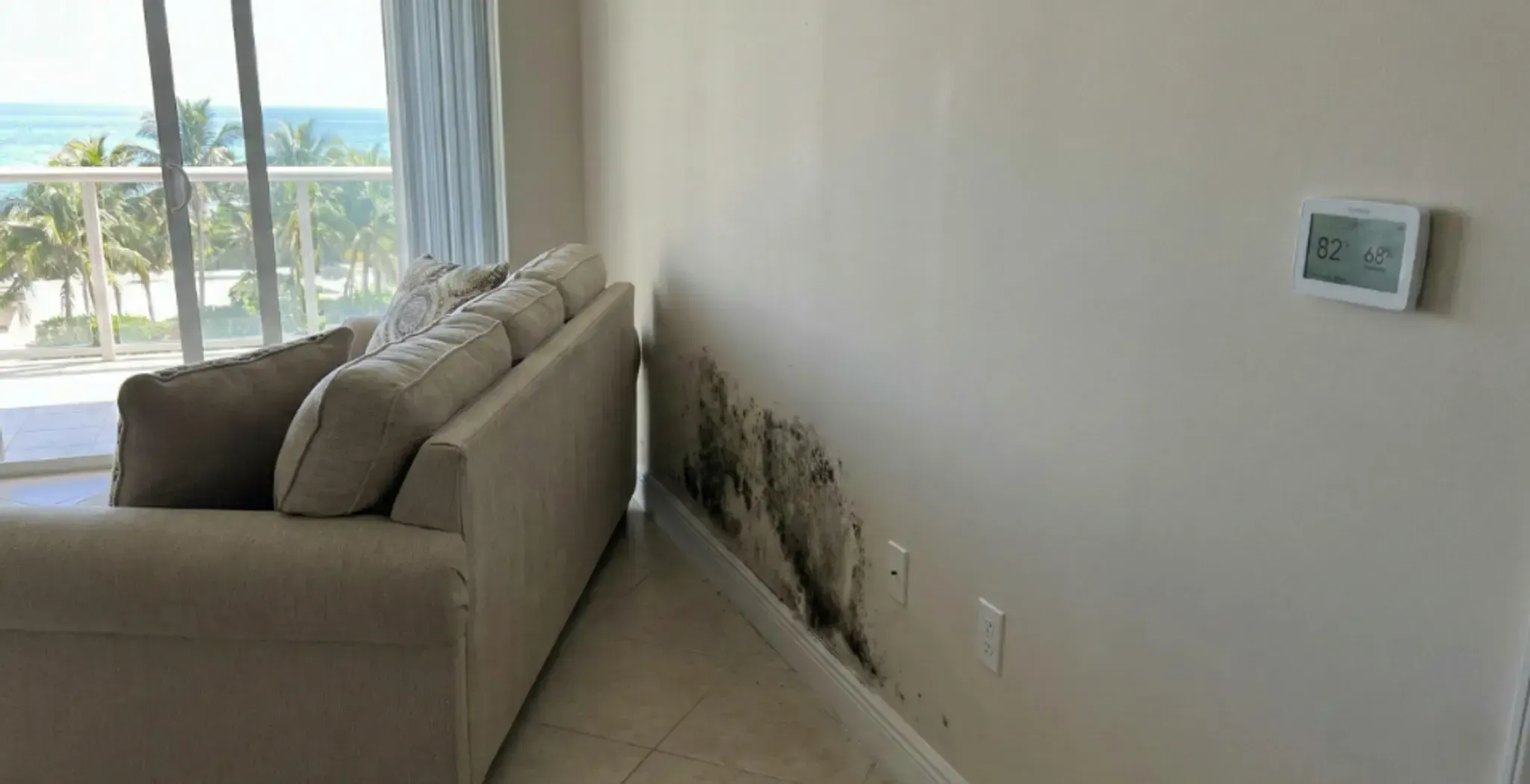

Many people who own condos in West Palm Beach go up north for the summer and come back in the winter. They leave in May and feel sure that their place is fine. When they return in November, they often find black mold behind the couch, paint that bubbles up, and bad smells that stay in the air. This happens because many people do not set their AC the right way before they leave. The hot and wet summer helps mold grow fast when the air is not cool enough inside.
The problem is not only about heat. There is also a link between how hot it is, how much water is in the air, and the dew point in closed high-rise condos.
The 60 Percent Humidity Line
Mold does not need standing water. It only needs some moisture in the air. This is enough for things like drywall, wood, and fabric to soak up the water. Building science shows 60 percent relative humidity as the critical point. When it is under this level, most things will stay dry. If it rises over 60 percent, things will soak up moisture from the air.
If the air stays at 70 percent RH (relative humidity) for a long time, mold can grow even on clean places. When the RH reaches 80 percent or more, mold can show up fast. It can start within one to two days. For empty condos in West Palm Beach, you want to keep RH at 58 percent or less. This will help keep out extra humidity that comes with summer storms.
Many snowbirds want to save money, so they turn the AC off or set it to 85 degrees. This can be a big problem because of the dew point.
The Dew Point Problem on Shared Walls
Dew point is the time when the air gets so full of water, it cannot take more. If air touches a surface that is cooler than the dew point, water in the air turns into drops of liquid. You can see this happen on walls that people share between a lived-in and an empty condo.
Here is what goes on. You go away for summer and set the thermostat to 85 to save some money. This lets humid Florida air get in through the door gaps. This makes the inside dew point go up to 75 degrees. At the same time, your neighbor keeps their unit at 72 degrees all year. The wall you both share gets cool from the concrete. This makes the wall on your side drop to 73 or 74 degrees.
When your wall is at 74 degrees and your air's dew point is 75 degrees, water forms on the wall. This happens behind dressers, inside closets, or behind wall TVs where air does not go much. You can not see it. But water keeps building up for months while mold starts to grow on the wet drywall. By November, you have a lot of mold in hidden places.
AC Short-Cycling Fails to Remove Humidity
Many people keep an AC on, but they make the temperature setting too high. An AC does two things. It cools the room and takes moisture out of the air. Moisture goes away if air keeps moving over the cold coil for enough time.
If you set the thermostat to 82, the unit will reach that number fast and then turn off. This is called short-cycling. The run time is too short for it to take out moisture from the air. You may feel cool, but your condo will feel damp, with high humidity. This is a good setup for mold to grow.
The best setting for empty West Palm Beach condos is 77 to 78 degrees. This helps the AC run long enough to dry out the air in the unit but does not use a lot of energy. The unit will turn on and off at the right times. This cuts down on moisture, and the RH stays under 60 percent.
The Stack Effect Spreads Problems
High-rise condos are not closed boxes. They are rooms in a tall or high column. Pressure changes push air up and down in the building. The air goes through elevator shafts, stairwells, and spaces used for pipes and wires.
Elevators work like pistons. When they go up or down, they move air between floors. If the building is not closed tight between floors, spores can travel easily. A mold problem that starts in a garage or a lower part of the building can move up to other areas.
When you turn the AC off or set it very high, your unit can have less pressure than the hallway. Hallways often have fresh air systems that keep the air moving. This means air gets sucked into your unit from under the door, through outlets, or through pipe holes in shared walls. If the hallway carpet has mold or a neighbor has issues, that air can get pulled into your clean, empty unit.
What Works for Vacant Condos
The right way to keep safe has a few steps. First, set the thermostat at 77 to 78 degrees. You should not turn it off. This step is not just a choice.
Second, put in a dehumidifier that you can move and let it drain into the sink or shower. Set it to keep the humidity at 58 percent. This helps when the AC does not run enough and there is still moisture.
Third, air needs to move. Keep all inside doors open. This means doors to closets and bathrooms too. This helps stop the air from sitting still. That way, the air moves, and damp spots do not form. If you have a closet on an outside wall and keep it closed, moisture can build up inside without you seeing it.
Fourth, remote monitoring. Use Wi-Fi hygrometers. These tools send a message to your phone if the air holds more than 60 percent water. This helps you find and fix problems before they grow. A person like a property manager can check things or change settings from anywhere.
When You Need Remediation
If you come back and see mold, smell something musty, or notice water stains, you will need a pro to fix it. Cleaning is not enough. Using bleach does not get rid of it. The mold gets deep into the drywall's paper and core so, wiping only the top will leave mold there.
Pro remediation follows set rules. This means there will be walls to keep spores from spreading during demo. Workers use HEPA filters in the area. Any drywall and insulation that has a problem will be taken out. The rest of the surfaces get treated. At the end, air tests are done to make sure it is safe.
Cost changes based on how big the space is. A small spot can cost a few thousand. If there is damage in many rooms, it can go over $10,000. That is a lot more than the few hundred you may save on summer electric by using the AC in the wrong way.
West Palm Beach Specific Risks
West Palm Beach sits along the coast, so there is more humidity because of the ocean air. Buildings close to the Intracoastal or the Atlantic feel even higher humidity than others. There is salt in the air, and moisture is also around it. This speeds up the wearing out of AC parts. The AC system can stop working faster. A broken AC in your empty summer condo is a disaster.
Older high-rise buildings in West Palm Beach, built in the 1970s and 1980s, do not have modern sealing like new ones. The air from outside comes in more easily, especially when units are empty. This can make the air inside feel more wet and sticky. It is important to use good dehumidification in the older buildings to keep things comfortable.
Protect Your Investment
West Palm Beach vacation condos are big investments. Leaving them empty during summer with the wrong climate can lead to costly mold. You can stop this by managing indoor humidity. Set the thermostat between 77 and 78. Use something to reduce moisture in the air. Check things from a distance. Doing these simple things can stop repairs that cost thousands for owners who come back each fall.
If you come back and see mold, have a pro look at it before you start cleaning. Contact Fast Mold Testing for inspection and air checks. They will show you how much the area is affected and if cleanup is needed.
Frequently Asked Questions
- What temperature should I leave my AC on when I leave my West Palm Beach condo for the summer?
- Set your thermostat between 77 and 78 degrees and leave it running the entire time you are away. This range lets the AC cycle long enough to pull moisture out of the air without burning excess energy. Pushing the setting to 82 or 85 to save money causes short-cycling: the unit hits its target too quickly, shuts off, and never removes humidity. Pair the thermostat setting with a humidistat goal of 58 percent relative humidity. If your condo cannot hold that humidity level on the AC alone, add a portable dehumidifier that drains into a sink or shower.
- Why do snowbird condos in Florida get mold even when they are locked up and empty?
- Empty condos still pull humid Florida air in through door gaps, outlets, and shared wall penetrations. Without the AC running to dehumidify, indoor relative humidity climbs above 60 percent and drywall, wood, and fabric soak up moisture from the air. Mold does not need a leak. It only needs sustained humidity. At 70 percent relative humidity mold colonizes clean surfaces, and at 80 percent it can appear within one to two days. By the time owners return in November, hidden colonies behind couches, inside closets, and on the back of shared walls are usually well established.
- How does the dew point cause mold on shared condo walls?
- Dew point is the temperature at which water vapor in the air condenses into liquid. When your unit sits at 85 degrees with humid air seeping in, your indoor dew point can climb to around 75 degrees. Meanwhile, an occupied neighbor unit at 72 degrees cools the shared concrete wall, dropping your side of that wall to roughly 73 or 74 degrees. Since the wall surface is now colder than your dew point, water condenses behind dressers, inside closets, and behind wall-mounted TVs. The condensation feeds drywall paper and mold colonies grow undetected for months.
- Should I run a dehumidifier or rely on the AC alone in a vacant West Palm Beach condo?
- Use both when possible. The AC is your first line of defense for cooling and dehumidification, but during long summer storms it may not run enough hours to keep humidity under 60 percent on its own. A portable dehumidifier set to 58 percent relative humidity picks up the slack and drains continuously into a sink, shower, or condensate pump. Open all interior doors, including closets and bathrooms, so air keeps moving and damp pockets do not form. A Wi-Fi hygrometer alerts your phone when humidity spikes, so a property manager can intervene before mold takes hold.
- How quickly can mold grow in a vacant Florida condo during the summer?
- It depends on the indoor humidity, not the calendar. If relative humidity sits at 70 percent for an extended period, mold can begin colonizing on previously clean drywall, baseboards, and fabric. Once humidity reaches 80 percent or higher, visible growth can appear in as little as one to two days on susceptible surfaces. Snowbirds who leave in May and return in November are gone for roughly six months. That is far more time than mold needs to spread behind furniture, inside closets, and along shared walls, especially during peak summer storms and overnight humidity swings.
- When should I get mold testing after returning to my West Palm Beach condo?
- Schedule testing if you notice any of the classic return-from-summer signs: black or fuzzy patches on drywall, bubbled or peeling paint, a persistent musty smell, water staining on baseboards, or unexplained allergy symptoms within hours of walking in. An independent mold inspector can sample air and surfaces and send them to an AIHA-LAP (EMLAP) accredited lab, with results typically back in one to two business days. Fast Mold Testing performs the inspection and lab work only. We do not remediate, so the findings stay conflict-free and you can hand them to any qualified remediation contractor.