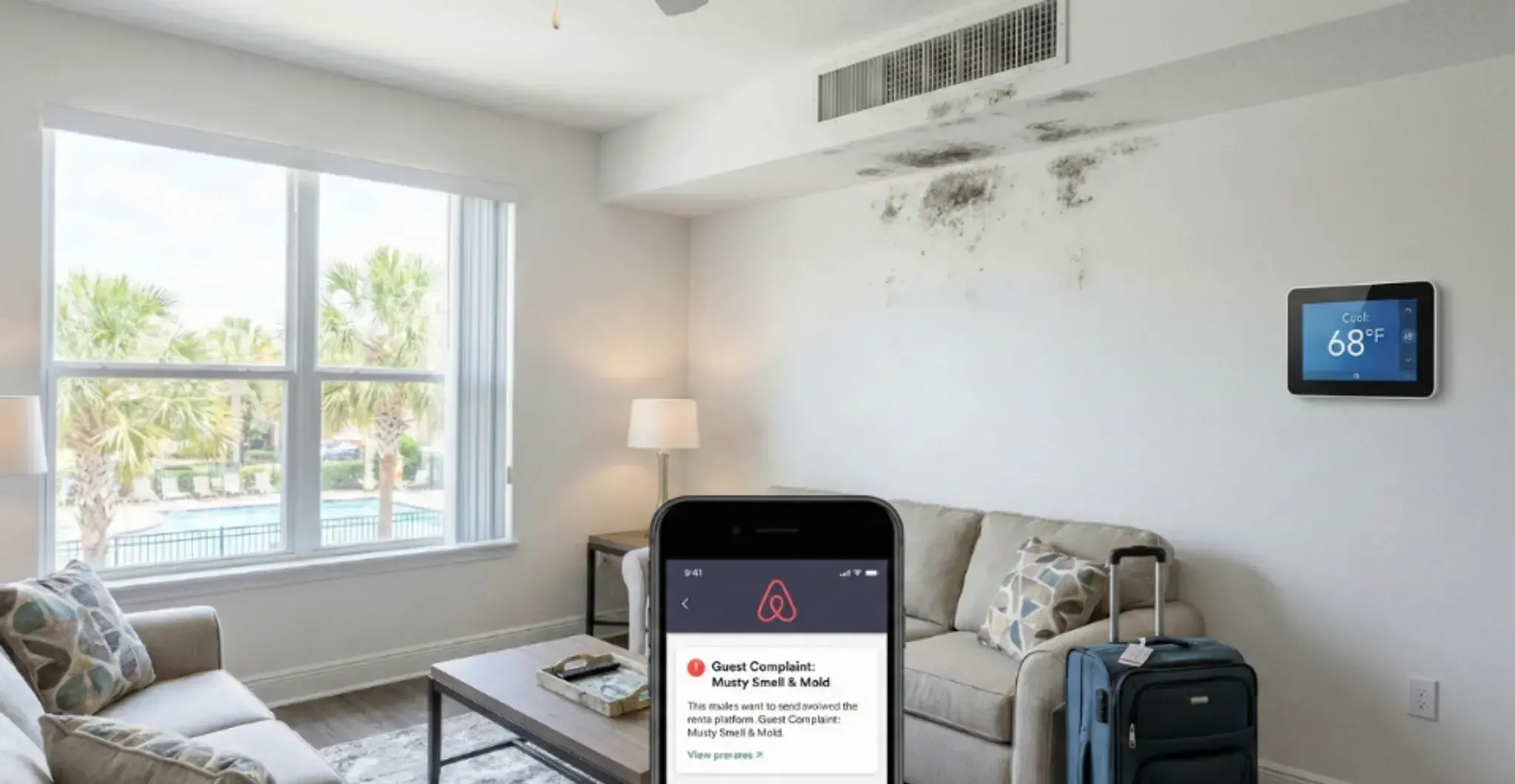

Orlando vacation rental owners deal with a risk that most regular homeowners do not. People who stay in short-term rentals may come from cooler places, and they can set the thermostat to 68 degrees or even lower. This makes the inside of the home much colder. The ductwork then starts to get wet from the cool air, which helps mold grow. If any guest says they see mold, the rental platform usually takes the guest’s side. This can lead to your place being closed for many weeks. A single problem with mold can cost you a lot of money.
It is important to know why this happens and how it affects your money. This will help you keep your Orlando STR investment safe.
Platform Policies Hit Hard
Airbnb and VRBO see mold as a safety problem, not just about being clean. Their rules say that listings must be free of any things that are bad for health. Mold is one of the main reasons a place can be turned down.
Guest Power
If a guest says there is a mold smell or they see it, most platforms usually take the guest's side. Guests often take photos to show what they found. If guests decide not to stay because of mold, the rules say they get a full refund, including any extra fees. That means the host does not get paid for that stay, and they also lose earnings for any days that the place is blocked next.
Guests often use home mold test kits to find out if there are spores in a place. They need the scientific proof from these tests to get some or all of their money back. Once guests say a place has mold, the host has to show that the property does not have this problem. Hosts can do this by having a professional inspection done.
Listing Suspensions
The worst thing that can happen is that your listing stops right away. A good mold report can make Airbnb stop your listing so people can’t book it anymore. This stop will be for at least 5 days. It can also last even more, with no set end.
To lift the suspension, hosts need to give a Professional Clearance Letter that comes from a licensed mold specialist. This can make the shutdown last a few more days or weeks. If there are repeated problems, they will be removed from the platform for good.
The Money Impact
Orlando STR mold events affect you in three main ways. First is the cost to clean up mold. Second, there is loss of money because you have to close while fixing it. Third, your name can get hurt if word gets out.
Timelines
Minor problems under 10 square feet can take 1 to 2 days. This will be for setting up and cleaning. Major problems over 100 square feet need 1 to 2 weeks. There will be drying, demo, putting things back, and testing.
Revenue Burn
Orlando STRs have set benchmarks. The average daily rate is between $187 and $224. The best properties can get over $400 for one night.
A big cleanup that takes 14 days means you can lose about $3,136 because you make $224 every night. You also need to pay the average Orlando cleanup cost, which is between $1,040 and $4,228, and there is a testing fee of about $500. So, for one mold problem, you may have to pay anywhere from $4,500 to $8,000. This can cut out months of your profit.
Why Ducts Sweat
The mold problem happens because the ducts sweat when guests make the place too cool.
The 68-Degree Problem
People from cooler places often set the thermostat to 68 degrees or below when they visit. This can make the air inside the HVAC ducts feel much colder. In many homes in Florida, the ducts go through areas that are not cooled, such as attics. These places can get to 90 degrees or even hotter, and the air is very humid there.
Dew Point Physics
Condensation starts when a surface cools down below the dew point in the air. In the summer in Orlando, the dew point is usually between 72 and 78 degrees.
If cold air inside the duct makes the outside of the duct feel like 60 or 65 degrees because of poor insulation, that outside part is now about 10 to 15 degrees lower than the dew point in the air around it. Water in the attic air then quickly turns into drops on the duct surface. It is just like how a cold soda can gets wet on the outside.
Distribution Problem
Condensation makes dust and insulation on the ductwork wet. Dust gives food. Sweat puts in water. Mold grows on plenum and duct joints.
The HVAC system pushes air over these surfaces. The spores move into every room in the rental. From the first day, guests breathe air that is not clean.
Prevention Steps
You need to use more than one way to stop the duct from sweating.
Duct Insulation
Building science shows that ducts in places with a lot of humidity need to have R-8 insulation at least. This helps stop cold duct surfaces from touching humid air. All joints in the ducts must be sealed with mastic. This stops air from leaking out.
A lot of older rentals in Orlando have poor duct insulation or air leaks where pieces connect. This is a problem you cannot see, but it can lead to mold that you can see.
Thermostat Management
Think about smart thermostats that you can watch from far and set limits on. Set the lowest temp at 72 degrees. This keeps it from getting too cold and stops water drops from forming. Some people who rent out their homes use thermostats that you can lock.
Guest comfort is still important. But telling people that homes in Florida work in a different way helps people know what to expect. Give portable fans to help the air move instead of setting the AC to very cold.
Regular HVAC Maintenance
It is good to have a pro HVAC inspection every 6 months. The tech will look for signs of condensation, look at the insulation, and test the airflow. Finding small moisture problems early can help stop big mold problems later.
Change the filters every month in places that are used a lot. Clogged filters slow down the airflow. They make the system run for a longer time. This can also lead to more water build-up.
Catch It Early
Don’t wait until guests complain. Pro active testing helps you find problems early.
Between-Guest Checks
Walk around the property after each checkout. Try to find any musty smells, mostly near vents. Look at vent registers to see if there is any color change or anything growing. Run your hand along places on the ductwork where you can reach to feel for wet spots.
Quarterly Air Testing
Book pro air quality tests every three months in the busy season. This helps you set the spore level to compare in the future. A high number means a problem is starting, even when you do not see anything yet.
Testing costs about $500 in Orlando. This is not much when you think that cleanup can be $8,000 plus there could be weeks without bookings.
Guest Feedback Watching
Watch the reviews closely for any talk about a musty smell, dampness, or people saying they feel allergies. These signs can come before there is a real mold problem. It is good to handle these things right away before they get worse.
Orlando Climate Factors
Orlando’s weather is great for mold to grow. The air stays wet all year. There are a lot of storms in the afternoon. The warm air keeps the tiny mold spores going.
Homes near lakes or water often have more humidity in the air. Houses built in the 1970s and 1980s do not have new vapor barriers or good HVAC sealing.
Pool homes come with extra risk. Humid air from the pool area can get into the main house through doors and windows. This makes more moisture in the air that your HVAC system has to take care of, along with what it already does for daily use.
Protect Your Orlando STR
Orlando vacation rentals deal with special mold risks because of what guests do and how the booking sites make rules. When you use the AC a lot, duct sweating can happen. This brings mold that can stop your listing for weeks. The rules on some platforms help guests when they make a mold complaint. That is why stopping mold is so important.
Make sure the duct insulation is done right. Check the thermostat settings often. Plan for inspections on a regular basis. Test the air quality every few months. These steps help keep your investment safe from mold problems that can cost a lot of money and lower your profits.
Set up a pro mold check with Fast Mold Testing to help see the air quality first and find risks before any guests say something.
Learn more about mold in Orlando in our feature article.
Related reading
Frequently Asked Questions
- How do vacation rental guests trigger mold growth in Orlando properties?
- Vacation rental guests in Orlando trigger mold growth through several behaviors: leaving AC set at 80 degrees or off entirely during their stay, creating sustained high indoor humidity; taking multiple showers per day without running bathroom exhaust fans; bringing in wet swimwear and towels; and closing blinds or curtains that prevent solar drying of moisture-prone surfaces. These patterns repeated across weekly guest turnover accelerate mold development significantly.
- What are the early warning signs of guest-triggered mold in an Orlando vacation rental?
- Early signs of guest-triggered mold in an Orlando vacation rental include a musty odor that guests report but cleaning staff cannot eliminate, dark spotting at ceiling edges in bathrooms and bedrooms, condensation stains on AC vent covers, and recurring complaints about air quality or odors in guest reviews. These signs indicate mold that cleaning cannot address without professional assessment.
- How much does a mold inspection cost for an Orlando vacation rental property?
- Mold inspections for Orlando vacation rental properties typically cost between $500 and $800 (more for extensive inspections). Fast Mold Testing starts at our transparent rate and provides results in 1 to 2 business days. Inspections can be scheduled during a gap between guest stays to minimize booking disruption while ensuring the property meets health and safety standards.
- How often should Orlando vacation rental owners get professional mold inspections?
- Orlando vacation rental owners should schedule a professional mold inspection at least once per year, and additionally after any guest complaint about odors or air quality, after any HVAC service call involving drainage issues, or whenever the property has been vacant for more than two weeks in summer. Fast Mold Testing can establish a recurring inspection schedule that fits the property's rental calendar.