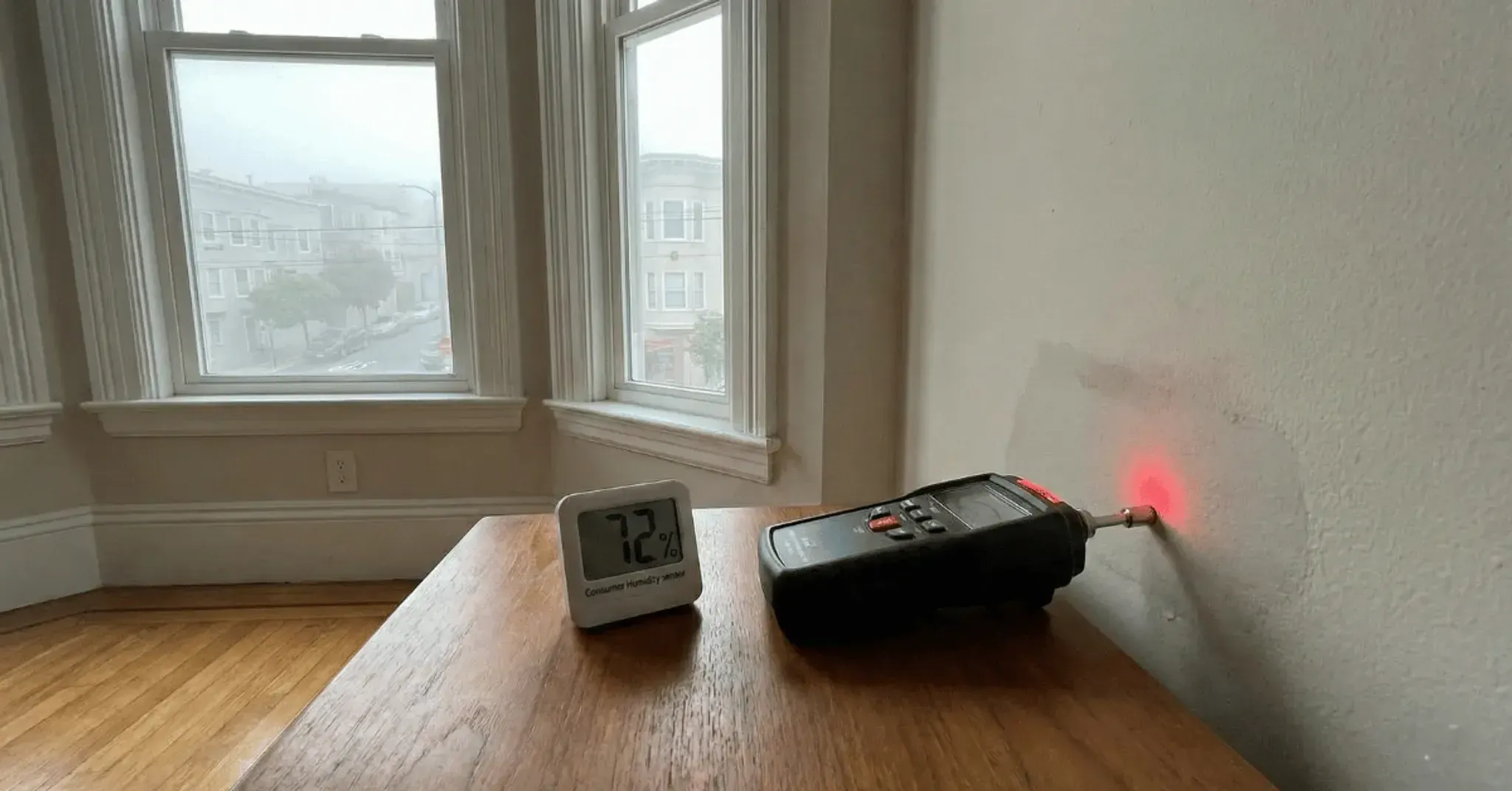

Your Airthings or Govee sensor has been blinking orange for three weeks. Most mornings, the humidity in your Richmond District flat goes up to 72%. There is a strange smell behind the bathroom wall. You have had a stuffy nose since October.
Here is what the sensor can tell you. The air inside your house has a lot of water in it right now. Here is what the sensor cannot say. It does not know if mold spores are in the air. It also cannot say what kind they are. It cannot tell if there is something growing behind your walls, either.
These are two different things. In San Francisco, it can be a big and expensive mistake to confuse them.
What a Humidity Sensor Actually Measures
A humidity sensor checks how much water is in the air. That is all it does. It cannot check the air for things that are alive. It will not find mold pieces either. A humidity sensor cannot tell the difference between mold, dust, or steam from cooking.
Consumer sensors can be wrong by 2 to 5 percent, and this can change with age. Delmhorst says these sensor parts get worn down when they touch air, so you have to change them for good readings. Most people who rent do not do this.
High humidity means that mold could grow, but it does not show that mold is there yet. Mold needs water and something to eat to grow. Things like drywall paper, wood framing, and old plaster can all be used by mold as food.
A slow leak behind the wall can make the wood inside soak up 20 to 30 percent water. But the air in the room can still feel normal and show about 50 percent on a humidity meter. Your sensor does not check what is going on inside the wall.
Why San Francisco Makes Humidity Readings Especially Unreliable
SF outdoor humidity is usually around 84 percent in the early morning. It goes down to about 59 percent by early afternoon. These numbers come from long-term averages by the NCEI.
This change in humidity gets into homes that do not have good insulation. A lot of old Victorian and Edwardian homes in SF were not built with tight insulation.
In foggy places like the Outer Sunset, Richmond District, and West Portal, you feel the rise in morning moisture more. It is stronger and stays around for a longer time. Cracked windows, spaces in old single-pane window frames, and open areas under your house with no heat barriers can let this damp air come in.
If you live west of Twin Peaks, your sensor will read high for a few hours each day in the morning. This happens all year. That is not a mold alarm. It is a weather reading.
The sensor will not show you if your north-facing bathroom wall has stayed wet long enough for mold like Penicillium or Stachybotrys to grow. These types of mold send their spores into the air before you see any marks or notice any smell.
What Lab Testing Actually Does
A mold inspection checks the air for mold. It sends air samples to a certified lab. The lab runs a spore trap test. This test counts and sorts living particles by size. You get a number of spores in each cubic meter of air. Spores are sorted by type. The results are compared to a sample taken from outside at the same time.
The outdoor check is very important. There is outdoor mold in the SF air all year. So if you find there are more mold spores inside the house than outside, that shows the problem. A humidity test does not tell you this.
The type of mold will guide what you do next. The Penicillium and Aspergillus molds are found a lot in Bay Area homes. These can bring on allergy symptoms, but they can usually be treated on the surface.
Stachybotrys, or black mold, is not seen as often as some other types. But it is much more serious. The only way to clean it is with full containment, not just by treating the outside.
Kaiterra's air quality research shows that no device made for people at home can tell you what kind of mold is in the air. A lab is the only place that can tell you this. A sensor that is at 70 percent humidity will not say what you are dealing with.
When a Humidity Sensor Is Actually Useful
Sensors can be very good at one thing. They help people find problems early. This is the real value of sensors.
If you see that the RH level in your SoMa or Noe Valley bathroom is over 65 percent most of the time, check the air system and see if there are any leaks. These devices help you find too much water in the air before you get mold.
Airthings says in its own papers that the Wave Mini does not find mold spores. It gives a risk score using both temperature and humidity. It does not give you a number for spores. It is there to give you a warning, not to test for mold.
If you smell something, see stains, or notice new health problems when at home, you are no longer in the early stage. A humidity check will not help you show what is wrong, speak to your property owner, file an insurance claim, or plan a cleanup.
Mold Testing in San Francisco: Common Questions
Does high humidity on my sensor mean I have mold?
No. High humidity means the place can get mold if there is also water in your walls or floors. A lot of SF apartments show high humidity for hours when the morning comes, because of the layer of air that comes from the sea. That by itself does not prove you have mold.
Can I use my sensor reading as evidence with my landlord?
No, not by itself. A sensor can tell you about the air but not if there is something harmful. To really prove something, you need lab tests. These tests must show that the spore count inside is higher than outside. Learn what must be in a mold lab report so you can use it with your insurer or the person who owns the place.
Why does my sensor read higher in summer than winter?
SF fog time usually lasts from about May to September. The cool air from the ocean is strongest in summer. This is why the air inside your home often gets more damp during summer, not winter.
That is not like what you see in most US cities. Do not think a high summer reading is normal.
Does mold testing cost $800 in San Francisco?
The price depends on how big the job is. A test for one room will cost a lot less money than checking many rooms. Fast Mold Testing's SF inspection service gives you indoor air quality results in just one or two business days. When you find the right answer early, you will spend less than if you find a wrong answer and fix it later.
Can mold grow in SF apartments that feel dry?
Yes, some parts of the Mission and Noe Valley are more dry than the rest of the city. Still, mold can grow inside walls, under sinks, or in crawl spaces. This happens where pipes can sweat or cold surfaces make water drip. Black mold can take time to grow in wet spots that are hard to see, not only in places where the whole room feels wet.
What to Do If Your Sensor Has Been Alarming
Your sensor has spotted something you need to check. The next thing to do is not to wait and see what happens with the numbers.
Get air samples taken. Compare them to an outdoor baseline. These will be checked by a certified lab.
Many buildings in SF are old. The climate is often damp where it should not be. Most people who live there do not know what is behind their walls.
A sensor is where it all begins. The results from the lab give you the answer.
Frequently Asked Questions
- Can a humidity sensor tell me if I have a mold problem in my San Francisco home?
- A humidity sensor can tell you that relative humidity in a room is high enough to support mold growth, generally above 60 percent, but it cannot tell you whether mold is actually present, where it is located, or what type it is. In San Francisco, outdoor fog and marine layer regularly push indoor humidity above safe levels, so a sensor reading above 60 percent warrants a professional inspection, not just a humidity adjustment.
- What does a humidity sensor miss that a professional mold inspection catches in San Francisco?
- A humidity sensor measures the air in one room at one moment. It misses moisture trapped inside walls, under floors, and in HVAC ductwork. In San Francisco's Victorian and Edwardian homes, moisture migrates through thick plaster walls and can reach levels that support mold growth in wall cavities even when the room air feels relatively dry. Only a moisture meter scan of the wall surface reveals this hidden moisture.
- When should a San Francisco homeowner move from monitoring humidity to getting a professional mold inspection?
- Move from humidity monitoring to a professional mold inspection when you notice a persistent musty odor even at normal humidity levels, when mold keeps appearing on the same surface after cleaning, when someone in the home has unexplained respiratory symptoms, or when you see water stains on walls or ceilings even if they appear dry now.
- How much does a mold inspection cost in San Francisco compared to buying humidity sensors?
- Quality humidity sensors for a typical San Francisco home cost $50 to $200 and provide ongoing monitoring but no mold confirmation. A professional mold inspection from Fast Mold Testing starts at our transparent rate and provides a one-time definitive assessment with moisture mapping, lab analysis, and a written report. For property transactions or tenant disputes, only the professional inspection produces usable documentation.