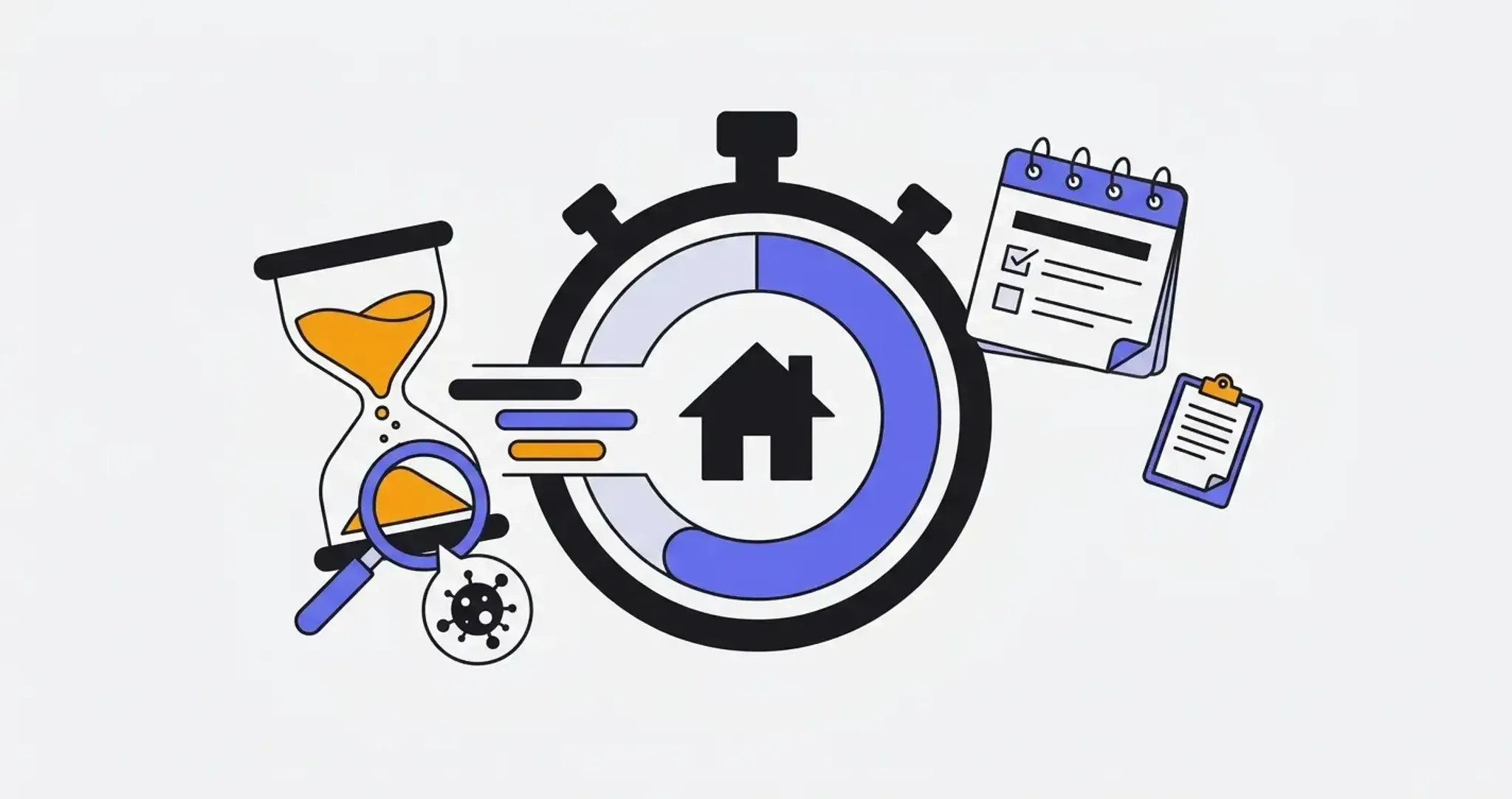

Most mold inspections take 1-3 hours on-site, depending on your property size and how many areas need sampling. Full reports typically delivered within 1-2 business days of the inspection via AI-assisted lab analysis — compared to the 5-14 day wait at most competitors. If you book same-day in Sacramento, San Francisco, Atlanta, Denver, New York, or 50+ other service areas across the country, you can have an inspector at your door within hours and a full lab report typically within 2-3 business days of booking.
The timeline depends on three variables: property square footage, how many problem areas the inspector finds, and whether you need air samples, surface samples, or both. A 1,200 sq ft condo with one visible patch of mold runs faster than a 3,500 sq ft house with musty smells in three rooms and a crawlspace the inspector needs to check.
Here's what actually happens during those 1-3 hours, how the lab turnaround works, and what makes some inspections longer than others.
How Long Does the On-Site Inspection Take?
On-site inspections typically take 1-3 hours. Smaller properties run closer to 1 hour; larger properties with attics, crawlspaces, or multiple problem areas can take 2.5-3 hours.
| Property Size | Typical Inspection Time | What's Included |
|---|---|---|
| Under 1,500 sq ft | 1-1.5 hours | Visual assessment, moisture mapping, 2-4 air or surface samples |
| 1,500-3,000 sq ft | 1.5-2.5 hours | Visual assessment, moisture mapping, thermal imaging, 4-6 samples |
| Over 3,000 sq ft | 2.5-3+ hours | Full property assessment, thermal imaging, HVAC inspection, 6-10 samples |
The inspector spends most of that time doing three things: checking every room for visible mold and moisture issues, using a thermal camera to spot hidden water damage behind walls, and taking samples from problem areas. Sampling itself only takes 5-10 minutes per location, but the inspector has to document each sample with photos and notes for the lab report.
Properties with finished basements, attics, or crawlspaces take longer because those are common hiding spots for mold. If the inspector finds moisture readings above 16% on a wall or ceiling, they'll investigate further — that adds time but catches problems you can't see.
A certified mold inspection also includes HVAC system checks. Mold spores spread through air handlers and ductwork, so inspectors pull the air handler cover and check the coil, drip pan, and duct interiors. That adds 15-20 minutes but finds problems a visual walkthrough would miss.
What Happens During a Mold Inspection?
A mold inspection follows a structured process: visual assessment, moisture mapping, thermal imaging, sampling, and documentation. The inspector checks every room, plus areas homeowners rarely access like attics, crawlspaces, and inside HVAC systems.
Here's the step-by-step breakdown:
- Initial walkthrough (15-20 minutes) — The inspector asks where you've seen mold, smelled mustiness, or had water damage. They document the visible problem areas and note any health symptoms you've mentioned. This sets the scope for where to sample.
- Visual assessment (20-40 minutes) — Room by room, the inspector checks walls, ceilings, floors, windows, and any areas with plumbing or exterior exposure. They look for visible mold, water stains, discoloration, and peeling paint. Bathrooms, kitchens, basements, and laundry rooms get extra attention.
- Moisture mapping (15-25 minutes) — Using a moisture meter, the inspector measures moisture levels in walls, ceilings, and floors near suspected problem areas. Readings above 16% indicate active moisture that could support mold growth. High readings trigger further investigation.
- Thermal imaging (10-20 minutes) — A thermal camera detects temperature differences that signal hidden water damage or leaks behind drywall. Cold spots often mean moisture; the inspector marks these areas for possible sampling.
- Air and surface sampling (20-40 minutes total) — The inspector collects air samples (using a pump that pulls air through a collection cassette for 5-10 minutes per location) and surface samples (using swabs or tape lifts on visible mold patches). Each sample gets labeled with its location, time, and environmental conditions.
- HVAC inspection (15-20 minutes) — The inspector opens the air handler, checks the coil and drip pan for mold, and inspects accessible ductwork. Mold in HVAC systems spreads spores throughout the house, so this step catches whole-house contamination risks.
- Documentation and wrap-up (10-15 minutes) — The inspector takes photos of problem areas, logs all sample locations, and explains what happens next. Samples go to an AIHA-LAP (EMLAP) accredited lab for species identification and spore count analysis.
The inspector is IICRC- or NORMI-certified, which means they're trained specifically in mold inspection methodology — not a general home inspector with a mold add-on. That training shows in how they check hidden areas most people don't think about.
How Long Do Lab Results Take?
Full reports typically arrive within 1-2 business days of the inspection via AI-assisted lab analysis, compared to 5-14 days at most mold testing companies.
Traditional labs manually analyze samples under a microscope, which takes 5-7 business days for standard turnaround (10-14 days during busy seasons like spring and fall when water damage spikes). AI-assisted analysis uses computer vision to identify mold species and count spore concentrations, with every result verified by our on-staff microbiologist — cutting analysis time to 1-2 business days without sacrificing accuracy.
The lab is AIHA-LAP (EMLAP) accredited, which is the accreditation standard for environmental microbiology labs. The certification means the lab follows strict protocols for sample handling, chain of custody, and species identification accuracy. When a tenant dispute or real estate transaction depends on the report, AIHA-LAP (EMLAP) accredited is what housing authorities and attorneys recognize.
Once analysis is complete, you get an interactive web report — not a 30-page PDF. The report breaks down findings sample by sample, shows photos of each location, identifies which mold species were found, and includes spore count data. The inspector follows up with a call to walk through what it means and what to do next.
Doug L., a Sacramento homeowner, noted in his Google review: "Got my report back in 48 hours. Other companies I called said 7-10 days minimum." That speed difference matters when you're deciding whether to move forward with a real estate closing or when a tenant dispute has a deadline.
The 1-2 business day timeline assumes the inspector drops samples at the lab the same day as the inspection. If you book late on a Friday, weekend processing might push results to Monday or Tuesday. Same-day inspections in service areas (San Francisco, Sacramento, Atlanta, Denver, New York) typically deliver results by midweek.
What Affects Mold Inspection Length?
Five factors determine whether your inspection runs 1 hour or 3+ hours: property size, number of problem areas, access to hidden spaces, additional testing requests, and environmental conditions during sampling.
Property size and layout — A 900 sq ft apartment takes less time than a 4,000 sq ft house, but layout matters as much as square footage. A single-story ranch is faster to inspect than a three-story home with a basement and attic, even if the total square footage is similar.
Number of problem areas — One visible mold patch in a bathroom takes 15-20 minutes to assess and sample. Three moldy areas in different rooms — bathroom, basement, bedroom closet — means the inspector samples each location separately and documents conditions in each space. Multiple problem areas extend the inspection by 20-40 minutes.
Access to crawlspaces, attics, and mechanical spaces — If the inspector needs to check a crawlspace or attic and access is difficult (narrow hatch, blocked entry, no safe flooring), that adds 20-30 minutes. Inspectors check these areas because they're common mold hiding spots, but access issues slow things down.
ERMI testing or expanded sampling — Standard inspections include 2-6 air or surface samples depending on property size. ERMI (Environmental Relative Moldiness Index) testing samples 30+ locations to build a full mold profile of the property. ERMI adds 45-60 minutes to the inspection and costs more, but it's the most thorough option for properties with unexplained health symptoms or extensive water damage history.
Environmental conditions — Air sampling requires still-air conditions (no open windows, no HVAC running) to get accurate spore counts. If the property has been closed up for days, the inspector can sample immediately. If windows are open or the AC just ran, they may ask you to close everything and wait 30-60 minutes before sampling. That waiting period extends the total appointment time.
The inspector will give you a time estimate when you book, but these variables can shift the timeline by 30-60 minutes in either direction. Most inspections land in the 1.5-2 hour range for typical single-family homes.
Same-Day Inspection Timeline
In service areas (San Francisco, Sacramento, Atlanta, Denver, New York), you can book online and have an inspector on-site the same day — sometimes within hours.
Here's what the same-day timeline looks like:
9:00 AM — You book online at fastmoldtesting.com. The system checks inspector availability in your metro and confirms a 2:00 PM appointment.
2:00 PM — Inspector arrives, conducts the 1-3 hour inspection (depending on property size and findings).
4:30 PM — Inspector finishes, drops samples at the lab, and uploads initial notes to your account.
Day 2-3 — Lab completes AI-assisted analysis with on-staff microbiologist verification. Your interactive report goes live, and the inspector calls to walk through findings and answer questions.
Total time from booking to final report: typically 1-2 business days in best-case scenarios. Weekends and holidays may extend that window.
Jessica C., a San Francisco homeowner, described her experience: "Same-day emergency testing and results — they showed up within hours when I found mold in my bathroom." That speed works because Fast Mold Testing is a marketplace with inspectors already positioned across 50+ service areas, not a single-operator business dispatching from one central office.
Same-day availability depends on inspector schedules. Book before noon for same-day service; afternoon bookings usually slot into next-business-day appointments. Secondary markets (LA, Seattle, Houston, Miami, and others within our 50+ service areas) typically offer next-business-day service rather than same-day, but the full-report turnaround stays at 1-2 business days of the inspection regardless of market.
The speed comes from two infrastructure pieces: the marketplace model (more inspectors means more availability) and AI-assisted lab analysis (no manual microscope review bottleneck). Traditional mold companies often run 3-5 business days out for appointments, then another 7-10 days for lab results. The timeline difference is 10-15 days versus 1-2 business days.
Conclusion
Mold inspections take 1-3 hours on-site and the full report typically arrives within 1-2 business days of the inspection via AI-assisted lab analysis — significantly faster than the 5-14 day industry standard. Same-day appointments are available in San Francisco, Sacramento, Atlanta, Denver, New York, and 50+ other service areas across the country, with most inspections delivering final reports within 1-2 business days of the inspection.
The timeline depends on property size, how many problem areas need sampling, and access to hidden spaces like attics and crawlspaces. Larger properties and ERMI testing extend inspection time, but most homes fall in the 1.5-2 hour range.
Fast Mold Testing runs conflict-free inspections — we test only, we don't remediate. That means the inspector's job is to find out what's actually there and get you a lab-backed report, not to upsell a cleanup project. Residential inspections typically range between $500 and $800 (more for extensive inspections) with transparent pricing published online.
Book online in under two minutes. Inspector visits same-day or next business day in 50+ service areas across the country. Full report typically delivered within 1-2 business days of the inspection. No hidden fees, no cleanup upsell, no 10-day wait for answers.
Frequently Asked Questions
- Can I get mold inspection results the same day?
- No. Lab analysis takes 1-2 business days minimum, even with AI-assisted analysis. The inspector can give you verbal observations on-site about visible mold and moisture issues, but species identification and spore counts require lab analysis. Same-day inspection appointments are available in service areas, but the full report typically arrives within 1-2 business days of the inspection.
- How long does the inspector stay in my house?
- Most inspections take 1-3 hours depending on property size. Smaller properties (under 1,500 sq ft) typically take 1-1.5 hours. Larger properties with attics, crawlspaces, or multiple problem areas can take 2.5-3 hours. The inspector will give you an estimated duration when you book.
- Why do some mold tests take 2 weeks for results?
- Traditional labs analyze samples manually under a microscope, which requires trained technicians and sequential processing. High-volume labs during busy seasons (spring and fall) build up backlogs that push turnaround to 10-14 days. AI-assisted analysis automates species identification using computer vision, with every AI result verified by our on-staff microbiologist — cutting analysis time to 1-2 business days without sacrificing accuracy.
- Do I need to be home during the inspection?
- You don't have to be present for the entire inspection, but the inspector will want 10-15 minutes at the start to ask about problem areas, water damage history, and any health symptoms. After that, you can leave if needed. The inspector will call when they're done and follow up once lab results are ready.
- How long after finding mold should I get an inspection?
- Book an inspection as soon as you notice visible mold, smell mustiness, or discover water damage. Mold spreads quickly in humid conditions — colonies can grow within one to two days after water exposure. That said, waiting a few days to schedule won't make a major difference in what the inspector finds. What matters more is getting the inspection before mold spreads to new areas or causes structural damage.