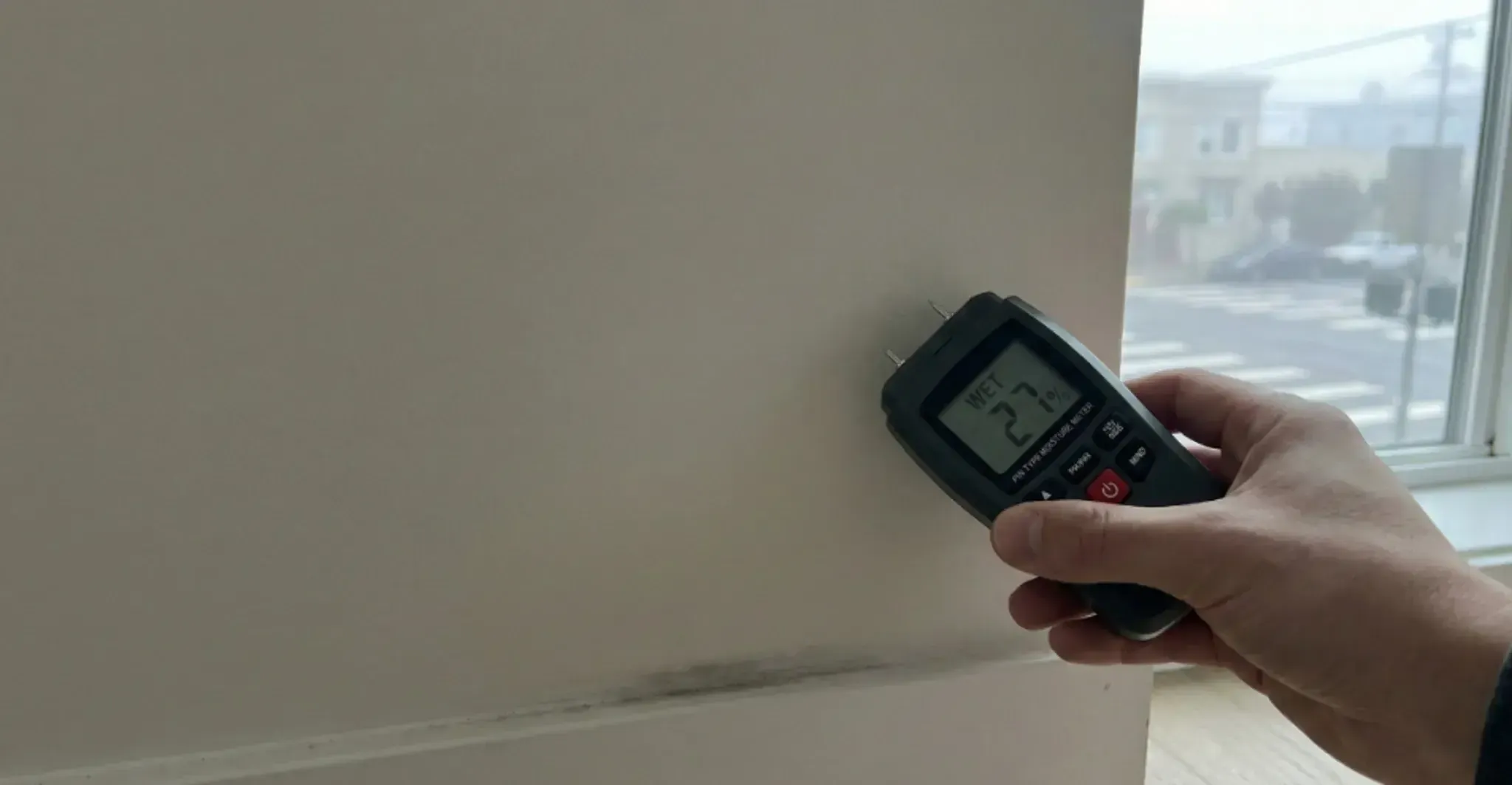

The same thing happens in many San Francisco Bay Area homes. A homeowner sees a water stain on the wall. When they touch it, the wall feels the same as the room. It's not cold or wet. They think the problem has dried by itself. In about three months, there's a musty smell. Black spots show up at the baseboard. The wall feels soft if you press it. A problem that looked fixed has now turned into a big mold problem.
This is called "False Dry." People who know about the subject say this. It explains why you do not feel wetness with your hand, even when it is still there. That is because of how things work in the Bay Area climate, which makes it more risky.
How Skin Detects Wetness
Human skin does not feel wetness directly. We feel wetness because of temperature changes. When you touch something wet, the water pulls away heat from your skin. This happens as water evaporates. About 540 calories per gram is taken from your skin. Your nerves feel this drop in heat. The brain takes this message and you feel "wet."
This works well on surfaces that have not been painted. Touch wet concrete or bare drywall, and you feel it fast. The water on it dries up easily, cools your finger, and you feel that cold feeling.
Painted drywall does not let water out as easily. The latex paint you use inside works like a vapor blocker. Painted drywall has less than 5 perms while drywall without paint has more than 50 perms. Paint stops water from leaving the middle part of the drywall. Because of this, water inside does not go away, so there is no cooling. The outside of the drywall gets to the same feel as room temperature. When you put your hand on it, you feel that it is dry, but the drywall under the paint can still be very wet.
The Insulation Trap
Water gets into the wall space and soaks the fiberglass insulation that sits between the studs. Fiberglass can't keep water inside its glass fibers, but it does have a big surface area. Water sticks to thousands of small fibers because of how it holds to the surface. The insulation becomes like a wet sponge pushed up against the back part of your drywall.
Paper on the back of drywall comes into contact with this wet insulation. Paper is made of cellulose, so it pulls in water fast. The paper gets over 20 percent water in it, while the painted front side looks dry. Paint doesn't only stop water from leaving on the outside. It holds the water in, pushing it into the center part of the drywall.
This setup helps mold grow fast. The back of drywall is not painted and sits next to wet insulation in a dark space. Mold likes these conditions. It can start to grow in just one or two days. After around two weeks, it forms spots on the paper side of the drywall. Most people don’t know this is happening because the front looks fine and feels dry. You only notice a problem later when mold shows up on the front side or the drywall gets soft. By that time, mold has been growing for weeks.
Why Bay Area Makes This Worse
The Bay Area has a marine climate. The air there has a lot of water in it, so things do not dry out fast. Homes in Phoenix or Vegas dry out over time, even if walls are sealed. The hot and dry air outside pulls water out of homes. That does not happen in the Bay Area. Fog is common and it keeps the air wet outside. Inside, activities like cooking and taking showers put more water into the air. Wall spaces indoors do not dry on their own, unlike places where the air is dry.
Homes built in the 1960s and 1970s may not have vapor barriers. A lot of these homes put the insulation in the wrong way. Some did not seal up the air inside. Because of this, water from the air can pass into the walls. This is a problem if there is a leak, too. Both of these make the walls stay wet on the inside for many months.
Why Standard Tools Miss It
Infrared cameras pick up heat changes. Wet spots should feel cooler because of evaporation. But in False Dry, paint keeps the surface from letting water out. When water does not leave, there is no cooling. Wet and dry parts feel the same to the camera. The camera does not give the right answer.
Running fans makes this problem even bigger. Forced air brings heat across all walls the same way. Any small change you feel in room temperature goes away. Contractors with cameras that work with heat may not catch wet walls at all when drying machines are already working.
Pinless moisture meters are not always right. They work by checking the dielectric constant. Water has a high dielectric constant, so the meter looks for it. The problem is, these meters also pick up signals from metal. Things like corner beads, wire mesh, foil insulation, metal studs, and pipes can cause the meter to read high. In Bay Area homes, if there is metal lath or foil insulation, pinless meters can say a wall is "wet" even when it is really dry. This false reading is a lot like when the meter misses real wet spots.
What Actually Works
Pin meters go through paint and into drywall to show true moisture levels. The pins skip the paint and check for water in the gypsum. If numbers read more than 16 to 20 percent, mold could grow there. These meters do not worry if the outside feels dry. They check real water inside the wall.
Testing all across the wall shows how much water is there. Wet drywall does not happen by itself. Water moves down and to the sides inside the wall. A little leak halfway up can make the wall wet down to the floor. It also makes water move several feet left and right. Testing the whole wall finds everything.
Air testing checks the air, even if moisture levels are close to normal. Mold found behind drywall puts spores into the wall space. Spores move through spaces next to outlets and baseboards. Air samples find them, even if you cannot see the mold. Lab tests show which types of mold are in the air and how many spores there are. If indoor spore levels are higher than the ones outside, it means mold is growing inside.
What to Do After a Leak
Don't trust your hand to check for water. Don't trust infrared when gear for drying is on. Don't think paint looking normal means all is ok. Call a pro to test for moisture with pin meters. Do this within 48 hours after finding a leak. If the test shows high moisture, open the wall while you can still measure the water inside. If you wait for mold to show, then the problem will get much bigger.
Take out wet insulation fast. Wet fiberglass or cellulose will not dry where it is. Look at the back of the drywall before you choose to keep it. If the paper behind the drywall has a color change, feels soft, or smells bad, it is time for new drywall. Do not judge it by the look on the front side.
Run dehumidifiers and fans. Check how well things are drying by using meters every 1-2 business days. The water levels should keep going down. If they do not, or if you see them going up, then there is water that keeps coming in and you need to find it. Humidity in the Bay Area may keep things from drying out well. Using machines will help pull water from the air.
Get Pro Testing
False dry makes it harder to find moisture after San Francisco Bay Area water damage than you may think. A pro test takes away the guessing and finds problems before they get to be costly for you. Book your test with Fast Mold Testing for moisture finding and air tests that show what the eye can't see or feel.
Frequently Asked Questions
- Why does my Bay Area wall feel dry but still have mold growing inside it?
- In the Bay Area, painted drywall acts as a vapor barrier, which means it does not let much water pass through. It has less than 5 perms of permeability. Because of this, moisture can get trapped behind the wall. That is why you might feel the wall and think it is dry, but inside, the drywall core and the insulation can be wet. Mold likes this hidden moisture. A moisture meter is needed to find the water inside the wall.
- How much does a mold inspection cost in the San Francisco Bay Area?
- A professional mold check in the San Francisco Bay Area will usually cost between $500 and $800 (more for extensive inspections). Fast Mold Testing does these checks starting at our transparent rate. You can get your results in 1 to 2 business days. They use moisture meters and heat cameras, not just basic touch tests that may not be right.
- Should I get a mold inspection if I see an old water stain on my Bay Area home's wall but it feels dry now?
- Yes, old water stains in Bay Area homes are one of the most common places where hidden mold can grow. The coastal weather keeps the air wet enough for mold to stay inside the walls even if the leak looks like it dried up.
- Can a home inspector catch hidden mold in Bay Area walls during a real estate transaction?
- A normal home checkup looks at things you can see, and does not check for water behind walls. So, if you are buying a Bay Area home, you need to get a mold checkup with water mapping from Fast Mold Testing. This is the only way to know if walls are free of hidden mold.