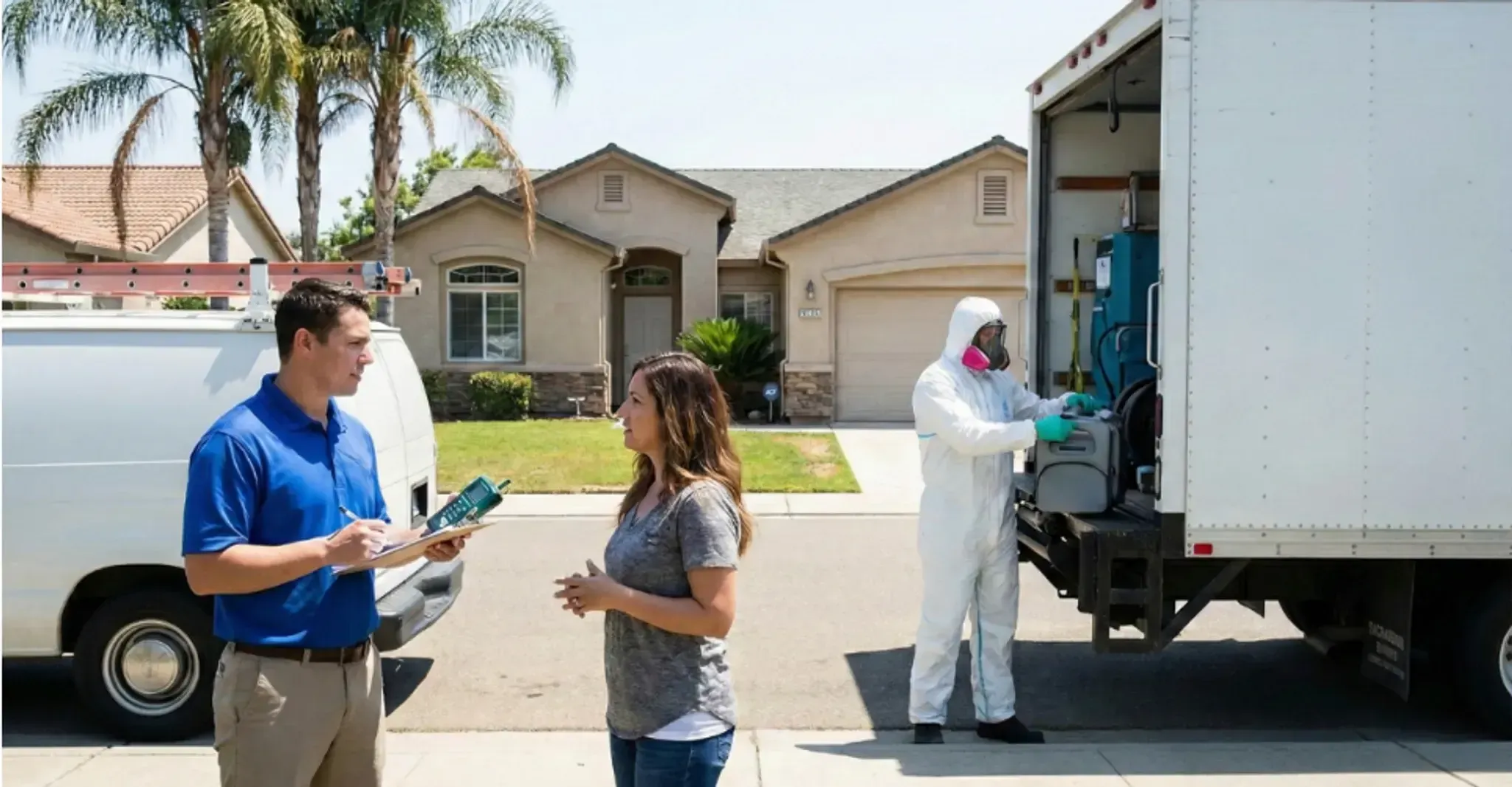

California has strict rules for environmental toxins. But when it comes to mold cleanup, the rules are loose. States like Florida, Texas, and New York ask for state mold licenses. California does not. This is a problem in Sacramento. The safety of people depends on how well homeowners check who they hire.
The most important rule is easy to follow. The company that checks for mold should not be the same one that cleans it. When you keep this step separate, you can save tens of thousands.
The Core Problem
The company that checks for mold should not be the same one that cleans it up. This will help protect you from any problems.
Finding Problems Conflict
When a company does both testing and cleanup, they do it to find big problems. Testing will cost from $500 to $800. Cleanup will cost between $15,000 and $40,000.
This can make people feel tempted. They may say things are worse than they really are. They may find the smallest contamination that does not really need to be fixed. They might tell you that you need much more work done than is true. A little mold on the surface can turn into tearing down an entire room.
Many people make choices based on money and not on facts. Even good companies feel this pressure. When a business needs money for fixing problems and things are not clear, money pressure can change what people do.
A company that gets money just from testing does not need to say things are bigger than they are. People trust them because they do their job right, not because the project is big.
Checking Work Conflict
The problem gets worse after cleanup. The company that fixes the issue checks their own work with air tests. It is like they are giving themselves their own grade.
Look at what motivates them. The contract says you pay when the job is done. If tests show there is still a lot of mold, the company has to clean it again at their own cost. This means you will wait longer to pay. If they finish and take the money, they just leave and go to the next job.
This makes people feel they have to say things went well even if that is not true. They may try to check things when the weather is good. They may do tests far away from where problems happen. You can't know the real result without someone else checking.
Industry Rules Require Separation
Major industry standards require separation.
The S520 Standard says that an independent expert should check the work to keep things fair. If a contract says you must follow S520, then keeping roles separate becomes a rule you must follow. In California, courts say S520 is the way things should be done.
The American Council for Accredited Certification says that you should not do both the assessment and the remediation on the same job. Doing both can cause a conflict, no matter how honest you are.
Service Model That Protects You
Proper approach uses two separate firms.
Firm A checks things. They get air samples. They get surface samples. They look at lab results. They write a plan that says what work is needed. This plan shows what has to be done and is used for bidding.
More than one remediation contractor offers a bid for the work that is clearly explained. They try to offer you a good price. They also try to finish the work fast. You choose a contractor after looking at their skills, insurance, what people say about them, and how much they charge. The contractor you pick does only the work that is written in the plan.
After the cleanup is done, Firm A comes back to see the work. They do air tests. They also look for things you can see that are still dirty. They make sure everything in the plan was done the right way. They either say the work is done, or tell you what has to be fixed.
You only pay the contractor all the money after Firm A says you can go ahead.
This system gives many ways to keep the work safe. There is a separate plan that stops the contractors from adding work in the middle of the project. Bidding helps make sure the price is fair for that job. A check from another person makes sure the job is done well before the last payment.
Vetting Without State Licensing
California does not ask you to have a mold license. You need to have certifications and the right insurance.
Required Certifications
For this testing company, you must have ACAC certification. A Council-certified Indoor Environmental Consultant (CIEC) needs to have eight years of experience. A Council-certified Indoor Environmentalist (CIE) needs to have two years of experience.
For a cleanup contractor, you need an IICRC Applied Microbial Remediation Technician (AMRT). This helps make sure that the workers are trained in how to keep things in and work in a safe way.
Also make sure that the contractor has a California State Contractors License. Look at the license and any complaints on the CSLB website.
Insurance Required
Standard business insurance does not cover fungus or germs. A contractor will need to have Contractors Pollution Liability or the Mold and Fungi Endorsement.
Get the current insurance certificate. Check with the insurance company to make sure everything is right. The certificate needs to have your address on it and cover the time you need.
If you work without pollution insurance, you can face big risks.
Vetting Checklist
Before hiring anyone, verify these items.
Request copies of the certificates. Check them with the group that gave out the papers to make sure they are real. Do not use copies because people can make fake ones. You can call ACAC or IICRC to see if the certificate is still good.
Get the insurance papers that show pollution is covered. Call the insurance company to check if the policy is current. Make sure it covers mold work. Check the limits listed on the certificate.
Check the State Contractors License on the CSLB website. See if there is any complaint history. See if there are any actions taken against them. If contractors have proven complaints, skip them right away.
Ask for references from work done in the last six months. Don’t use old references. Call the people and talk to them. Ask how well the worker talked and shared updates. Ask if they kept the work area clean. Ask if they finished everything on time. Ask if clearance testing was passed the first time. If they had to come back and clean again, that can mean there were problems with the work quality.
Review the contract carefully before you sign it. Make sure it says IICRC S520 compliance. Check that it shows an independent third-party will do the testing. Do not accept contracts that let companies test their own work.
Make sure the contract has a detailed scope. Saying "Remove all mold" is not enough. The scope needs to say how much area to contain. It should list which materials to remove. It should say what equipment to use. It also should say what needs to be done to get the last payment.
Red Flags to Avoid
Some warnings mean you should not use the contractor, no matter how they look or act.
The biggest warning sign is when a company offers both testing and cleanup. This should be a reason to say no right away. If any company says they do it all, it helps them make more money from the same job. They get what they want instead of you.
Not having any clear proof for certifications can mean someone is not qualified. Good companies show their skills and papers with pride. They ask you to check these details.
Pressure from a seller means there are problems. If they use a limited-time offer, it means there are problems. If they want you to decide that day, they don’t want you to look at other proposals. Mold work needs a plan. When they push you to say yes right now, it makes you feel something is not right.
Saying no to a detailed written contract can mean you want to add more charges during the project. A spoken agreement does not help when there are problems or arguments.
Much lower prices than others can mean they are leaving things out. They may use the wrong materials. They may not use good gear. They may not get rid of things the right way. They may skip steps that keep people safe. A good price is fine if you are getting the same work. But if a company gives a quote that is 40 to 50 percent lower than most, the work may not be very good.
Using chemicals like bleach instead of cleaning by hand goes against the rules. The rules say things like drywall that have tiny holes cannot be cleaned well this way. These things must be taken out. A worker who wants to use sprays is not right for the job or does not tell the truth.
Sacramento Climate Issues
Sacramento has a Mediterranean climate. There is rain in winter, and it starts in November and goes through March. Most of the rain comes during this time. Homes that are close to rivers can get groundwater problems.
Many older homes from the 1950s and 1960s do not have much insulation. Areas with a long history, such as Land Park and Curtis Park, need special care to keep the feel and look of their homes.
When the summer heat hits 100 to 105 degrees, and your AC is set too cold, it makes water form. The ducts in a hot attic get wet and sweat. Water starts to build up inside the walls where you cannot see it.
Protect Through Separation
Sacramento does not have state licensing. There must be a difference between testing and cleanup.
When one company handles both jobs, it can cause a real money problem. Only having someone from outside check the work can make sure things are safe.
Never let a company do both jobs. Ask for proof of their certificates and their insurance for pollution. Ask for some new references and look at them.
Book an independent checkup with Fast Mold Testing for a fair inspection, lab testing, and a full plan. Independent testing makes sure that your contractor finishes the job to the right standards before you make the last payment.
Frequently Asked Questions
- Why must mold testing and mold cleanup be done by separate companies in Sacramento?
- When the same Sacramento company both tests for mold and performs the cleanup, it has a financial incentive to find more mold than actually exists, recommend a larger remediation scope, and declare the job complete when it may not be. Separating the assessor and the remediator eliminates this conflict, which is why industry standards and several state regulations require independence between these two roles.
- How do I find a truly independent mold assessor in Sacramento?
- A truly independent Sacramento mold assessor does not offer remediation services at all. Companies that offer both assessment and remediation always have a conflict of interest, even if they claim to keep the roles separate internally. Fast Mold Testing is assessment-only in Sacramento, which means their findings have no financial connection to any subsequent remediation work.
- What should a Sacramento mold assessment report include before remediation begins?
- A Sacramento pre-remediation mold assessment report should include moisture meter readings at all suspect locations, air sample results compared to an outdoor control sample, identification of the moisture source, a map showing mold locations and extent, and the inspector's credentials and license number. This report becomes the scope document that holds the remediation contractor accountable for completing a thorough job.
- How does post-remediation testing in Sacramento confirm the cleanup was successful?
- Post-remediation testing in Sacramento by an independent assessor like Fast Mold Testing compares indoor air sample results to outdoor control samples taken at the same time. If indoor spore counts and types match outdoor levels, the remediation is considered successful. If indoor levels remain elevated or water-indicator species are still present, the remediation contractor is required to do additional work before clearance is granted.