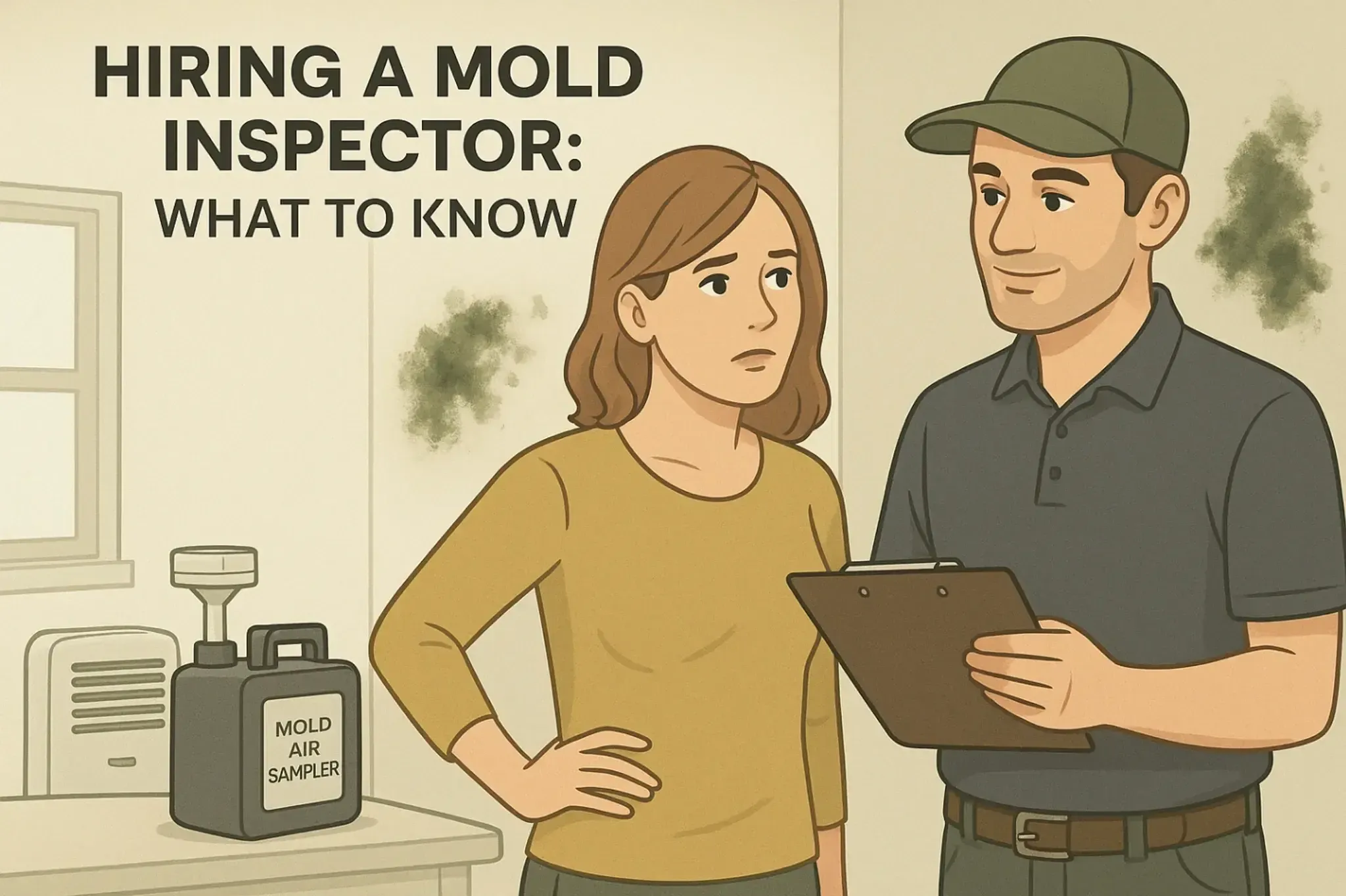

Mold issues can be both hazardous to your health and financially draining if mishandled. Hiring the right mold inspector is not just a box to check—it's a decision that can save you from unnecessary remediation, legal headaches, or long-term exposure to unhealthy indoor air. In a largely self-regulated industry, it pays to know what red flags to watch for and what questions to ask. Here's your essential guide.
The stakes are not hypothetical. According to the EPA, molds can be found almost anywhere; they can grow on virtually any substance, providing moisture is present. That is why the inspector you hire, and the moisture questions they ask, matter more than any single lab number.
"If mold is a problem in your home, you must clean up the mold AND eliminate sources of moisture."
United States Environmental Protection Agency, Mold Guidance (epa.gov/mold)
1. Do They Also Offer Mold Remediation?
This is the most important question to ask.
If a company offers both mold inspection and mold remediation, you should be extremely cautious. This dual-service model creates a built-in conflict of interest: the same person identifying the problem is also the one profiting from solving it.
Imagine if your mechanic was paid more depending on how many problems they "found." You'd have a hard time trusting their diagnosis. The mold industry is no different.
"Years ago, we encountered an inspector who handled both testing and remediation. At the lab we worked with, their samples regularly showed something odd—dual traces on the microscope slide. The normal environmental trace would be there, but floating 30 to 100 microns above or below it was a second trace with nothing but toxic mold spores like Stachybotrys and Chaetomium. No background dust, no skin cells, just mold. Every time. When questioned, the inspector claimed a cat had knocked over their sampler. That didn’t explain why the anomaly always benefited their business."
When someone has a financial incentive to find a problem, their objectivity is compromised.
2. What Certifications Do They Hold—and Who Regulates Them?
While industry certifications like IAC2 or InterNACHI may look impressive, they are not government-regulated. These certifications are part of a self-regulated ecosystem, often requiring little more than a fee and an online course to obtain.
So yes, certifications are better than nothing—they show the inspector has at least pursued some education. But they are not guarantees of integrity, experience, or independence.
"We've seen no shortage of bad actors wielding industry certifications like shields. One common pattern? They flash acronyms and seals that sound impressive, but the credentials come from the very same self-regulated industry clubs that offer certification to anyone willing to pay and pass an open-book test."
Ask for experience, references, and documented sampling protocols in addition to any certifications.
3. What Do Their Reviews Actually Say?
A mold inspector with hundreds of 5-star reviews is impressive. But dig deeper.
Look for reviews that say:
-
The inspector didn't find mold and explained why.
-
The client didn't hire them, but still left a review praising their transparency.
-
The inspector took time to explain the process and answer all questions.
"Clients have told us, 'I chose you because your reviews include people who didn’t even hire you.' That feedback floored us. It showed that honesty and education were just as valuable to clients as mold detection itself."
"Another mark of a trustworthy inspector is when they help clients navigate next steps—even if it doesn't mean hiring them. For instance, some clients may want to verify their home's health status for medical reasons after a remediation. In these cases, we often refer them to MoldCo’s HERTSMI-2 test, which provides clinically relevant data designed for healthcare providers, not remediation decisions."
Red flag: All reviews end in expensive remediation with no mention of situations where no problem was found.
4. What Lab Do They Use, and Is It Certified?
A professional mold inspector should disclose the lab they use. Ideally, the lab should be AIHA AIHA-LAP (EMLAP) accredited or AIHA EMLAP accredited, which ensures the lab adheres to strict protocols for environmental microbiology.
Be wary if:
-
The inspector refuses to name their lab.
-
They use a lab no one has heard of.
-
They use a lab that lacks proper accreditation.
"One well-known local operator refused for years to name the lab he used, raising industry-wide suspicions. He eventually aligned with a remote lab nobody else seemed to use. His business address? Routinely listed as empty warehouses or abandoned lots. Clients are right to ask, 'Why the secrecy?'"
5. Do They Offer Free On-Site Assessments?
Free assessments sound convenient but should raise alarm bells.
Legitimate inspectors are in demand. They don’t need to drive across town for free unless they’re selling something else—like expensive remediation.
"While we haven’t personally seen a ‘free inspection’ escalate into an unsafe situation, we’ve fielded calls from people who nearly booked one—and backed out after we explained the risks. When someone’s willing to enter your home for free, they’re likely aiming to sell you something else once inside."
A professional inspector will offer a clear scope of work, a written quote, and a service agreement—before showing up.
6. What Sampling Equipment Do They Use, and How Do They Use It?
Not all sampling methods are equal. Reliable inspectors use industry-established, research-backed equipment and methodologies.
Air sampling should be at least 75 liters, ideally 150 liters, and collected with properly calibrated pumps.
Surface sampling (like swabs or tape lifts) should be done only when appropriate—not as a one-size-fits-all.
"We’ve seen reports where inspectors relied only on surface swabs to justify expensive remediation. In one recent case, the same operator used swabs for diagnosis, then low-volume faulty cassettes for clearance—essentially gaming the system to ensure mold was 'found' when needed, and 'cleared' when required."
Some newer cassettes on the market diverge from established aerodynamic principles. We’ll be publishing data on this soon, but in the meantime, ask your inspector what gear they use and how long they've used it.
7. Do They Use or Correct the Term "Mildew"?
"Mildew" is a lay term. Scientifically, it's not a distinct organism from mold. Any inspector who says otherwise may not be current on their training—or may be trying to downplay a mold issue.
"We’ve seen inspectors—especially those hired by landlords—use the term ‘mildew’ as a magic word to dismiss mold concerns. When challenged, they often claim that mildew isn’t mold. That’s simply untrue. ‘Mildew’ is a layman’s term; in environmental science, it has no separate definition."
A qualified mold inspector should either avoid the term entirely or clarify it immediately.
Final Thoughts
Hiring a mold inspector shouldn't be a gamble. By asking the right questions and knowing what red flags to watch for, you can avoid scams, bad science, and unnecessary remediation.
Look for:
-
Inspectors who don’t remediate
-
Transparent pricing
-
Research-backed methodology
-
Real, balanced reviews
Whether you're in San Francisco, Sacramento, Northern California, or anywhere across the United States, the principles above can help you find a trustworthy mold inspection professional who puts your health and safety first.
Sources
Frequently Asked Questions
- What is the most important question to ask a mold inspector before hiring them?
- The most important question is whether the inspector also performs mold remediation. If the answer is yes, there is a financial conflict of interest because finding more mold means more remediation revenue. Always hire an inspector who does assessment only, like Fast Mold Testing, so you get an unbiased report.
- What credentials should a mold inspector have before I hire them?
- Look for inspectors with certifications from recognized organizations such as ACAC, AIHA, or IICRC. In states with specific mold licensing requirements, like Florida, New York, and Texas, verify the inspector holds the required state license. Ask for the license number and verify it directly with the state licensing board before booking.
- What equipment should a qualified mold inspector use during an inspection?
- A qualified mold inspector should use calibrated pin and pinless moisture meters, a thermo-hygrometer to measure temperature and relative humidity, an infrared or thermal imaging camera to detect hidden moisture, and professional air sampling pumps with cassettes sent to an AIHA-accredited laboratory. Inspectors who rely on visual observation alone cannot find hidden mold.
- How long should a thorough mold inspection take for a typical home?
- A thorough mold inspection of a typical single-family home should take between one and three hours depending on size and complexity. This includes time for moisture mapping of walls, ceilings, and floors, visual inspection of all rooms, HVAC components, attic, and crawlspace, and setting up air sampling equipment. Inspections that take less than 30 minutes are almost certainly incomplete.